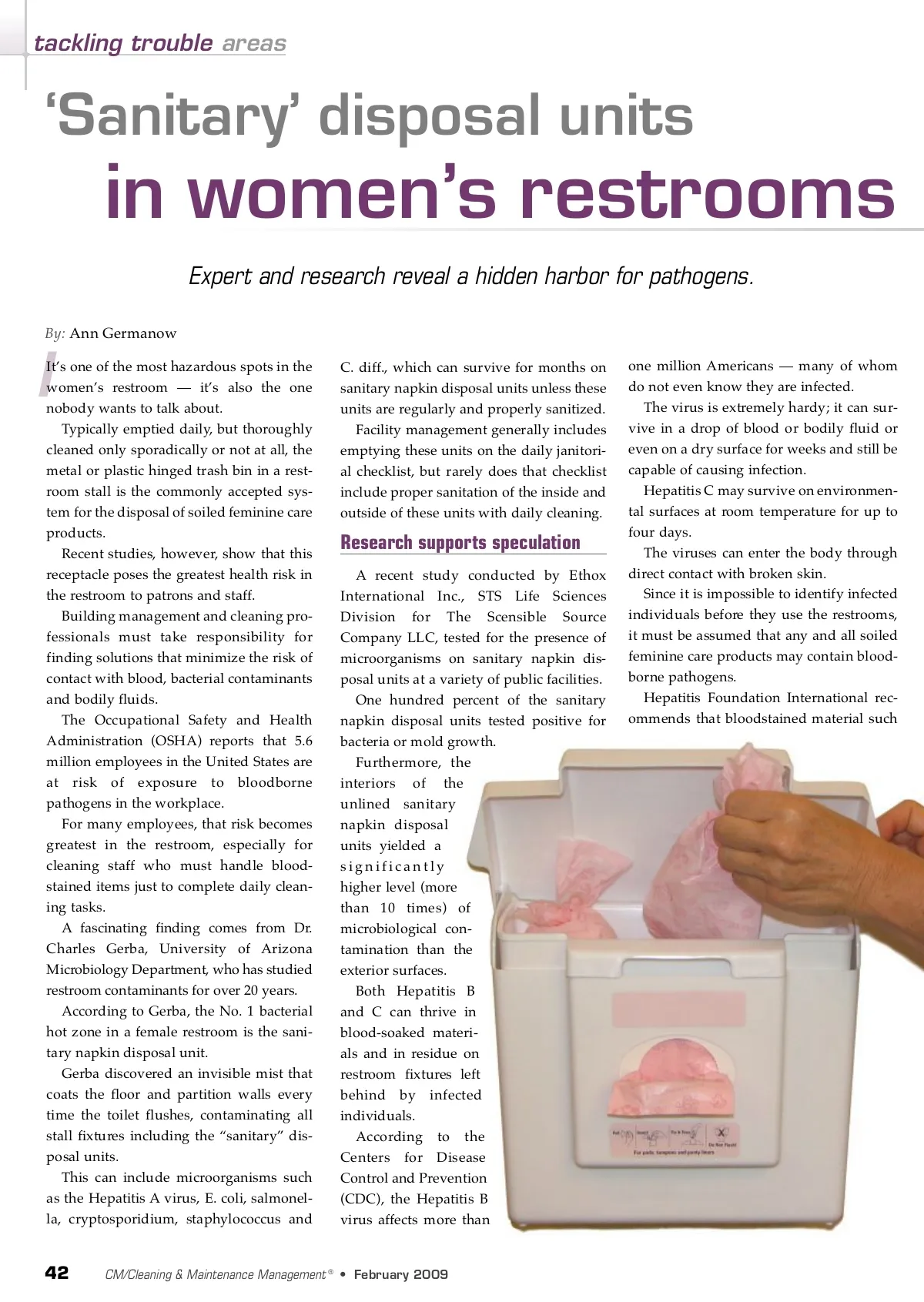
tackling trouble areas ‘Sanitary’ disposal units in women’s restrooms Expert and research reveal a hidden harbor for pathogens. By: Ann Germanow I It’s one of the most hazardous spots in the women’s restroom — it’s also the one nobody wants to talk about. Typically emptied daily, but thoroughly cleaned only sporadically or not at all, the metal or plastic hinged trash bin in a rest-room stall is the commonly accepted sys-tem for the disposal of soiled feminine care products. Recent studies, however, show that this receptacle poses the greatest health risk in the restroom to patrons and staff. Building management and cleaning pro-fessionals must take responsibility for finding solutions that minimize the risk of contact with blood, bacterial contaminants and bodily fluids. The Occupational Safety and Health Administration (OSHA) reports that 5.6 million employees in the United States are at risk of exposure to bloodborne pathogens in the workplace. For many employees, that risk becomes greatest in the restroom, especially for cleaning staff who must handle blood-stained items just to complete daily clean-ing tasks. A fascinating finding comes from Dr. Charles Gerba, University of Arizona Microbiology Department, who has studied restroom contaminants for over 20 years. According to Gerba, the No. 1 bacterial hot zone in a female restroom is the sani-tary napkin disposal unit. Gerba discovered an invisible mist that coats the floor and partition walls every time the toilet flushes, contaminating all stall fixtures including the “sanitary” dis-posal units. This can include microorganisms such as the Hepatitis A virus, E. coli, salmonel-la, cryptosporidium, staphylococcus and C. diff., which can survive for months on sanitary napkin disposal units unless these units are regularly and properly sanitized. Facility management generally includes emptying these units on the daily janitori-al checklist, but rarely does that checklist include proper sanitation of the inside and outside of these units with daily cleaning. Research supports speculation A recent study conducted by Ethox International Inc., STS Life Sciences Division for The Scensible Source Company LLC, tested for the presence of microorganisms on sanitary napkin dis-posal units at a variety of public facilities. One hundred percent of the sanitary napkin disposal units tested positive for bacteria or mold growth. Furthermore, the interiors of the unlined sanitary napkin disposal units yielded a significantly higher level (more than 10 times) of microbiological con-tamination than the exterior surfaces. Both Hepatitis B and C can thrive in blood-soaked materi-als and in residue on restroom fixtures left behind by infected individuals. According to the Centers for Disease Control and Prevention (CDC), the Hepatitis B virus affects more than one million Americans — many of whom do not even know they are infected. The virus is extremely hardy; it can sur-vive in a drop of blood or bodily fluid or even on a dry surface for weeks and still be capable of causing infection. Hepatitis C may survive on environmen-tal surfaces at room temperature for up to four days. The viruses can enter the body through direct contact with broken skin. Since it is impossible to identify infected individuals before they use the restrooms, it must be assumed that any and all soiled feminine care products may contain blood-borne pathogens. Hepatitis Foundation International rec-ommends that bloodstained material such 42 CM/Cleaning & Maintenance Management ® • February 2009
CMM – Archives Feb 2009: 42