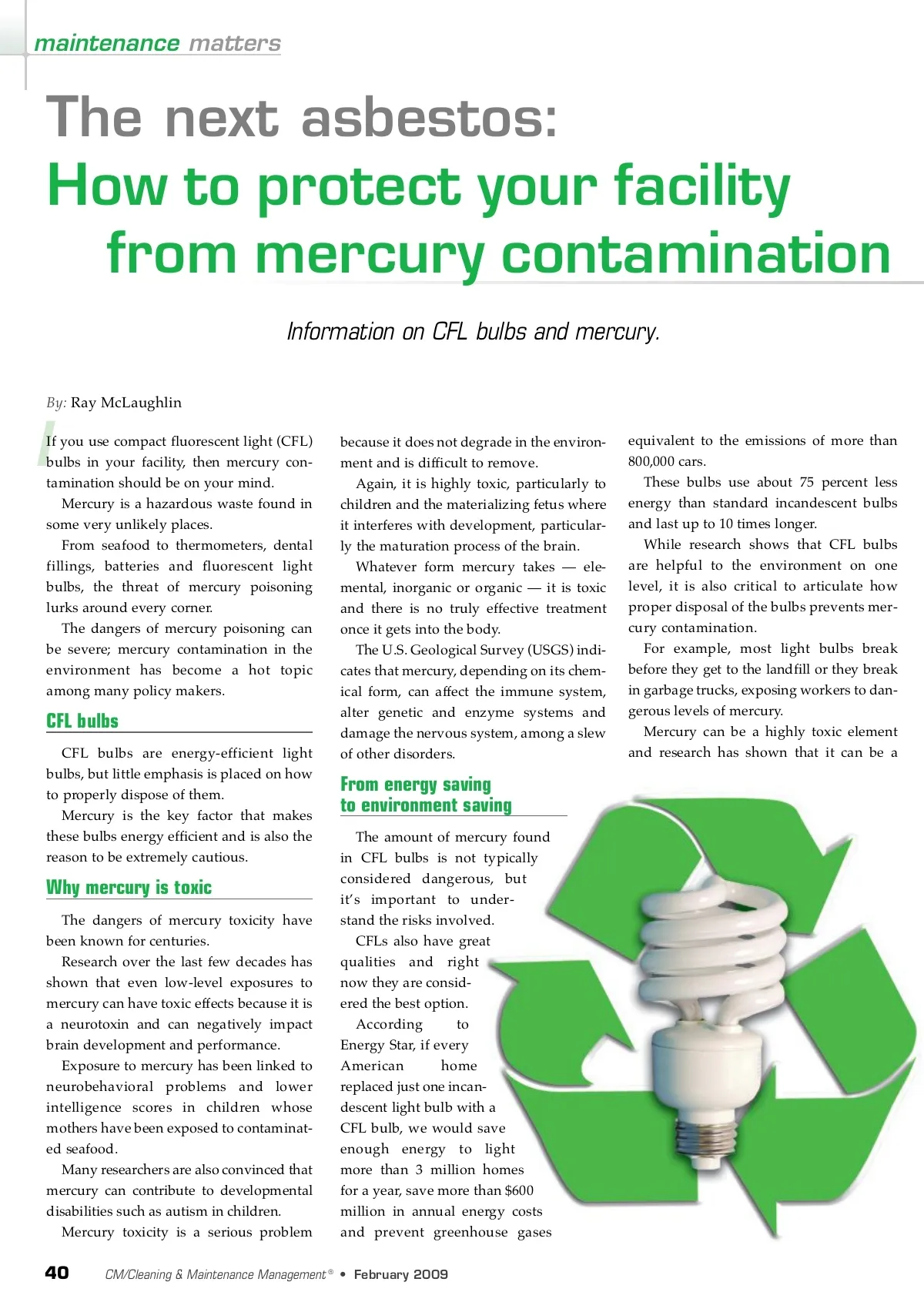
maintenance matters The next asbestos: How to protect your facility from mercury contamination Information on CFL bulbs and mercury. By: Ray McLaughlin I If you use compact fluorescent light (CFL) bulbs in your facility, then mercury con-tamination should be on your mind. Mercury is a hazardous waste found in some very unlikely places. From seafood to thermometers, dental fillings, batteries and fluorescent light bulbs, the threat of mercury poisoning lurks around every corner. The dangers of mercury poisoning can be severe; mercury contamination in the environment has become a hot topic among many policy makers. CFL bulbs CFL bulbs are energy-efficient light bulbs, but little emphasis is placed on how to properly dispose of them. Mercury is the key factor that makes these bulbs energy efficient and is also the reason to be extremely cautious. because it does not degrade in the environ-ment and is difficult to remove. Again, it is highly toxic, particularly to children and the materializing fetus where it interferes with development, particular-ly the maturation process of the brain. Whatever form mercury takes — ele-mental, inorganic or organic — it is toxic and there is no truly effective treatment once it gets into the body. The U.S. Geological Survey (USGS) indi-cates that mercury, depending on its chem-ical form, can affect the immune system, alter genetic and enzyme systems and damage the nervous system, among a slew of other disorders. equivalent to the emissions of more than 800,000 cars. These bulbs use about 75 percent less energy than standard incandescent bulbs and last up to 10 times longer. While research shows that CFL bulbs are helpful to the environment on one level, it is also critical to articulate how proper disposal of the bulbs prevents mer-cury contamination. For example, most light bulbs break before they get to the landfill or they break in garbage trucks, exposing workers to dan-gerous levels of mercury. Mercury can be a highly toxic element and research has shown that it can be a From energy saving to environment saving The amount of mercury found in CFL bulbs is not typically considered dangerous, but it’s important to under-stand the risks involved. CFLs also have great qualities and right now they are consid-ered the best option. According to Energy Star, if every American home replaced just one incan-descent light bulb with a CFL bulb, we would save enough energy to light more than 3 million homes for a year, save more than $600 million in annual energy costs and prevent greenhouse gases Why mercury is toxic The dangers of mercury toxicity have been known for centuries. Research over the last few decades has shown that even low-level exposures to mercury can have toxic effects because it is a neurotoxin and can negatively impact brain development and performance. Exposure to mercury has been linked to neurobehavioral problems and lower intelligence scores in children whose mothers have been exposed to contaminat-ed seafood. Many researchers are also convinced that mercury can contribute to developmental disabilities such as autism in children. Mercury toxicity is a serious problem 40 CM/Cleaning & Maintenance Management ® • February 2009
CMM – Archives Feb 2009: 40