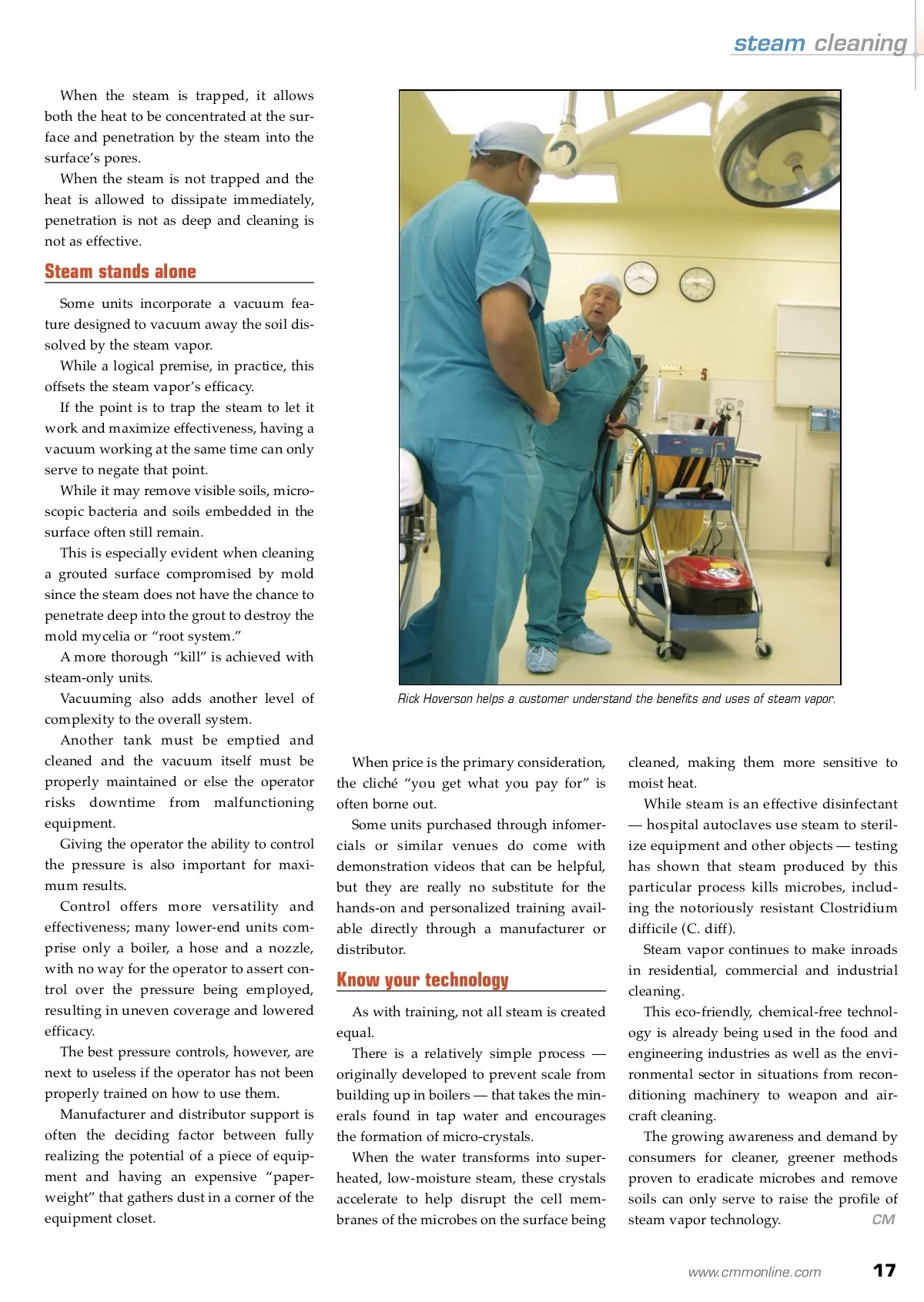
steam cleaning When the steam is trapped, it allows both the heat to be concentrated at the sur-face and penetration by the steam into the surface’s pores. When the steam is not trapped and the heat is allowed to dissipate immediately, penetration is not as deep and cleaning is not as effective. Steam stands alone Some units incorporate a vacuum fea-ture designed to vacuum away the soil dis-solved by the steam vapor. While a logical premise, in practice, this offsets the steam vapor’s efficacy. If the point is to trap the steam to let it work and maximize effectiveness, having a vacuum working at the same time can only serve to negate that point. While it may remove visible soils, micro-scopic bacteria and soils embedded in the surface often still remain. This is especially evident when cleaning a grouted surface compromised by mold since the steam does not have the chance to penetrate deep into the grout to destroy the mold mycelia or “root system.” A more thorough “kill” is achieved with steam-only units. Vacuuming also adds another level of complexity to the overall system. Another tank must be emptied and cleaned and the vacuum itself must be properly maintained or else the operator risks downtime from malfunctioning equipment. Giving the operator the ability to control the pressure is also important for maxi-mum results. Control offers more versatility and effectiveness; many lower-end units com-prise only a boiler, a hose and a nozzle, with no way for the operator to assert con-trol over the pressure being employed, resulting in uneven coverage and lowered efficacy. The best pressure controls, however, are next to useless if the operator has not been properly trained on how to use them. Manufacturer and distributor support is often the deciding factor between fully realizing the potential of a piece of equip-ment and having an expensive “paper-weight” that gathers dust in a corner of the equipment closet. Rick Hoverson helps a customer understand the benefits and uses of steam vapor. When price is the primary consideration, the cliché “you get what you pay for” is often borne out. Some units purchased through infomer-cials or similar venues do come with demonstration videos that can be helpful, but they are really no substitute for the hands-on and personalized training avail-able directly through a manufacturer or distributor. Know your technology As with training, not all steam is created equal. There is a relatively simple process — originally developed to prevent scale from building up in boilers — that takes the min-erals found in tap water and encourages the formation of micro-crystals. When the water transforms into super-heated, low-moisture steam, these crystals accelerate to help disrupt the cell mem-branes of the microbes on the surface being cleaned, making them more sensitive to moist heat. While steam is an effective disinfectant — hospital autoclaves use steam to steril-ize equipment and other objects — testing has shown that steam produced by this particular process kills microbes, includ-ing the notoriously resistant Clostridium difficile (C. diff). Steam vapor continues to make inroads in residential, commercial and industrial cleaning. This eco-friendly, chemical-free technol-ogy is already being used in the food and engineering industries as well as the envi-ronmental sector in situations from recon-ditioning machinery to weapon and air-craft cleaning. The growing awareness and demand by consumers for cleaner, greener methods proven to eradicate microbes and remove soils can only serve to raise the profile of CM steam vapor technology. www.cmmonline.com 17
CMM – Archives Feb 2009: 17