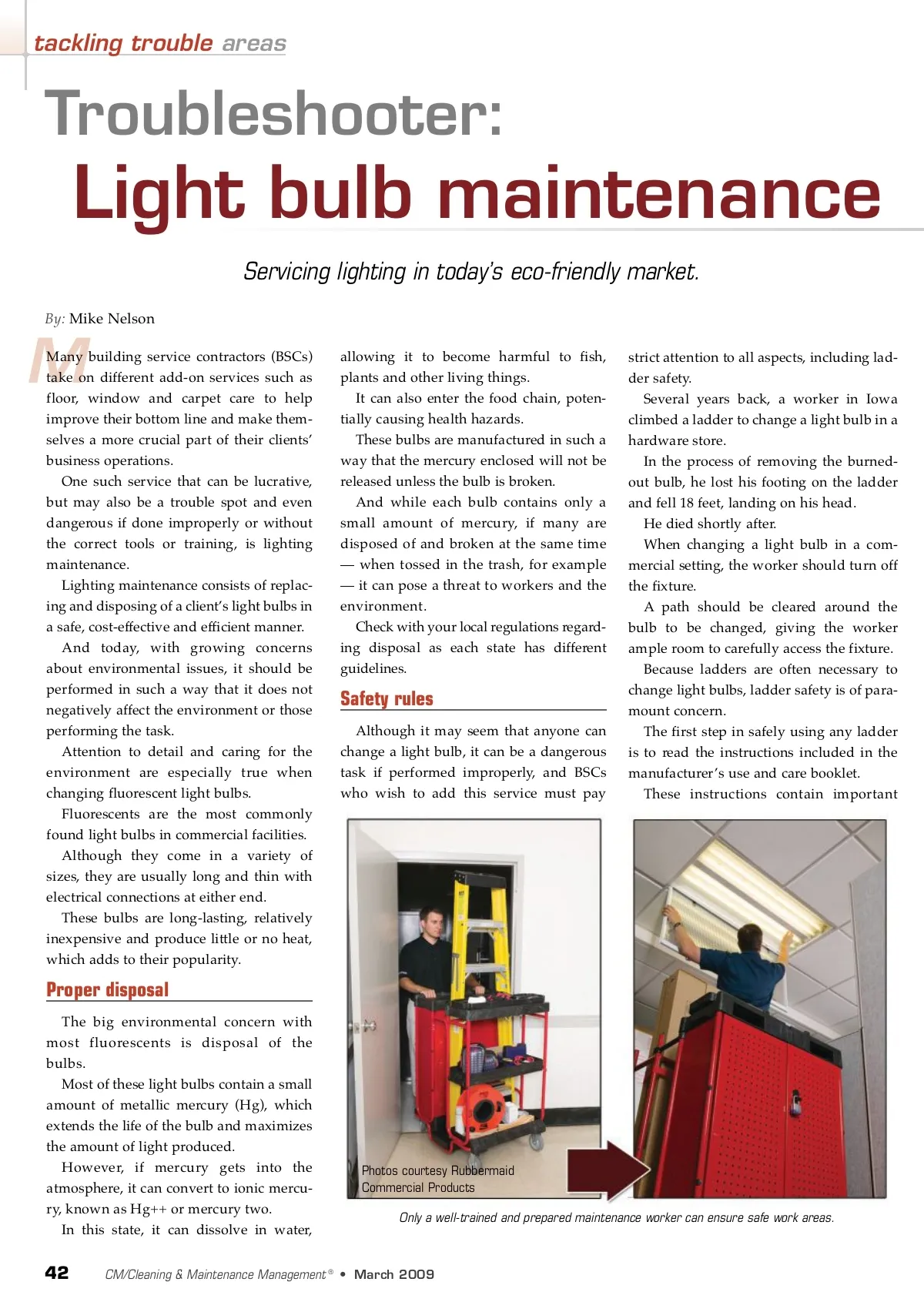
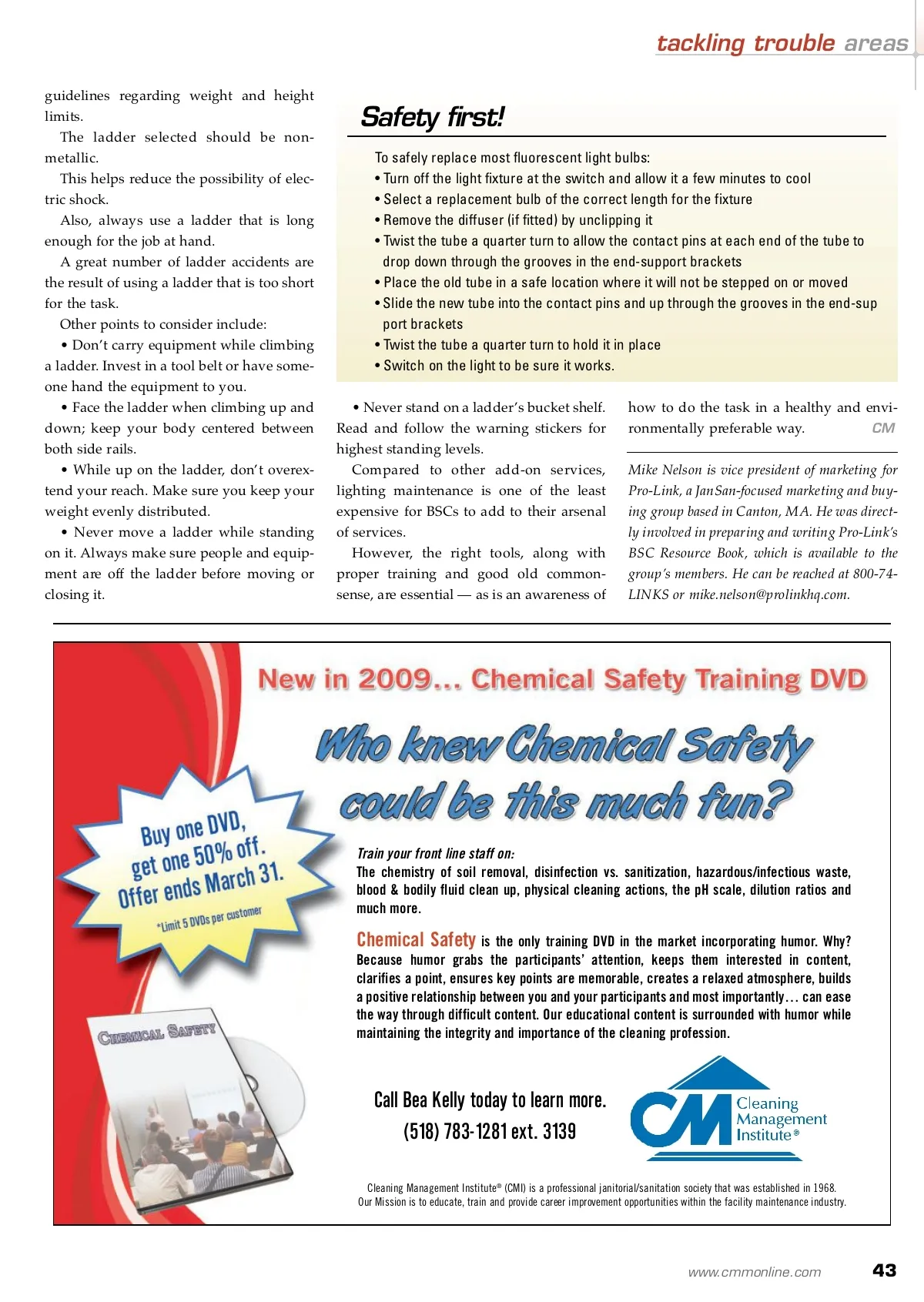
tackling trouble areas Troubleshooter: Light bulb maintenance Servicing lighting in today’s eco-friendly market. By: Mike Nelson M Many building service contractors (BSCs) take on different add-on services such as floor, window and carpet care to help improve their bottom line and make them-selves a more crucial part of their clients’ business operations. One such service that can be lucrative, but may also be a trouble spot and even dangerous if done improperly or without the correct tools or training, is lighting maintenance. Lighting maintenance consists of replac-ing and disposing of a client’s light bulbs in a safe, cost-effective and efficient manner. And today, with growing concerns about environmental issues, it should be performed in such a way that it does not negatively affect the environment or those performing the task. Attention to detail and caring for the environment are especially true when changing fluorescent light bulbs. Fluorescents are the most commonly found light bulbs in commercial facilities. Although they come in a variety of sizes, they are usually long and thin with electrical connections at either end. These bulbs are long-lasting, relatively inexpensive and produce little or no heat, which adds to their popularity. allowing it to become harmful to fish, plants and other living things. It can also enter the food chain, poten-tially causing health hazards. These bulbs are manufactured in such a way that the mercury enclosed will not be released unless the bulb is broken. And while each bulb contains only a small amount of mercury, if many are disposed of and broken at the same time — when tossed in the trash, for example — it can pose a threat to workers and the environment. Check with your local regulations regard-ing disposal as each state has different guidelines. Safety rules Although it may seem that anyone can change a light bulb, it can be a dangerous task if performed improperly, and BSCs who wish to add this service must pay strict attention to all aspects, including lad-der safety. Several years back, a worker in Iowa climbed a ladder to change a light bulb in a hardware store. In the process of removing the burned-out bulb, he lost his footing on the ladder and fell 18 feet, landing on his head. He died shortly after. When changing a light bulb in a com-mercial setting, the worker should turn off the fixture. A path should be cleared around the bulb to be changed, giving the worker ample room to carefully access the fixture. Because ladders are often necessary to change light bulbs, ladder safety is of para-mount concern. The first step in safely using any ladder is to read the instructions included in the manufacturer’s use and care booklet. These instructions contain important Proper disposal The big environmental concern with most fluorescents is disposal of the bulbs. Most of these light bulbs contain a small amount of metallic mercury (Hg), which extends the life of the bulb and maximizes the amount of light produced. However, if mercury gets into the atmosphere, it can convert to ionic mercu-ry, known as Hg++ or mercury two. In this state, it can dissolve in water, Photos courtesy Rubbermaid Commercial Products Only a well-trained and prepared maintenance worker can ensure safe work areas. 42 CM/Cleaning & Maintenance Management ® • March 2009
CMM – Archives Mar 2009: 42