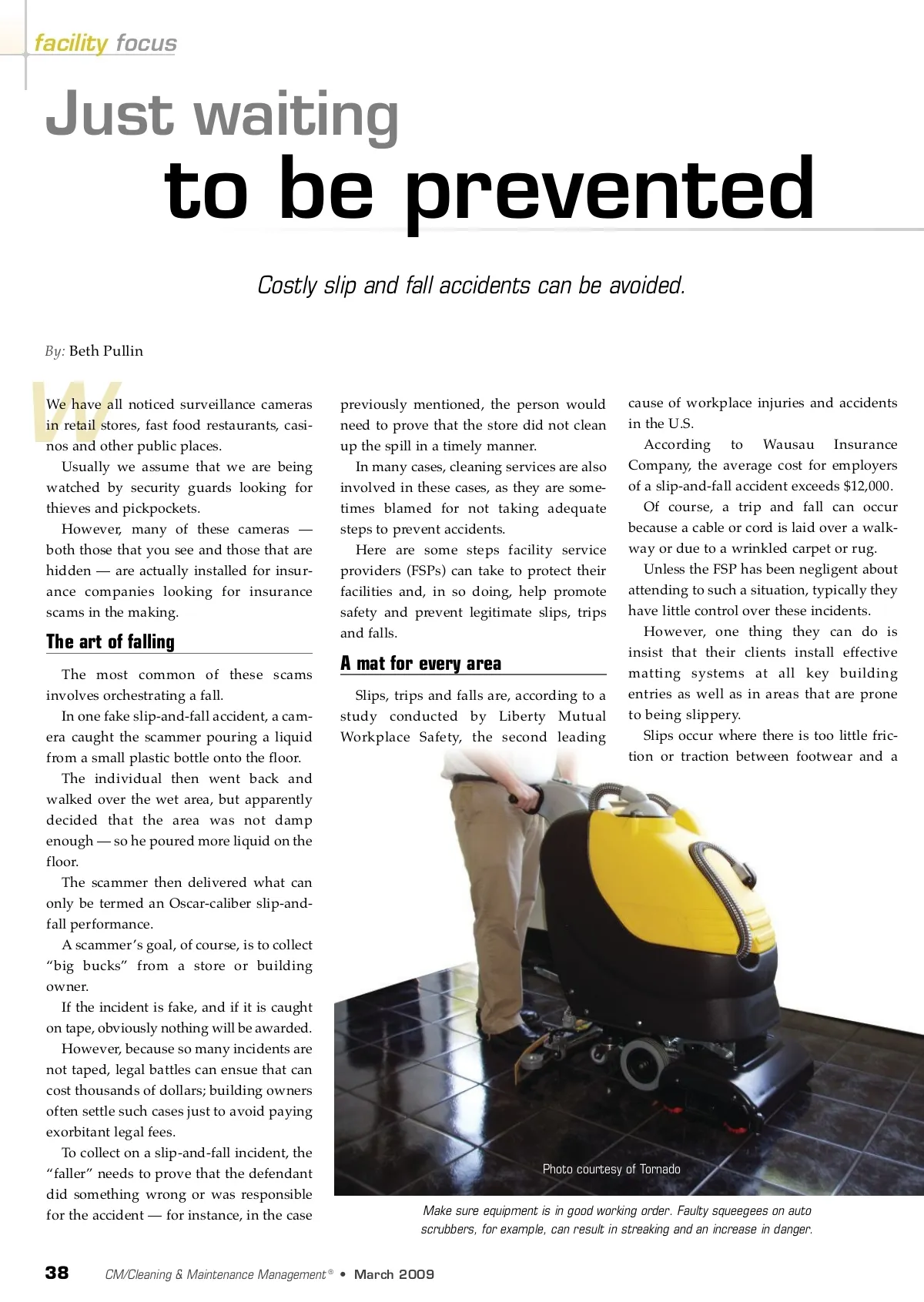
facility focus walking surface, according to Christopher Tricozzi, vice president of sales and marketing for Crown Mats and Matting. One of the most common causes of this is moisture or oily sub-stances on the walker’s shoes or on the floor. Tricozzi says that for every part of a facility, there is an appro-priate mat to help prevent slips, trips and falls. This starts at the front door, where at least 15 feet of high-per-formance matting should be placed; this removes as much as 80 percent of all moisture, oil and soils from shoe bottoms. Inside, Tricozzi suggests placing matting that hugs hard-surface floors in such areas as high-traffic walkways, in front of vending machines and elevator doors and in production areas. Areas prone to liquid spills probably require drainage mats. These systems allow liquids and oils to seep down below the floor, keeping them away from shoe bottoms. Some of these systems have one-piece construction, while oth-ers are similar to tiles that can be locked together, forming a mat as wide and long as needed. Tricozzi also adds that FSPs should be aware that there are antimicrobial matting systems available that are often used in medical and food service facilities. The antimicrobial properties of these products inhibit the growth of microorganisms as well as help to prevent cross con-tamination. Microorganisms can cause safety problems should they spread to floors or become attached to shoe bottoms. embedded grit and soil in order to keep the floor cleaner and more slip resistant. Starting a “Safety Culture Club” FSPs can do several things to help improve the safety of the facilities they maintain and to prevent slips and falls. However, the cooperation of building managers and occupants is an essential part of making any such effort a success. One cleaning contractor in northern California found a way to do this by meeting with one of his customers, a bank with 10 dif-ferent locations, to help them develop a “Safety Culture Club.” Addressing the staff at each location, the contractor educated them about how and why common slip-and-fall accidents occur and what steps individuals can take to help prevent them. This includes such things as becoming aware of potential haz-ards within the building and bringing them to the attention of managers and wearing footwear that adheres to floor surfaces. With the “Safety Culture Club” in place, the bank reported a sig-nificant reduction in slip-and-fall accidents. What’s more, the contractor found that the program greatly CM enhanced his relationship with the customer. Beth Pullin is a writer for the professional cleaning and building industries. Floor maintenance Almost all hard-surface flooring is slip resistant when dry. However, add moisture, soil, contaminants and even some fin-ishes and they can become dangerously slippery. For this reason, regular, if not daily, dust/damp mopping is a must. According to Mark Cuddy, director of sales -East for Tornado, floor care can become very expensive for facilities with large hard-surface floor areas because this type of cleaning is so labor intensive. In an attempt to cut costs, some managers may not maintain their floors as thoroughly as is necessary to promote safety. However, FSPs can reduce the cost of floor care significantly and promote safety by viewing floor care equipment as an investment in both facility safety and worker productivity. For instance, one person using a mop and a bucket will need about eight hours to clean 5,000 square feet of flooring. This time could be reduced to just 13 minutes by using an auto-matic scrubber. This means that the return on investment for such equipment can be quick and significant, says Cuddy. FSPs selecting auto scrubbers will need to consider the different types of technology available. For instance, cylindrical machines use brushes instead of the tra-ditional rotary type systems, which can actually spread slippery soils over floors. The inward, counter-rotating brushes used by cylindrical machines penetrate floor surfaces, helping to remove deeply Circle Product Information no. 201 on page 34 www.cmmonline.com 39
CMM – Archives Mar 2009: 39