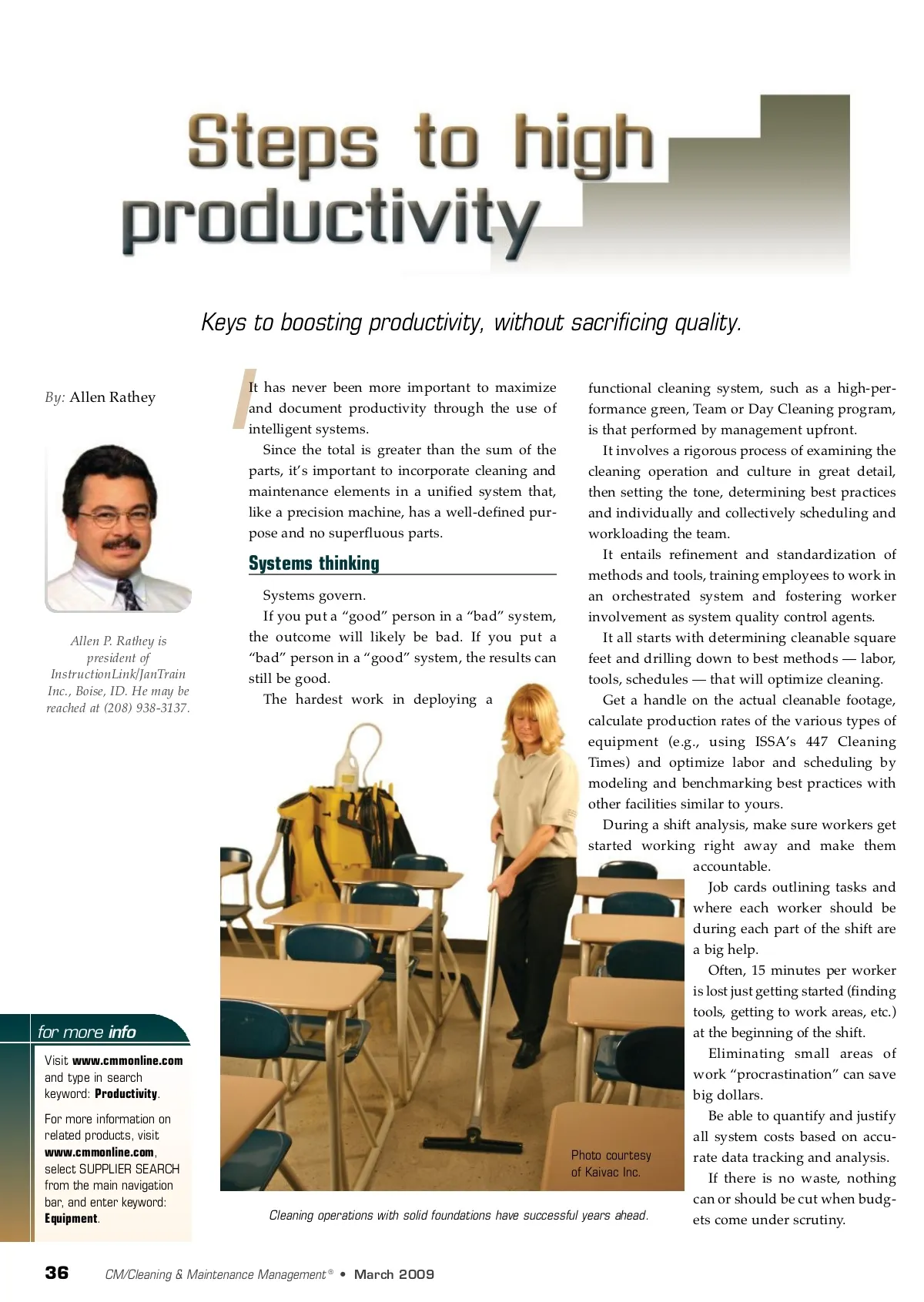
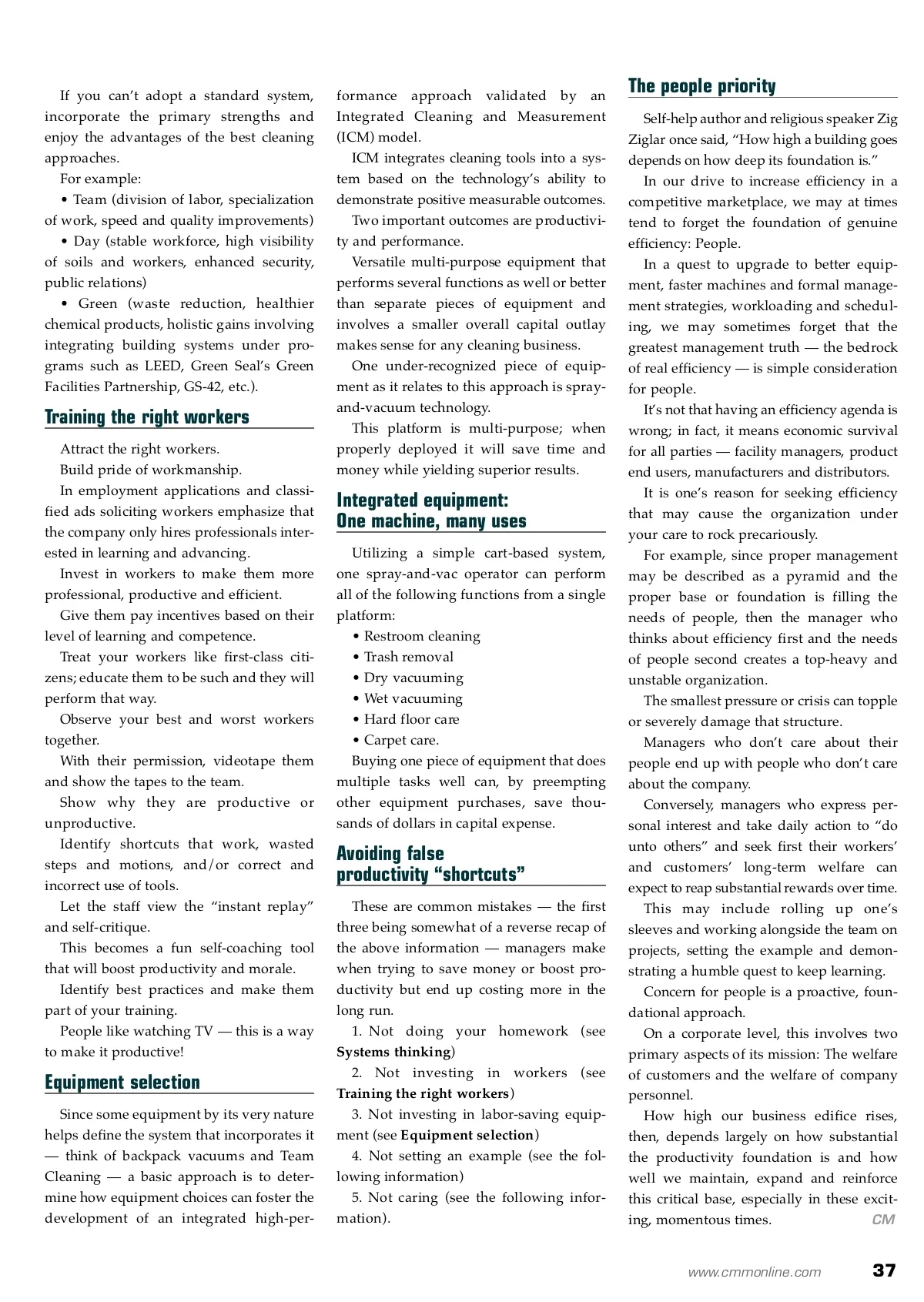
Keys to boosting productivity, without sacrificing quality. By: Allen Rathey I It has never been more important to maximize and document productivity through the use of intelligent systems. Since the total is greater than the sum of the parts, it’s important to incorporate cleaning and maintenance elements in a unified system that, like a precision machine, has a well-defined pur-pose and no superfluous parts. Allen P. Rathey is president of InstructionLink/JanTrain Inc., Boise, ID. He may be reached at (208) 938-3137. for more info Visit www.cmmonline.com and type in search keyword: Productivity . For more information on related products, visit www.cmmonline.com , select SUPPLIER SEARCH from the main navigation bar, and enter keyword: Equipment . functional cleaning system, such as a high-per-formance green, Team or Day Cleaning program, is that performed by management upfront. It involves a rigorous process of examining the cleaning operation and culture in great detail, then setting the tone, determining best practices and individually and collectively scheduling and workloading the team. It entails refinement and standardization of Systems thinking methods and tools, training employees to work in Systems govern. an orchestrated system and fostering worker If you put a “good” person in a “bad” system, involvement as system quality control agents. the outcome will likely be bad. If you put a It all starts with determining cleanable square “bad” person in a “good” system, the results can feet and drilling down to best methods — labor, still be good. tools, schedules — that will optimize cleaning. The hardest work in deploying a Get a handle on the actual cleanable footage, calculate production rates of the various types of equipment (e.g., using ISSA’s 447 Cleaning Times) and optimize labor and scheduling by modeling and benchmarking best practices with other facilities similar to yours. During a shift analysis, make sure workers get started working right away and make them accountable. Job cards outlining tasks and where each worker should be during each part of the shift are a big help. Often, 15 minutes per worker is lost just getting started (finding tools, getting to work areas, etc.) at the beginning of the shift. Eliminating small areas of work “procrastination” can save big dollars. Be able to quantify and justify all system costs based on accu-Photo courtesy rate data tracking and analysis. of Kaivac Inc. If there is no waste, nothing can or should be cut when budg-Cleaning operations with solid foundations have successful years ahead. ets come under scrutiny. 36 CM/Cleaning & Maintenance Management ® • March 2009
CMM – Archives Mar 2009: 36