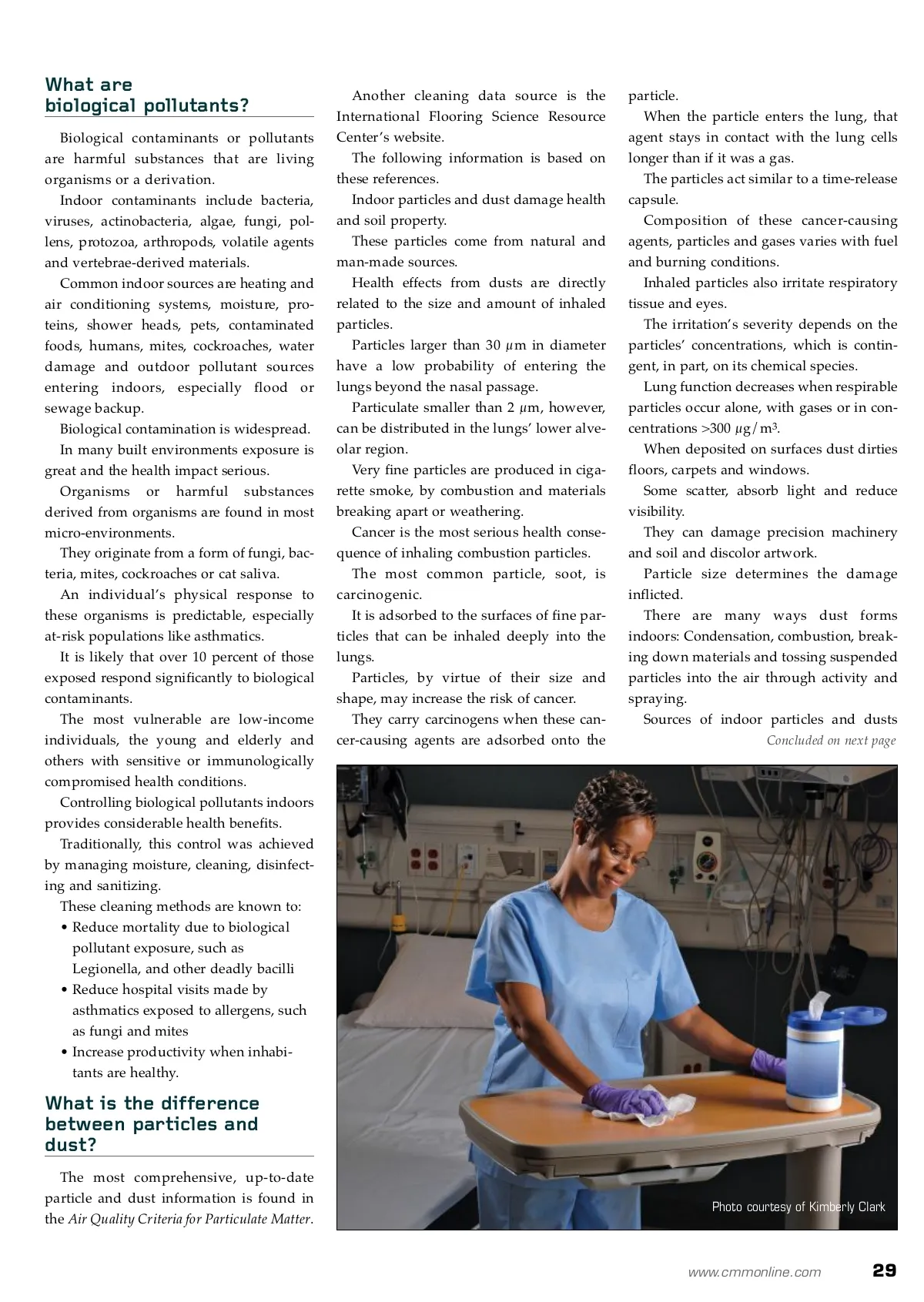
What are biological pollutants? Biological contaminants or pollutants are harmful substances that are living organisms or a derivation. Indoor contaminants include bacteria, viruses, actinobacteria, algae, fungi, pol-lens, protozoa, arthropods, volatile agents and vertebrae-derived materials. Common indoor sources are heating and air conditioning systems, moisture, pro-teins, shower heads, pets, contaminated foods, humans, mites, cockroaches, water damage and outdoor pollutant sources entering indoors, especially flood or sewage backup. Biological contamination is widespread. In many built environments exposure is great and the health impact serious. Organisms or harmful substances derived from organisms are found in most micro-environments. They originate from a form of fungi, bac-teria, mites, cockroaches or cat saliva. An individual’s physical response to these organisms is predictable, especially at-risk populations like asthmatics. It is likely that over 10 percent of those exposed respond significantly to biological contaminants. The most vulnerable are low-income individuals, the young and elderly and others with sensitive or immunologically compromised health conditions. Controlling biological pollutants indoors provides considerable health benefits. Traditionally, this control was achieved by managing moisture, cleaning, disinfect-ing and sanitizing. These cleaning methods are known to: • Reduce mortality due to biological pollutant exposure, such as Legionella, and other deadly bacilli • Reduce hospital visits made by asthmatics exposed to allergens, such as fungi and mites • Increase productivity when inhabi-tants are healthy. Another cleaning data source is the International Flooring Science Resource Center’s website. The following information is based on these references. Indoor particles and dust damage health and soil property. These particles come from natural and man-made sources. Health effects from dusts are directly related to the size and amount of inhaled particles. Particles larger than 30 µm in diameter have a low probability of entering the lungs beyond the nasal passage. Particulate smaller than 2 µm, however, can be distributed in the lungs’ lower alve-olar region. Very fine particles are produced in ciga-rette smoke, by combustion and materials breaking apart or weathering. Cancer is the most serious health conse-quence of inhaling combustion particles. The most common particle, soot, is carcinogenic. It is adsorbed to the surfaces of fine par-ticles that can be inhaled deeply into the lungs. Particles, by virtue of their size and shape, may increase the risk of cancer. They carry carcinogens when these can-cer-causing agents are adsorbed onto the particle. When the particle enters the lung, that agent stays in contact with the lung cells longer than if it was a gas. The particles act similar to a time-release capsule. Composition of these cancer-causing agents, particles and gases varies with fuel and burning conditions. Inhaled particles also irritate respiratory tissue and eyes. The irritation’s severity depends on the particles’ concentrations, which is contin-gent, in part, on its chemical species. Lung function decreases when respirable particles occur alone, with gases or in con-centrations >300 µg/m 3 . When deposited on surfaces dust dirties floors, carpets and windows. Some scatter, absorb light and reduce visibility. They can damage precision machinery and soil and discolor artwork. Particle size determines the damage inflicted. There are many ways dust forms indoors: Condensation, combustion, break-ing down materials and tossing suspended particles into the air through activity and spraying. Sources of indoor particles and dusts Concluded on next page What is the difference between particles and dust? The most comprehensive, up-to-date particle and dust information is found in the Air Quality Criteria for Particulate Matter . Photo courtesy of Kimberly Clark www.cmmonline.com 29
CMM – Archives Mar 2009: 29