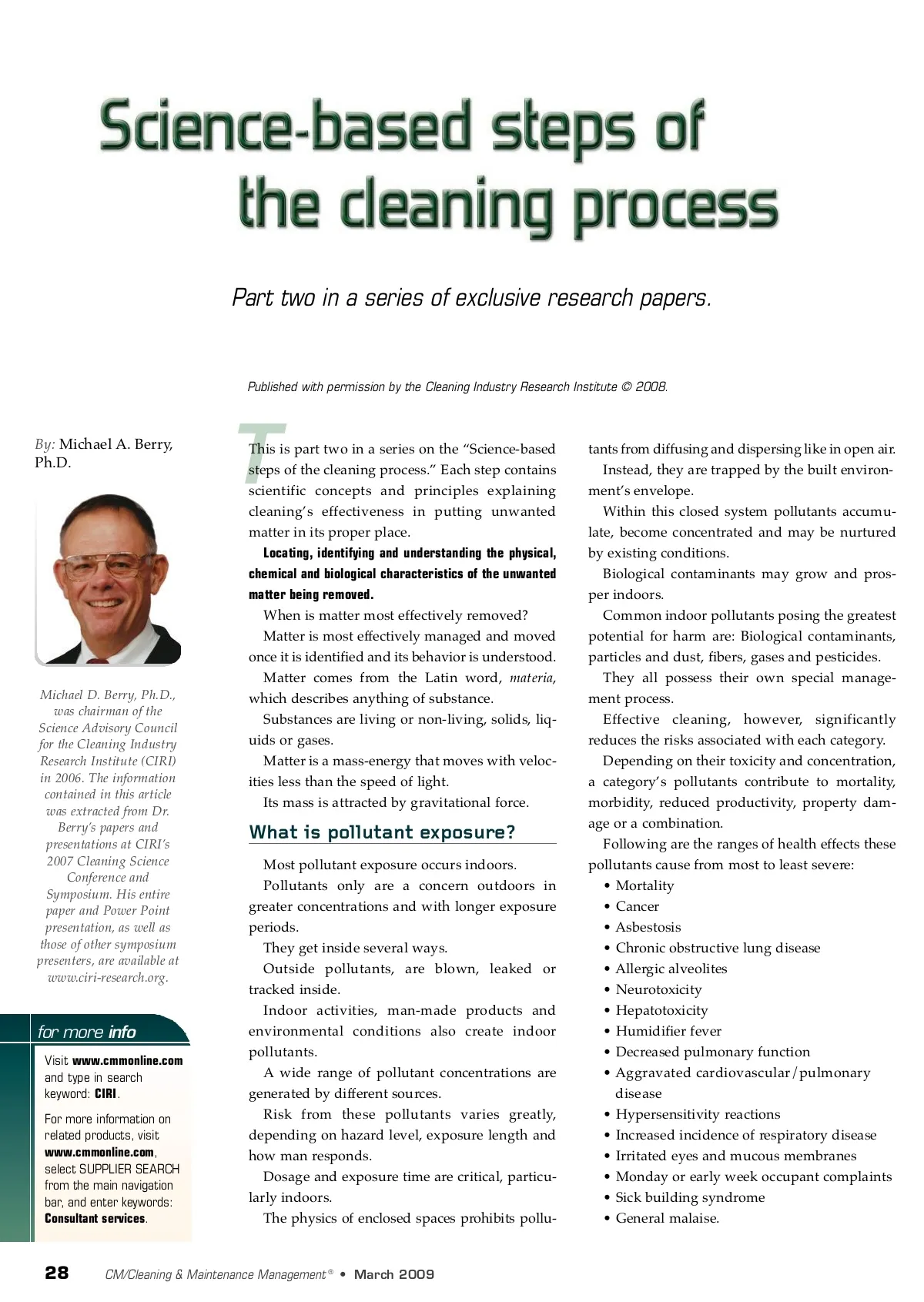
Part two in a series of exclusive research papers. Published with permission by the Cleaning Industry Research Institute © 2008. By: Michael A. Berry, Ph.D. T Michael D. Berry, Ph.D., was chairman of the Science Advisory Council for the Cleaning Industry Research Institute (CIRI) in 2006. The information contained in this article was extracted from Dr. Berry’s papers and presentations at CIRI’s 2007 Cleaning Science Conference and Symposium. His entire paper and Power Point presentation, as well as those of other symposium presenters, are available at www.ciri-research.org. This is part two in a series on the “Science-based steps of the cleaning process.” Each step contains scientific concepts and principles explaining cleaning’s effectiveness in putting unwanted matter in its proper place. Locating, identifying and understanding the physical, chemical and biological characteristics of the unwanted matter being removed. When is matter most effectively removed? Matter is most effectively managed and moved once it is identified and its behavior is understood. Matter comes from the Latin word, materia , which describes anything of substance. Substances are living or non-living, solids, liq-uids or gases. Matter is a mass-energy that moves with veloc-ities less than the speed of light. Its mass is attracted by gravitational force. What is pollutant exposure? Most pollutant exposure occurs indoors. Pollutants only are a concern outdoors in greater concentrations and with longer exposure periods. They get inside several ways. Outside pollutants, are blown, leaked or tracked inside. Indoor activities, man-made products and environmental conditions also create indoor pollutants. A wide range of pollutant concentrations are generated by different sources. Risk from these pollutants varies greatly, depending on hazard level, exposure length and how man responds. Dosage and exposure time are critical, particu-larly indoors. The physics of enclosed spaces prohibits pollu-for more info Visit www.cmmonline.com and type in search keyword: CIRI . For more information on related products, visit www.cmmonline.com , select SUPPLIER SEARCH from the main navigation bar, and enter keywords: Consultant services . tants from diffusing and dispersing like in open air. Instead, they are trapped by the built environ-ment’s envelope. Within this closed system pollutants accumu-late, become concentrated and may be nurtured by existing conditions. Biological contaminants may grow and pros-per indoors. Common indoor pollutants posing the greatest potential for harm are: Biological contaminants, particles and dust, fibers, gases and pesticides. They all possess their own special manage-ment process. Effective cleaning, however, significantly reduces the risks associated with each category. Depending on their toxicity and concentration, a category’s pollutants contribute to mortality, morbidity, reduced productivity, property dam-age or a combination. Following are the ranges of health effects these pollutants cause from most to least severe: • Mortality • Cancer • Asbestosis • Chronic obstructive lung disease • Allergic alveolites • Neurotoxicity • Hepatotoxicity • Humidifier fever • Decreased pulmonary function • Aggravated cardiovascular/pulmonary disease • Hypersensitivity reactions • Increased incidence of respiratory disease • Irritated eyes and mucous membranes • Monday or early week occupant complaints • Sick building syndrome • General malaise. 28 CM/Cleaning & Maintenance Management ® • March 2009
CMM – Archives Mar 2009: 28