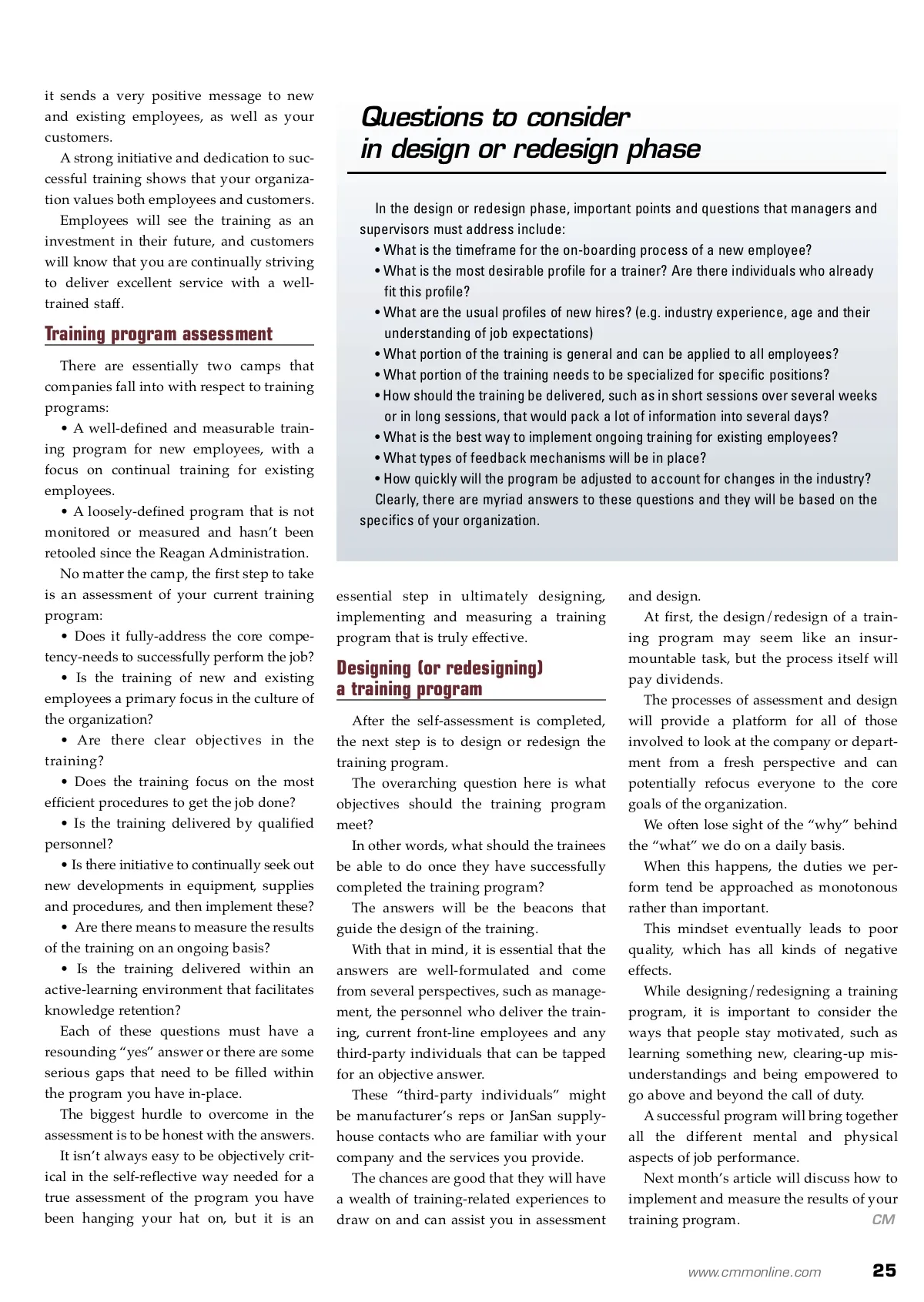
it sends a very positive message to new and existing employees, as well as your customers. A strong initiative and dedication to suc-cessful training shows that your organiza-tion values both employees and customers. Employees will see the training as an investment in their future, and customers will know that you are continually striving to deliver excellent service with a well-trained staff. Questions to consider in design or redesign phase In the design or redesign phase, important points and questions that managers and supervisors must address include: • What is the timeframe for the on-boarding process of a new employee? • What is the most desirable profile for a trainer? Are there individuals who already fit this profile? • What are the usual profiles of new hires? (e.g. industry experience, age and their understanding of job expectations) • What portion of the training is general and can be applied to all employees? • What portion of the training needs to be specialized for specific positions? • How should the training be delivered, such as in short sessions over several weeks or in long sessions, that would pack a lot of information into several days? • What is the best way to implement ongoing training for existing employees? • What types of feedback mechanisms will be in place? • How quickly will the program be adjusted to account for changes in the industry? Clearly, there are myriad answers to these questions and they will be based on the specifics of your organization. Training program assessment There are essentially two camps that companies fall into with respect to training programs: • A well-defined and measurable train-ing program for new employees, with a focus on continual training for existing employees. • A loosely-defined program that is not monitored or measured and hasn’t been retooled since the Reagan Administration. No matter the camp, the first step to take is an assessment of your current training program: • Does it fully-address the core compe-tency-needs to successfully perform the job? • Is the training of new and existing employees a primary focus in the culture of the organization? • Are there clear objectives in the training? • Does the training focus on the most efficient procedures to get the job done? • Is the training delivered by qualified personnel? • Is there initiative to continually seek out new developments in equipment, supplies and procedures, and then implement these? • Are there means to measure the results of the training on an ongoing basis? • Is the training delivered within an active-learning environment that facilitates knowledge retention? Each of these questions must have a resounding “yes” answer or there are some serious gaps that need to be filled within the program you have in-place. The biggest hurdle to overcome in the assessment is to be honest with the answers. It isn’t always easy to be objectively crit-ical in the self-reflective way needed for a true assessment of the program you have been hanging your hat on, but it is an essential step in ultimately designing, implementing and measuring a training program that is truly effective. Designing (or redesigning) a training program After the self-assessment is completed, the next step is to design or redesign the training program. The overarching question here is what objectives should the training program meet? In other words, what should the trainees be able to do once they have successfully completed the training program? The answers will be the beacons that guide the design of the training. With that in mind, it is essential that the answers are well-formulated and come from several perspectives, such as manage-ment, the personnel who deliver the train-ing, current front-line employees and any third-party individuals that can be tapped for an objective answer. These “third-party individuals” might be manufacturer’s reps or JanSan supply-house contacts who are familiar with your company and the services you provide. The chances are good that they will have a wealth of training-related experiences to draw on and can assist you in assessment and design. At first, the design/redesign of a train-ing program may seem like an insur-mountable task, but the process itself will pay dividends. The processes of assessment and design will provide a platform for all of those involved to look at the company or depart-ment from a fresh perspective and can potentially refocus everyone to the core goals of the organization. We often lose sight of the “why” behind the “what” we do on a daily basis. When this happens, the duties we per-form tend be approached as monotonous rather than important. This mindset eventually leads to poor quality, which has all kinds of negative effects. While designing/redesigning a training program, it is important to consider the ways that people stay motivated, such as learning something new, clearing-up mis-understandings and being empowered to go above and beyond the call of duty. A successful program will bring together all the different mental and physical aspects of job performance. Next month’s article will discuss how to implement and measure the results of your CM training program. www.cmmonline.com 25
CMM – Archives Mar 2009: 25