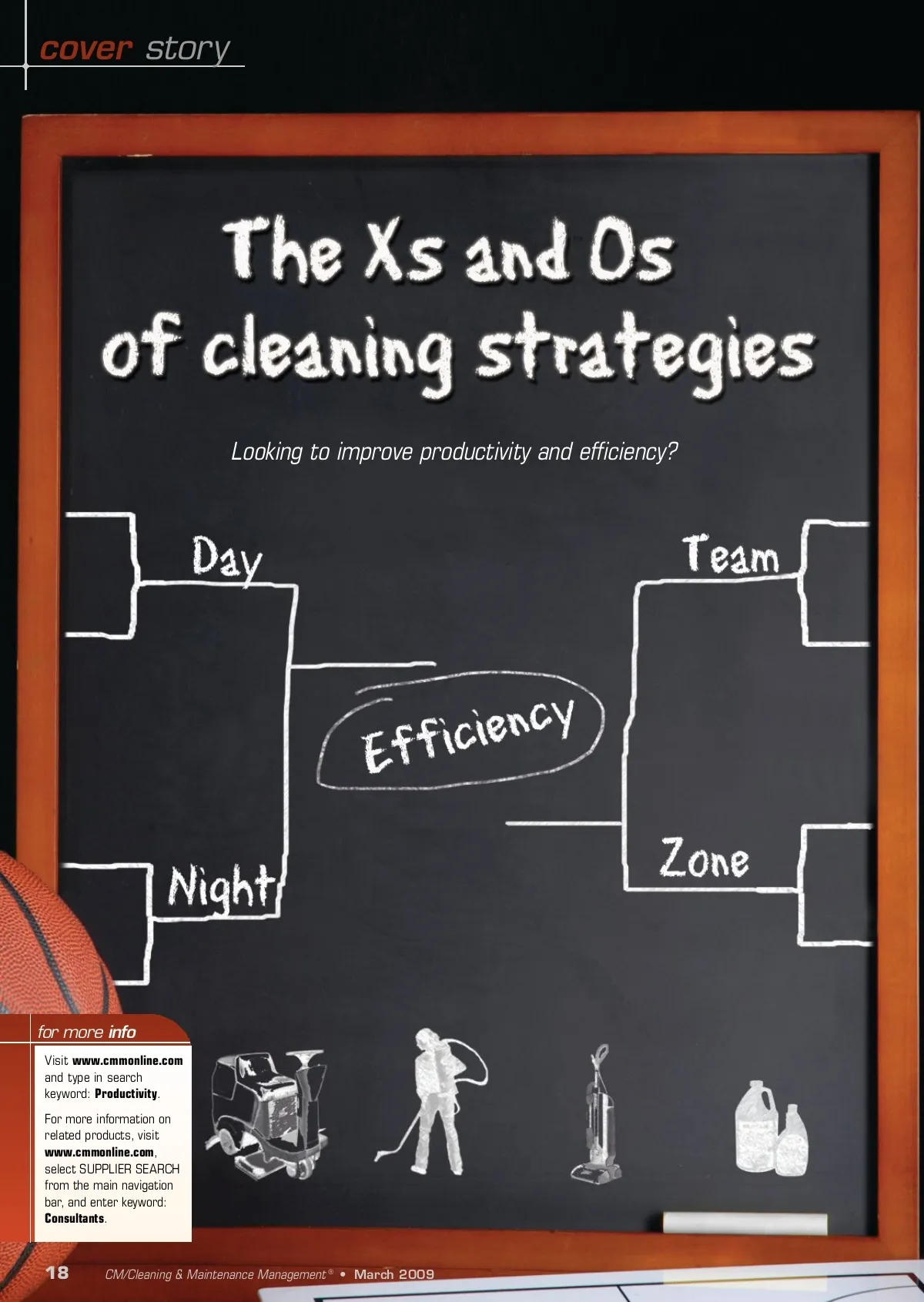
cover story By: Richard DiPaolo, Senior editor I In some end user circles, productivity is the leading industry buzzword of the day. Managers and owners need to know how to motivate employees, task appropri-ately and get better cleaning results. While there are many training products and consultants on the market today, many of which can be of great assistance, a strict cleaning strategy can help organize the workload in order to achieve desired results. Over the years, Team Cleaning and Zone Cleaning have become popular cleaning strategies. And, the debate between Day Cleaning and Night Cleaning still lingers as to which provides more benefits. Today, according to the experts we’ve interviewed, equipment innovations as well as industry trends, such as green cleaning, have positively affected cleaning strategies and productivity. tools and tasks as well as performance standards that are known and measure-able, using a checklist system,” says Rich Parillo, building service contractor special-ist at Pro-Link, a JanSan-focused marketing and buying group. According to Harris, workers in a Team Cleaning model stay productive through communication and written instruction. “[Each worker] is equipped with the following: Equipment specific for the assigned duties; job card (routing-duties-quadrants-time) which shows where to go, what to do and how long it should take; and a note pad for communication,” notes Harris, who adds that productivity can be modified by simply changing the job card. In order to be successful, Team Cleaning workers and managers must be properly trained. “To the untrained manager, Team Cleaning is confused with Gang Cleaning, which is where every cleaner works togeth-er [in one area at once,]” says Harris. “This could not be farther from the truth.” Zone coverage In the Zone Cleaning model, one employee typically performs all of the tasks for a specific area. This system gives the worker a sense of “ownership” for the entire area. Also, according to Daniels Associates Inc.’s CEO Ian G. Greig, the Zone Cleaning model enables the worker to clean at his/her own pace. A concern with Team Cleaning, says Greig, is that “people have to slow down, literally, to the speed of the slowest cleaner, which is not productive at all.” An industry consultant, Greig offered a modified version of Zone Cleaning, referred to as Task and Frequency Cleaning. “Zone Cleaning is efficient because you use [more of] the equipment on the market today, which allow [users] to get up to rates of 10,000 square feet an hour,” says Greig, who recalls breaking into the industry Continued on next page The team approach Depending on the facility’s needs, a Team Cleaning strategy is typically com-prised of numerous workers, according to Jim Harris, Sr., who is the CEO/president of Concepts4 Cleaning Consultants. In a Team Cleaning model, says Harris, numerous specialists work independently of each other: • Light-duty (starter) • Vac (closer) • Restroom (sanitor) • Utility 1, 2, 3, 4 (such as cleaning stairs, carpet spotting, specialty cleaning, etc.). “Each specialist’s role involves specific www.cmmonline.com 19
CMM – Archives Mar 2009: 19