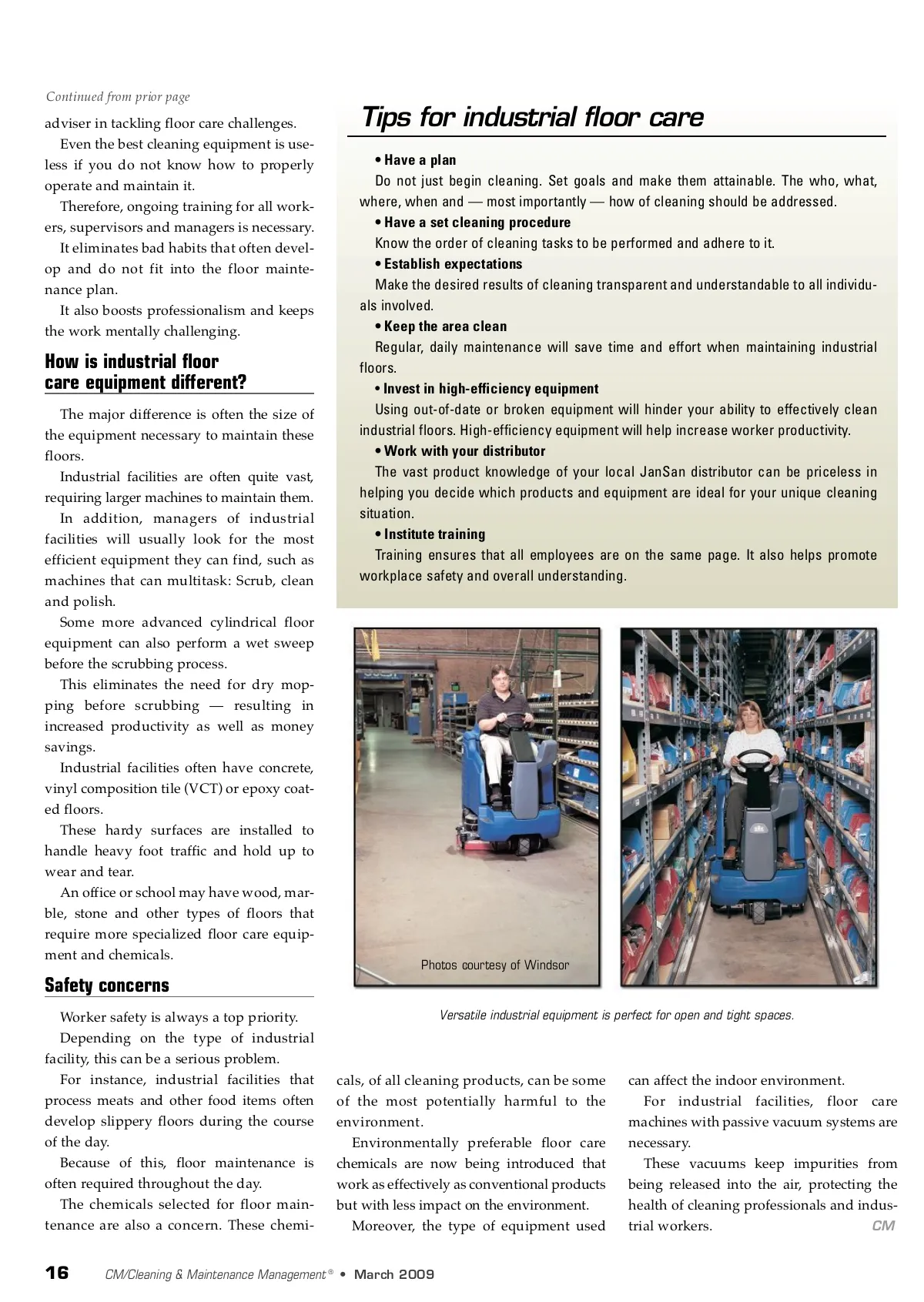
Continued from prior page adviser in tackling floor care challenges. Even the best cleaning equipment is use-less if you do not know how to properly operate and maintain it. Therefore, ongoing training for all work-ers, supervisors and managers is necessary. It eliminates bad habits that often devel-op and do not fit into the floor mainte-nance plan. It also boosts professionalism and keeps the work mentally challenging. Tips for industrial floor care • Have a plan Do not just begin cleaning. Set goals and make them attainable. The who, what, where, when and — most importantly — how of cleaning should be addressed. • Have a set cleaning procedure Know the order of cleaning tasks to be performed and adhere to it. • Establish expectations Make the desired results of cleaning transparent and understandable to all individu-als involved. • Keep the area clean Regular, daily maintenance will save time and effort when maintaining industrial floors. • Invest in high-efficiency equipment Using out-of-date or broken equipment will hinder your ability to effectively clean industrial floors. High-efficiency equipment will help increase worker productivity. • Work with your distributor The vast product knowledge of your local JanSan distributor can be priceless in helping you decide which products and equipment are ideal for your unique cleaning situation. • Institute training Training ensures that all employees are on the same page. It also helps promote workplace safety and overall understanding. How is industrial floor care equipment different? The major difference is often the size of the equipment necessary to maintain these floors. Industrial facilities are often quite vast, requiring larger machines to maintain them. In addition, managers of industrial facilities will usually look for the most efficient equipment they can find, such as machines that can multitask: Scrub, clean and polish. Some more advanced cylindrical floor equipment can also perform a wet sweep before the scrubbing process. This eliminates the need for dry mop-ping before scrubbing — resulting in increased productivity as well as money savings. Industrial facilities often have concrete, vinyl composition tile (VCT) or epoxy coat-ed floors. These hardy surfaces are installed to handle heavy foot traffic and hold up to wear and tear. An office or school may have wood, mar-ble, stone and other types of floors that require more specialized floor care equip-ment and chemicals. Photos courtesy of Windsor Safety concerns Worker safety is always a top priority. Depending on the type of industrial facility, this can be a serious problem. For instance, industrial facilities that process meats and other food items often develop slippery floors during the course of the day. Because of this, floor maintenance is often required throughout the day. The chemicals selected for floor main-tenance are also a concern. These chemi-Versatile industrial equipment is perfect for open and tight spaces. cals, of all cleaning products, can be some of the most potentially harmful to the environment. Environmentally preferable floor care chemicals are now being introduced that work as effectively as conventional products but with less impact on the environment. Moreover, the type of equipment used can affect the indoor environment. For industrial facilities, floor care machines with passive vacuum systems are necessary. These vacuums keep impurities from being released into the air, protecting the health of cleaning professionals and indus-CM trial workers. 16 CM/Cleaning & Maintenance Management ® • March 2009
CMM – Archives Mar 2009: 16