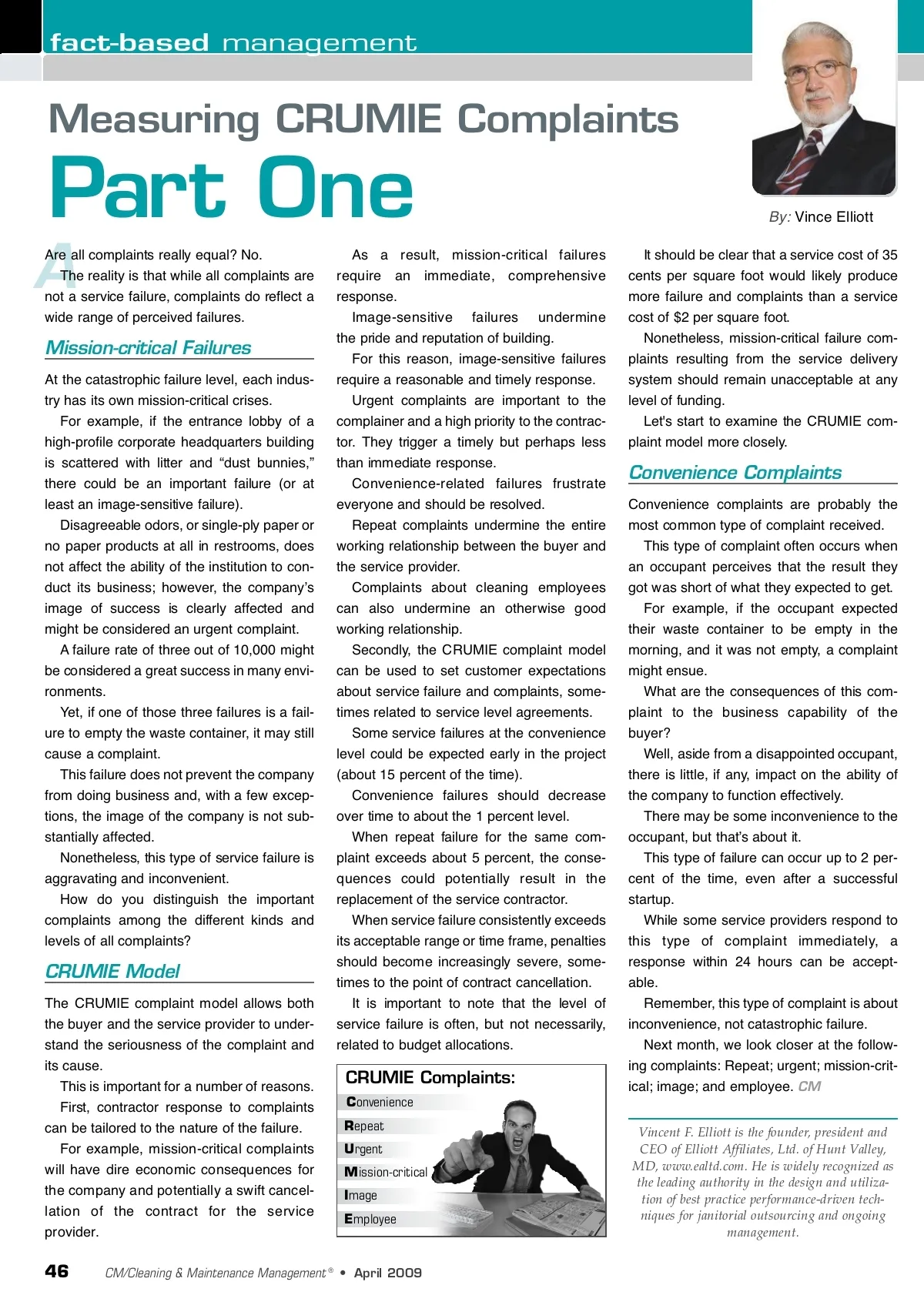
fact-based management Measuring CRUMIE Complaints Part One A Are all complaints really equal? No. The reality is that while all complaints are not a service failure, complaints do reflect a wide range of perceived failures. By: Vince Elliott It should be clear that a service cost of 35 cents per square foot would likely produce more failure and complaints than a service cost of $2 per square foot. Nonetheless, mission-critical failure com-plaints resulting from the service delivery system should remain unacceptable at any level of funding. Let's start to examine the CRUMIE com-plaint model more closely. Mission-critical Failures At the catastrophic failure level, each indus-try has its own mission-critical crises. For example, if the entrance lobby of a high-profile corporate headquarters building is scattered with litter and “dust bunnies,” there could be an important failure (or at least an image-sensitive failure). Disagreeable odors, or single-ply paper or no paper products at all in restrooms, does not affect the ability of the institution to con-duct its business; however, the companyʼs image of success is clearly affected and might be considered an urgent complaint. A failure rate of three out of 10,000 might be considered a great success in many envi-ronments. Yet, if one of those three failures is a fail-ure to empty the waste container, it may still cause a complaint. This failure does not prevent the company from doing business and, with a few excep-tions, the image of the company is not sub-stantially affected. Nonetheless, this type of service failure is aggravating and inconvenient. How do you distinguish the important complaints among the different kinds and levels of all complaints? CRUMIE Model The CRUMIE complaint model allows both the buyer and the service provider to under-stand the seriousness of the complaint and its cause. This is important for a number of reasons. First, contractor response to complaints can be tailored to the nature of the failure. For example, mission-critical complaints will have dire economic consequences for the company and potentially a swift cancel-lation of the contract for the service provider. As a result, mission-critical failures require an immediate, comprehensive response. Image-sensitive failures undermine the pride and reputation of building. For this reason, image-sensitive failures require a reasonable and timely response. Urgent complaints are important to the complainer and a high priority to the contrac-tor. They trigger a timely but perhaps less than immediate response. Convenience-related failures frustrate everyone and should be resolved. Repeat complaints undermine the entire working relationship between the buyer and the service provider. Complaints about cleaning employees can also undermine an otherwise good working relationship. Secondly, the CRUMIE complaint model can be used to set customer expectations about service failure and complaints, some-times related to service level agreements. Some service failures at the convenience level could be expected early in the project (about 15 percent of the time). Convenience failures should decrease over time to about the 1 percent level. When repeat failure for the same com-plaint exceeds about 5 percent, the conse-quences could potentially result in the replacement of the service contractor. When service failure consistently exceeds its acceptable range or time frame, penalties should become increasingly severe, some-times to the point of contract cancellation. It is important to note that the level of service failure is often, but not necessarily, related to budget allocations. Convenience Complaints Convenience complaints are probably the most common type of complaint received. This type of complaint often occurs when an occupant perceives that the result they got was short of what they expected to get. For example, if the occupant expected their waste container to be empty in the morning, and it was not empty, a complaint might ensue. What are the consequences of this com-plaint to the business capability of the buyer? Well, aside from a disappointed occupant, there is little, if any, impact on the ability of the company to function effectively. There may be some inconvenience to the occupant, but thatʼs about it. This type of failure can occur up to 2 per-cent of the time, even after a successful startup. While some service providers respond to this type of complaint immediately, a response within 24 hours can be accept-able. Remember, this type of complaint is about inconvenience, not catastrophic failure. Next month, we look closer at the follow-ing complaints: Repeat; urgent; mission-crit-ical; image; and employee. CM Vincent F. Elliott is the founder, president and CEO of Elliott Affiliates, Ltd. of Hunt Valley, MD, www.ealtd.com. He is widely recognized as the leading authority in the design and utiliza-tion of best practice performance-driven tech-niques for janitorial outsourcing and ongoing management. CRUMIE Complaints: C onvenience R epeat U rgent M ission-critical I mage E mployee 46 CM/Cleaning & Maintenance Management ® • April 2009
CMM – Archives Apr 2009: 46