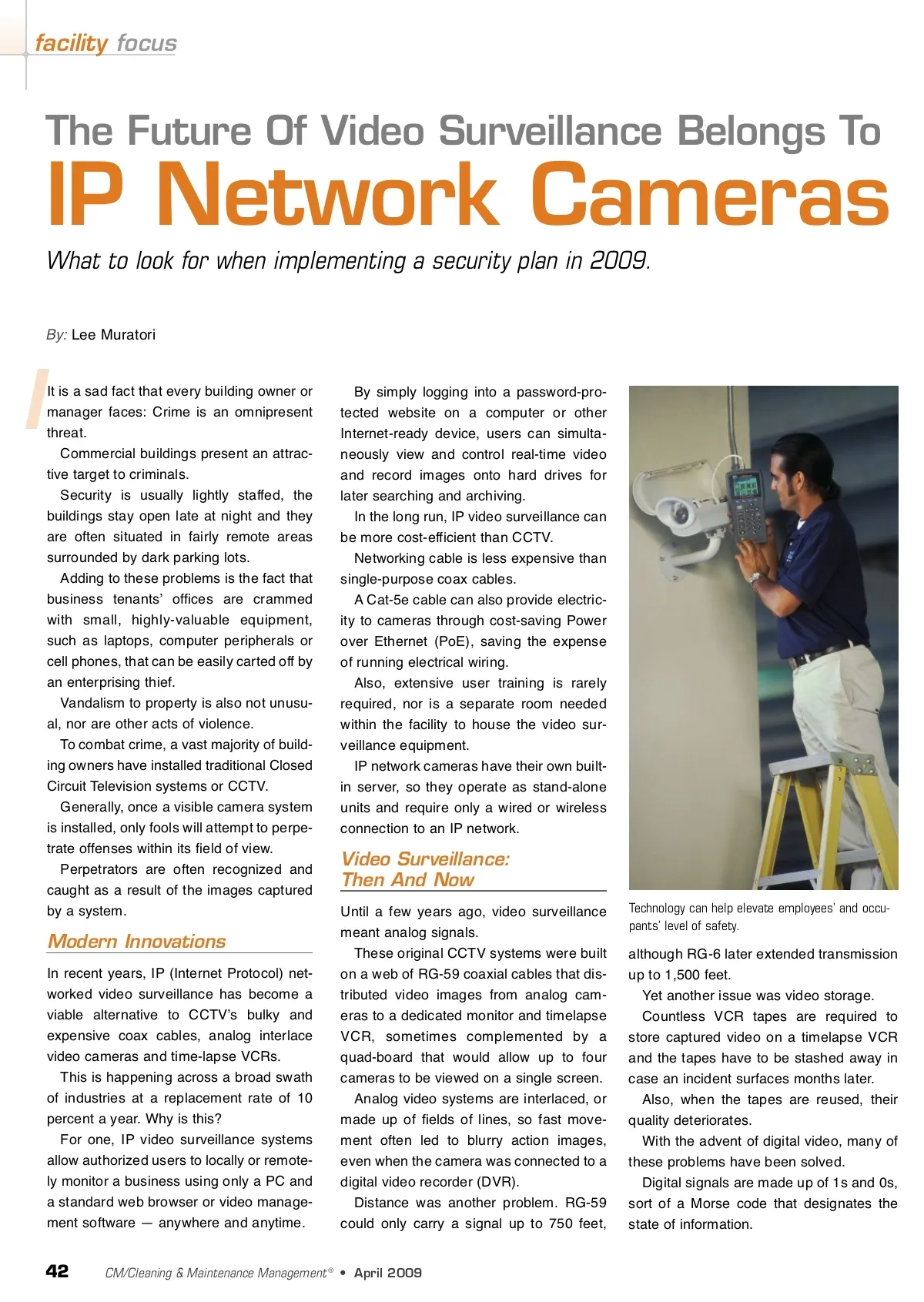
facility focus The Future Of Video Surveillance Belongs To IP Network Cameras What to look for when implementing a security plan in 2009. By: Lee Muratori I It is a sad fact that every building owner or manager faces: Crime is an omnipresent threat. Commercial buildings present an attrac-tive target to criminals. Security is usually lightly staffed, the buildings stay open late at night and they are often situated in fairly remote areas surrounded by dark parking lots. Adding to these problems is the fact that business tenantsʼ offices are crammed with small, highly-valuable equipment, such as laptops, computer peripherals or cell phones, that can be easily carted off by an enterprising thief. Vandalism to property is also not unusu-al, nor are other acts of violence. To combat crime, a vast majority of build-ing owners have installed traditional Closed Circuit Television systems or CCTV. Generally, once a visible camera system is installed, only fools will attempt to perpe-trate offenses within its field of view. Perpetrators are often recognized and caught as a result of the images captured by a system. By simply logging into a password-pro-tected website on a computer or other Internet-ready device, users can simulta-neously view and control real-time video and record images onto hard drives for later searching and archiving. In the long run, IP video surveillance can be more cost-efficient than CCTV. Networking cable is less expensive than single-purpose coax cables. A Cat-5e cable can also provide electric-ity to cameras through cost-saving Power over Ethernet (PoE), saving the expense of running electrical wiring. Also, extensive user training is rarely required, nor is a separate room needed within the facility to house the video sur-veillance equipment. IP network cameras have their own built-in server, so they operate as stand-alone units and require only a wired or wireless connection to an IP network. Video Surveillance: Then And Now Until a few years ago, video surveillance meant analog signals. These original CCTV systems were built on a web of RG-59 coaxial cables that dis-tributed video images from analog cam-eras to a dedicated monitor and timelapse VCR, sometimes complemented by a quad-board that would allow up to four cameras to be viewed on a single screen. Analog video systems are interlaced, or made up of fields of lines, so fast move-ment often led to blurry action images, even when the camera was connected to a digital video recorder (DVR). Distance was another problem. RG-59 could only carry a signal up to 750 feet, Technology can help elevate employees’ and occu-pants’ level of safety. Modern Innovations In recent years, IP (Internet Protocol) net-worked video surveillance has become a viable alternative to CCTVʼs bulky and expensive coax cables, analog interlace video cameras and time-lapse VCRs. This is happening across a broad swath of industries at a replacement rate of 10 percent a year. Why is this? For one, IP video surveillance systems allow authorized users to locally or remote-ly monitor a business using only a PC and a standard web browser or video manage-ment software — anywhere and anytime. although RG-6 later extended transmission up to 1,500 feet. Yet another issue was video storage. Countless VCR tapes are required to store captured video on a timelapse VCR and the tapes have to be stashed away in case an incident surfaces months later. Also, when the tapes are reused, their quality deteriorates. With the advent of digital video, many of these problems have been solved. Digital signals are made up of 1s and 0s, sort of a Morse code that designates the state of information. 42 CM/Cleaning & Maintenance Management ® • April 2009
CMM – Archives Apr 2009: 42