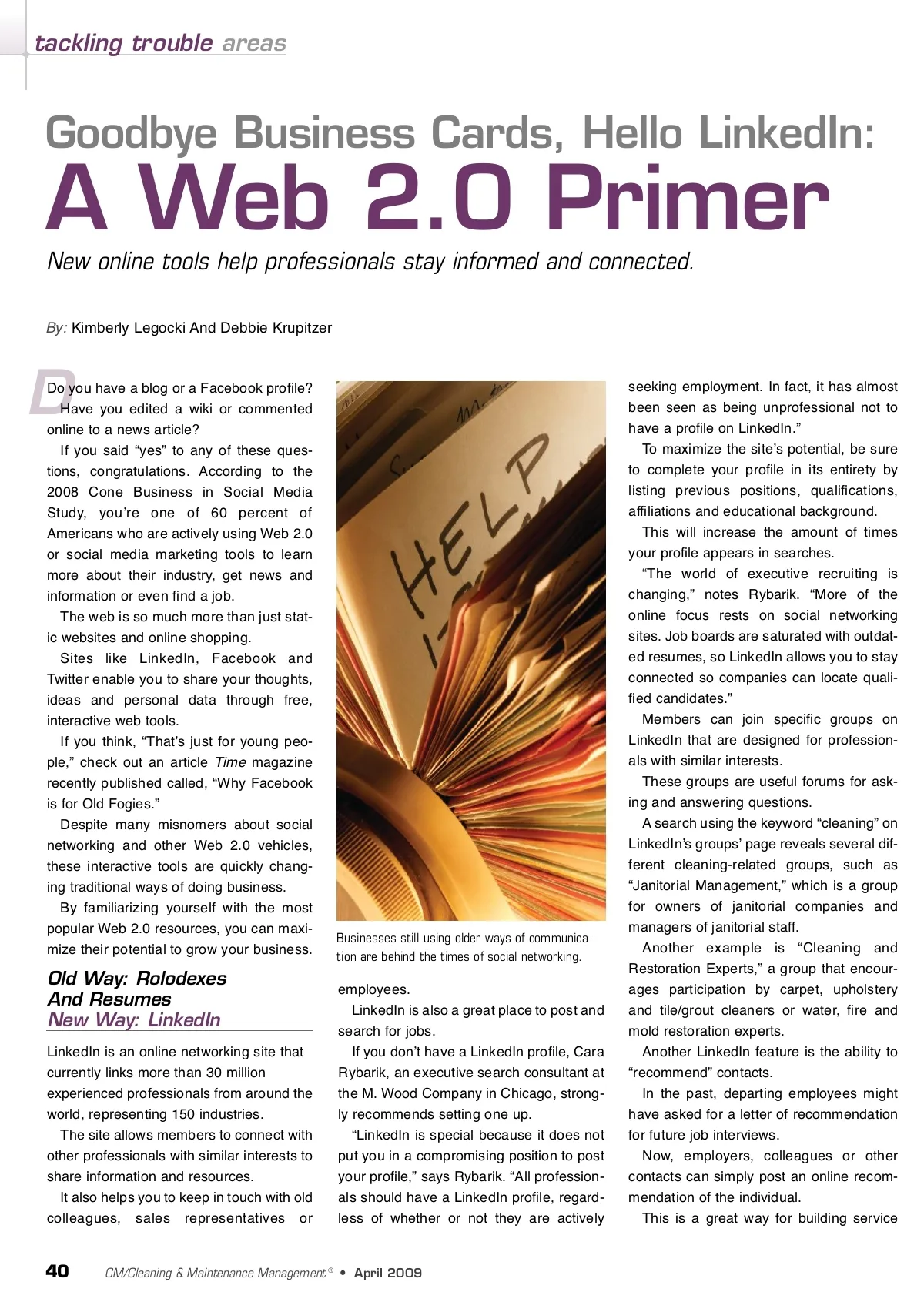
tackling trouble areas Goodbye Business Cards, Hello LinkedIn: A Web 2.0 Primer New online tools help professionals stay informed and connected. By: Kimberly Legocki And Debbie Krupitzer D Do you have a blog or a Facebook profile? Have you edited a wiki or commented online to a news article? If you said “yes” to any of these ques-tions, congratulations. According to the 2008 Cone Business in Social Media Study, youʼre one of 60 percent of Americans who are actively using Web 2.0 or social media marketing tools to learn more about their industry, get news and information or even find a job. The web is so much more than just stat-ic websites and online shopping. Sites like LinkedIn, Facebook and Twitter enable you to share your thoughts, ideas and personal data through free, interactive web tools. If you think, “Thatʼs just for young peo-ple,” check out an article Time magazine recently published called, “Why Facebook is for Old Fogies.” Despite many misnomers about social networking and other Web 2.0 vehicles, these interactive tools are quickly chang-ing traditional ways of doing business. By familiarizing yourself with the most popular Web 2.0 resources, you can maxi-mize their potential to grow your business. Businesses still using older ways of communica-tion are behind the times of social networking. Old Way: Rolodexes And Resumes New Way: LinkedIn LinkedIn is an online networking site that currently links more than 30 million experienced professionals from around the world, representing 150 industries. The site allows members to connect with other professionals with similar interests to share information and resources. It also helps you to keep in touch with old colleagues, sales representatives or employees. LinkedIn is also a great place to post and search for jobs. If you donʼt have a LinkedIn profile, Cara Rybarik, an executive search consultant at the M. Wood Company in Chicago, strong-ly recommends setting one up. “LinkedIn is special because it does not put you in a compromising position to post your profile,” says Rybarik. “All profession-als should have a LinkedIn profile, regard-less of whether or not they are actively seeking employment. In fact, it has almost been seen as being unprofessional not to have a profile on LinkedIn.” To maximize the siteʼs potential, be sure to complete your profile in its entirety by listing previous positions, qualifications, affiliations and educational background. This will increase the amount of times your profile appears in searches. “The world of executive recruiting is changing,” notes Rybarik. “More of the online focus rests on social networking sites. Job boards are saturated with outdat-ed resumes, so LinkedIn allows you to stay connected so companies can locate quali-fied candidates.” Members can join specific groups on LinkedIn that are designed for profession-als with similar interests. These groups are useful forums for ask-ing and answering questions. A search using the keyword “cleaning” on LinkedInʼs groupsʼ page reveals several dif-ferent cleaning-related groups, such as “Janitorial Management,” which is a group for owners of janitorial companies and managers of janitorial staff. Another example is “Cleaning and Restoration Experts,” a group that encour-ages participation by carpet, upholstery and tile/grout cleaners or water, fire and mold restoration experts. Another LinkedIn feature is the ability to “recommend” contacts. In the past, departing employees might have asked for a letter of recommendation for future job interviews. Now, employers, colleagues or other contacts can simply post an online recom-mendation of the individual. This is a great way for building service 40 CM/Cleaning & Maintenance Management ® • April 2009
CMM – Archives Apr 2009: 40