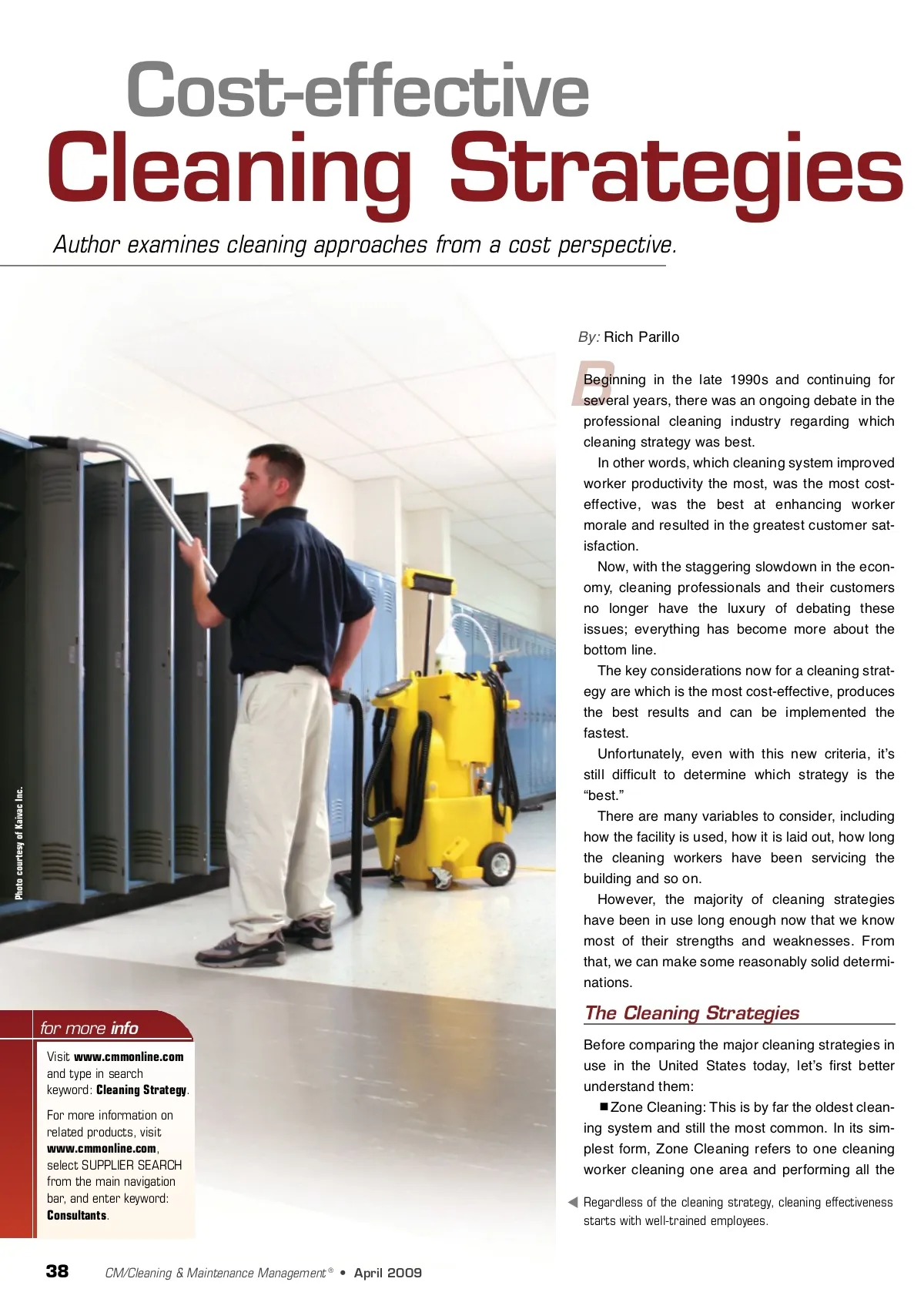
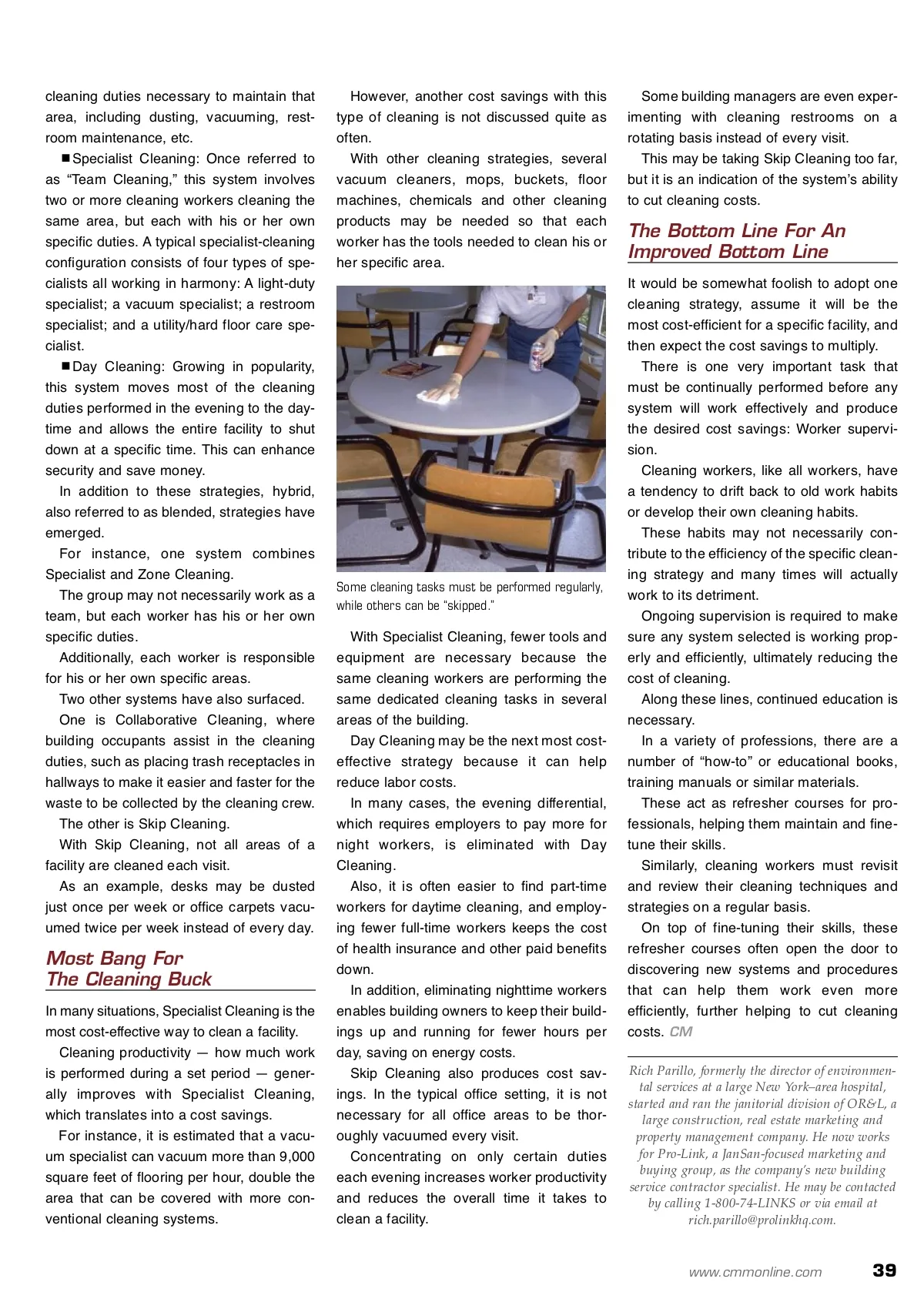
cleaning duties necessary to maintain that area, including dusting, vacuuming, rest-room maintenance, etc. Specialist Cleaning: Once referred to as “Team Cleaning,” this system involves two or more cleaning workers cleaning the same area, but each with his or her own specific duties. A typical specialist-cleaning configuration consists of four types of spe-cialists all working in harmony: A light-duty specialist; a vacuum specialist; a restroom specialist; and a utility/hard floor care spe-cialist. Day Cleaning: Growing in popularity, this system moves most of the cleaning duties performed in the evening to the day-time and allows the entire facility to shut down at a specific time. This can enhance security and save money. In addition to these strategies, hybrid, also referred to as blended, strategies have emerged. For instance, one system combines Specialist and Zone Cleaning. The group may not necessarily work as a team, but each worker has his or her own specific duties. Additionally, each worker is responsible for his or her own specific areas. Two other systems have also surfaced. One is Collaborative Cleaning, where building occupants assist in the cleaning duties, such as placing trash receptacles in hallways to make it easier and faster for the waste to be collected by the cleaning crew. The other is Skip Cleaning. With Skip Cleaning, not all areas of a facility are cleaned each visit. As an example, desks may be dusted just once per week or office carpets vacu-umed twice per week instead of every day. However, another cost savings with this type of cleaning is not discussed quite as often. With other cleaning strategies, several vacuum cleaners, mops, buckets, floor machines, chemicals and other cleaning products may be needed so that each worker has the tools needed to clean his or her specific area. Some building managers are even exper-imenting with cleaning restrooms on a rotating basis instead of every visit. This may be taking Skip Cleaning too far, but it is an indication of the systemʼs ability to cut cleaning costs. The Bottom Line For An Improved Bottom Line It would be somewhat foolish to adopt one cleaning strategy, assume it will be the most cost-efficient for a specific facility, and then expect the cost savings to multiply. There is one very important task that must be continually performed before any system will work effectively and produce the desired cost savings: Worker supervi-sion. Cleaning workers, like all workers, have a tendency to drift back to old work habits or develop their own cleaning habits. These habits may not necessarily con-tribute to the efficiency of the specific clean-ing strategy and many times will actually work to its detriment. Ongoing supervision is required to make sure any system selected is working prop-erly and efficiently, ultimately reducing the cost of cleaning. Along these lines, continued education is necessary. In a variety of professions, there are a number of “how-to” or educational books, training manuals or similar materials. These act as refresher courses for pro-fessionals, helping them maintain and fine-tune their skills. Similarly, cleaning workers must revisit and review their cleaning techniques and strategies on a regular basis. On top of fine-tuning their skills, these refresher courses often open the door to discovering new systems and procedures that can help them work even more efficiently, further helping to cut cleaning costs. CM Rich Parillo, formerly the director of environmen-tal services at a large New York–area hospital, started and ran the janitorial division of OR&L, a large construction, real estate marketing and property management company. He now works for Pro-Link, a JanSan-focused marketing and buying group, as the company’s new building service contractor specialist. He may be contacted by calling 1-800-74-LINKS or via email at [email protected]. Some cleaning tasks must be performed regularly, while others can be “skipped.” Most Bang For The Cleaning Buck In many situations, Specialist Cleaning is the most cost-effective way to clean a facility. Cleaning productivity — how much work is performed during a set period — gener-ally improves with Specialist Cleaning, which translates into a cost savings. For instance, it is estimated that a vacu-um specialist can vacuum more than 9,000 square feet of flooring per hour, double the area that can be covered with more con-ventional cleaning systems. With Specialist Cleaning, fewer tools and equipment are necessary because the same cleaning workers are performing the same dedicated cleaning tasks in several areas of the building. Day Cleaning may be the next most cost-effective strategy because it can help reduce labor costs. In many cases, the evening differential, which requires employers to pay more for night workers, is eliminated with Day Cleaning. Also, it is often easier to find part-time workers for daytime cleaning, and employ-ing fewer full-time workers keeps the cost of health insurance and other paid benefits down. In addition, eliminating nighttime workers enables building owners to keep their build-ings up and running for fewer hours per day, saving on energy costs. Skip Cleaning also produces cost sav-ings. In the typical office setting, it is not necessary for all office areas to be thor-oughly vacuumed every visit. Concentrating on only certain duties each evening increases worker productivity and reduces the overall time it takes to clean a facility. www.cmmonline.com 39
CMM – Archives Apr 2009: 39