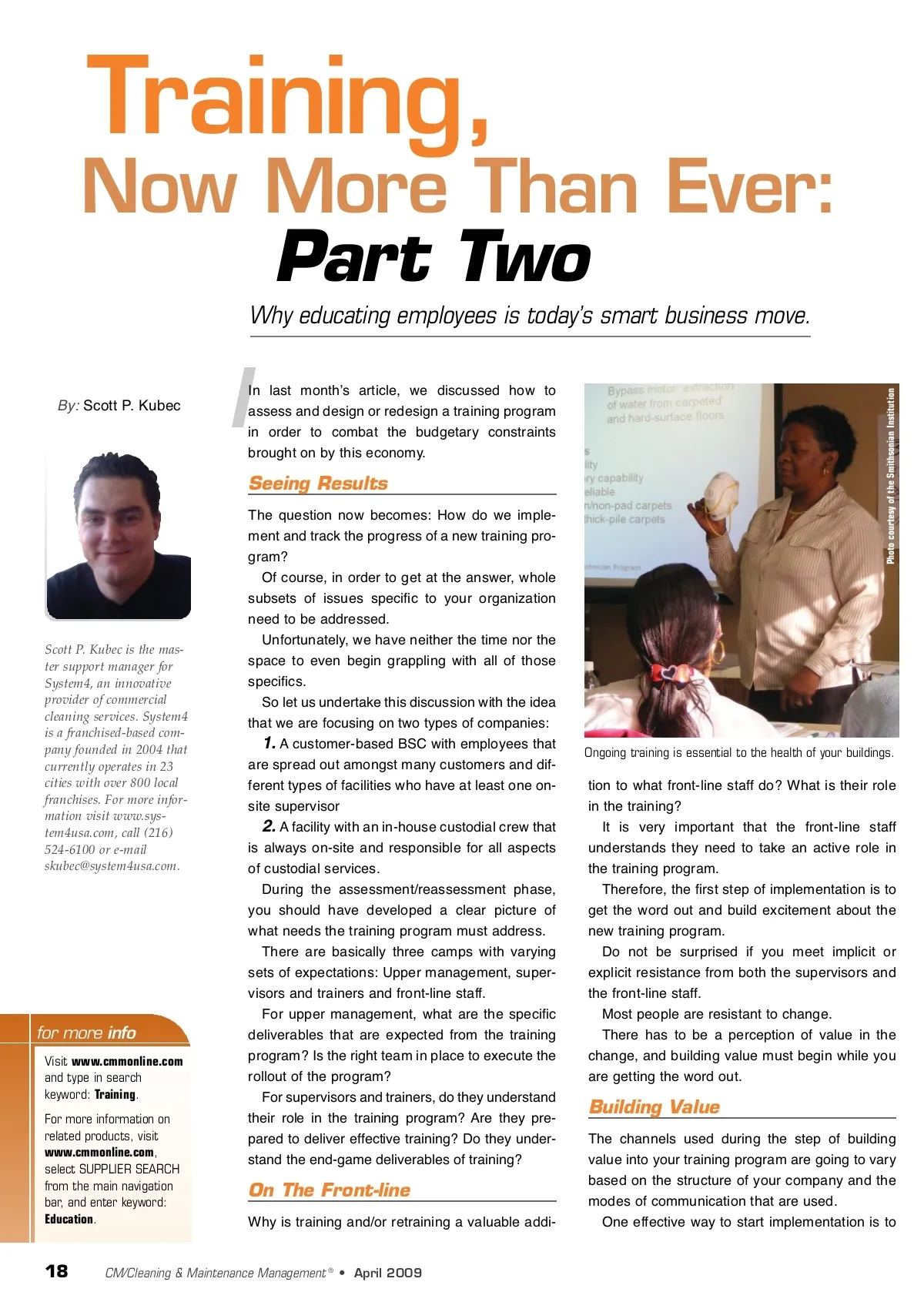
Now More Than Ever: Part Two Why educating employees is today’s smart business move. Photo courtesy of the Smithsonian Institution Training, I By: Scott P. Kubec In last monthʼs article, we discussed how to assess and design or redesign a training program in order to combat the budgetary constraints brought on by this economy. Seeing Results The question now becomes: How do we imple-ment and track the progress of a new training pro-gram? Of course, in order to get at the answer, whole subsets of issues specific to your organization need to be addressed. Unfortunately, we have neither the time nor the space to even begin grappling with all of those specifics. So let us undertake this discussion with the idea that we are focusing on two types of companies: 1. A customer-based BSC with employees that are spread out amongst many customers and dif-ferent types of facilities who have at least one on-site supervisor 2. A facility with an in-house custodial crew that is always on-site and responsible for all aspects of custodial services. During the assessment/reassessment phase, you should have developed a clear picture of what needs the training program must address. There are basically three camps with varying sets of expectations: Upper management, super-visors and trainers and front-line staff. For upper management, what are the specific deliverables that are expected from the training program? Is the right team in place to execute the rollout of the program? For supervisors and trainers, do they understand their role in the training program? Are they pre-pared to deliver effective training? Do they under-stand the end-game deliverables of training? Scott P. Kubec is the mas-ter support manager for System4, an innovative provider of commercial cleaning services. System4 is a franchised-based com-pany founded in 2004 that currently operates in 23 cities with over 800 local franchises. For more infor-mation visit www.sys-tem4usa.com, call (216) 524-6100 or e-mail [email protected]. Ongoing training is essential to the health of your buildings. for more info Visit www.cmmonline.com and type in search keyword: Training . For more information on related products, visit www.cmmonline.com , select SUPPLIER SEARCH from the main navigation bar, and enter keyword: Education . tion to what front-line staff do? What is their role in the training? It is very important that the front-line staff understands they need to take an active role in the training program. Therefore, the first step of implementation is to get the word out and build excitement about the new training program. Do not be surprised if you meet implicit or explicit resistance from both the supervisors and the front-line staff. Most people are resistant to change. There has to be a perception of value in the change, and building value must begin while you are getting the word out. Building Value The channels used during the step of building value into your training program are going to vary based on the structure of your company and the modes of communication that are used. One effective way to start implementation is to On The Front-line Why is training and/or retraining a valuable addi-18 CM/Cleaning & Maintenance Management ® • April 2009
CMM – Archives Apr 2009: 18