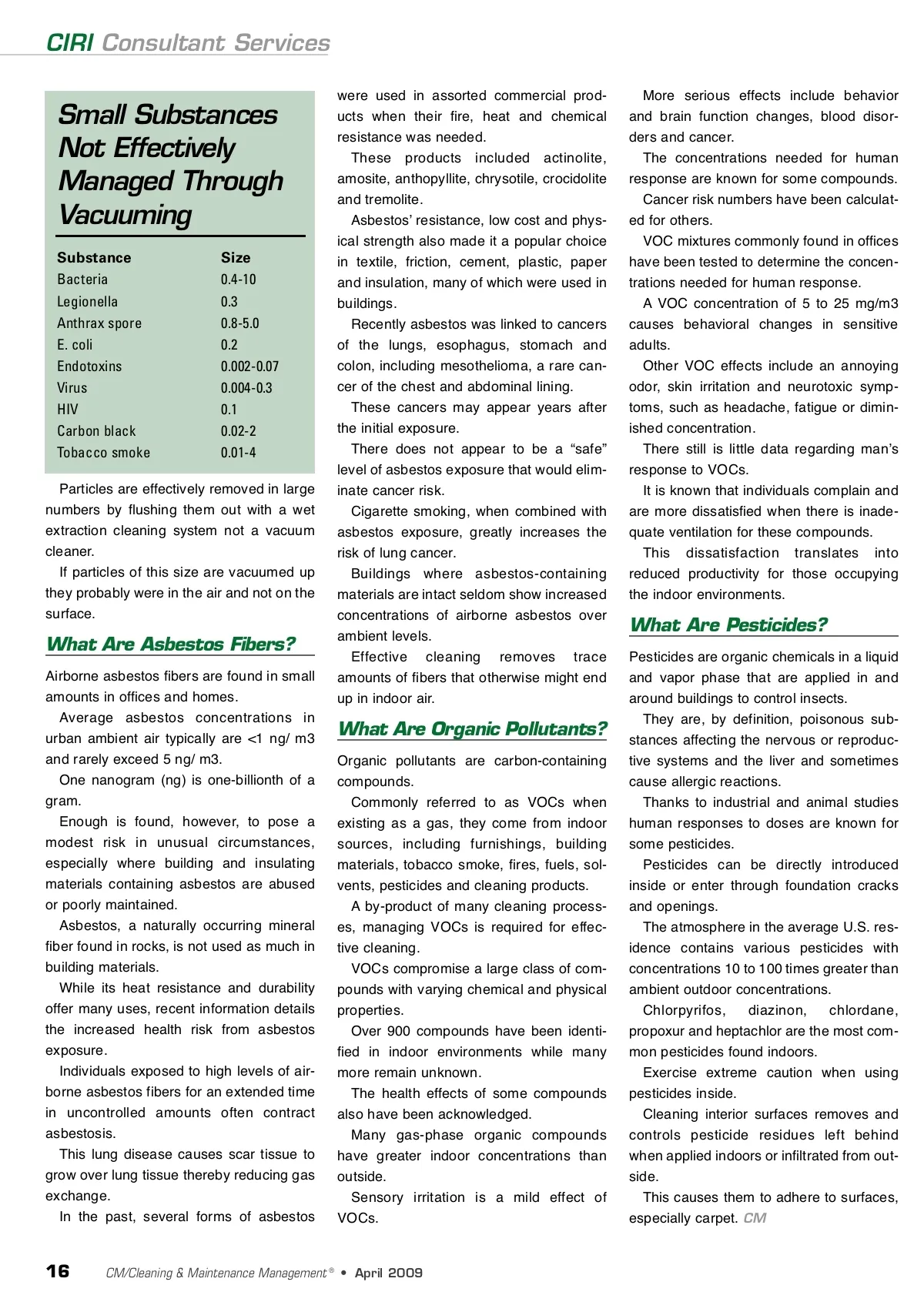
CIRI Consultant Services Small Substances Not Effectively Managed Through Vacuuming Substance Bacteria Legionella Anthrax spore E. coli Endotoxins Virus HIV Carbon black Tobacco smoke Size 0.4-10 0.3 0.8-5.0 0.2 0.002-0.07 0.004-0.3 0.1 0.02-2 0.01-4 Particles are effectively removed in large numbers by flushing them out with a wet extraction cleaning system not a vacuum cleaner. If particles of this size are vacuumed up they probably were in the air and not on the surface. What Are Asbestos Fibers? Airborne asbestos fibers are found in small amounts in offices and homes. Average asbestos concentrations in urban ambient air typically are <1 ng/ m3 and rarely exceed 5 ng/ m3. One nanogram (ng) is one-billionth of a gram. Enough is found, however, to pose a modest risk in unusual circumstances, especially where building and insulating materials containing asbestos are abused or poorly maintained. Asbestos, a naturally occurring mineral fiber found in rocks, is not used as much in building materials. While its heat resistance and durability offer many uses, recent information details the increased health risk from asbestos exposure. Individuals exposed to high levels of air-borne asbestos fibers for an extended time in uncontrolled amounts often contract asbestosis. This lung disease causes scar tissue to grow over lung tissue thereby reducing gas exchange. In the past, several forms of asbestos were used in assorted commercial prod-ucts when their fire, heat and chemical resistance was needed. These products included actinolite, amosite, anthopyllite, chrysotile, crocidolite and tremolite. Asbestosʼ resistance, low cost and phys-ical strength also made it a popular choice in textile, friction, cement, plastic, paper and insulation, many of which were used in buildings. Recently asbestos was linked to cancers of the lungs, esophagus, stomach and colon, including mesothelioma, a rare can-cer of the chest and abdominal lining. These cancers may appear years after the initial exposure. There does not appear to be a “safe” level of asbestos exposure that would elim-inate cancer risk. Cigarette smoking, when combined with asbestos exposure, greatly increases the risk of lung cancer. Buildings where asbestos-containing materials are intact seldom show increased concentrations of airborne asbestos over ambient levels. Effective cleaning removes trace amounts of fibers that otherwise might end up in indoor air. More serious effects include behavior and brain function changes, blood disor-ders and cancer. The concentrations needed for human response are known for some compounds. Cancer risk numbers have been calculat-ed for others. VOC mixtures commonly found in offices have been tested to determine the concen-trations needed for human response. A VOC concentration of 5 to 25 mg/m3 causes behavioral changes in sensitive adults. Other VOC effects include an annoying odor, skin irritation and neurotoxic symp-toms, such as headache, fatigue or dimin-ished concentration. There still is little data regarding manʼs response to VOCs. It is known that individuals complain and are more dissatisfied when there is inade-quate ventilation for these compounds. This dissatisfaction translates into reduced productivity for those occupying the indoor environments. What Are Pesticides? Pesticides are organic chemicals in a liquid and vapor phase that are applied in and around buildings to control insects. They are, by definition, poisonous sub-stances affecting the nervous or reproduc-tive systems and the liver and sometimes cause allergic reactions. Thanks to industrial and animal studies human responses to doses are known for some pesticides. Pesticides can be directly introduced inside or enter through foundation cracks and openings. The atmosphere in the average U.S. res-idence contains various pesticides with concentrations 10 to 100 times greater than ambient outdoor concentrations. Chlorpyrifos, diazinon, chlordane, propoxur and heptachlor are the most com-mon pesticides found indoors. Exercise extreme caution when using pesticides inside. Cleaning interior surfaces removes and controls pesticide residues left behind when applied indoors or infiltrated from out-side. This causes them to adhere to surfaces, especially carpet. CM What Are Organic Pollutants? Organic pollutants are carbon-containing compounds. Commonly referred to as VOCs when existing as a gas, they come from indoor sources, including furnishings, building materials, tobacco smoke, fires, fuels, sol-vents, pesticides and cleaning products. A by-product of many cleaning process-es, managing VOCs is required for effec-tive cleaning. VOCs compromise a large class of com-pounds with varying chemical and physical properties. Over 900 compounds have been identi-fied in indoor environments while many more remain unknown. The health effects of some compounds also have been acknowledged. Many gas-phase organic compounds have greater indoor concentrations than outside. Sensory irritation is a mild effect of VOCs. 16 CM/Cleaning & Maintenance Management ® • April 2009
CMM – Archives Apr 2009: 16