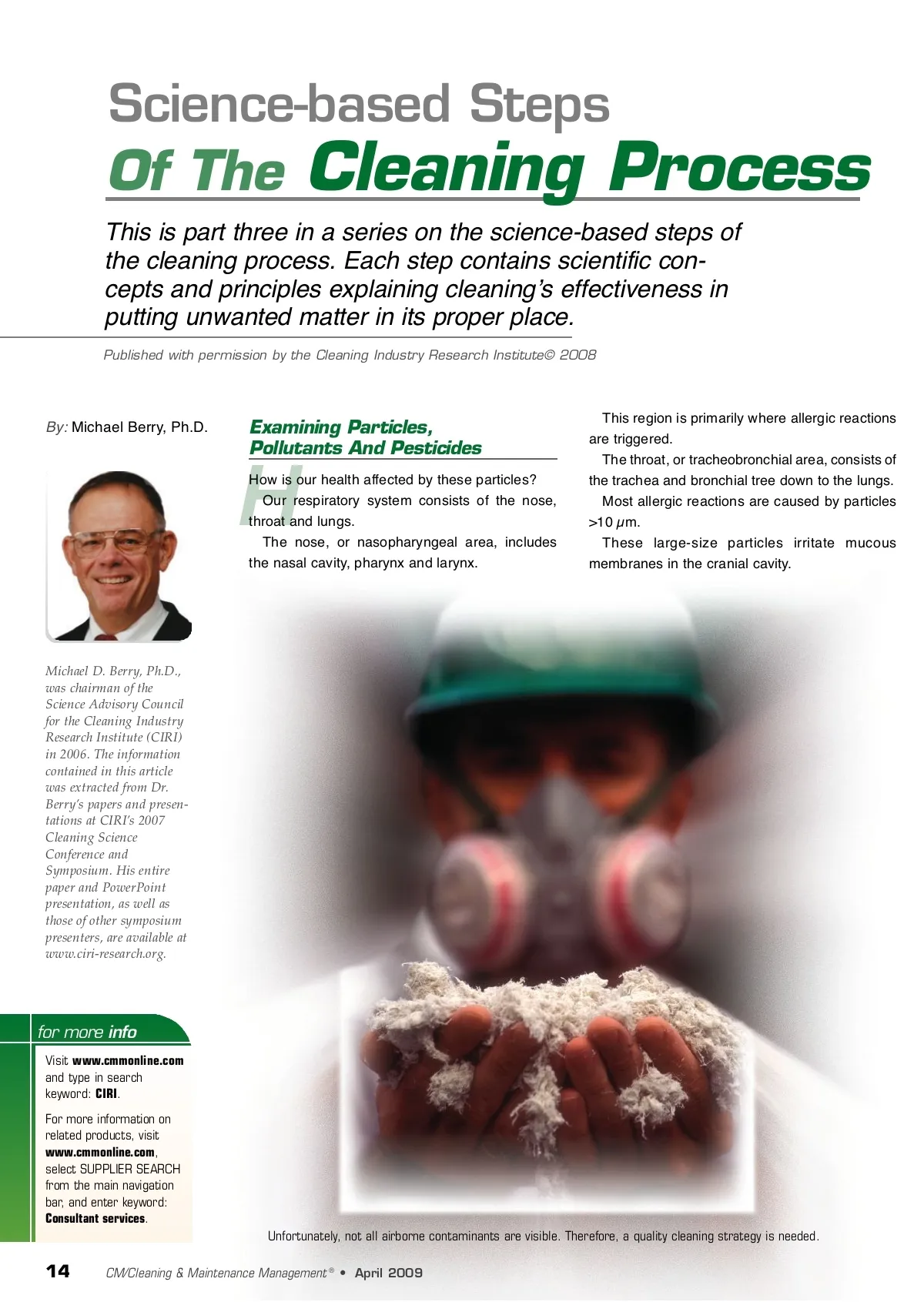
The pulmonary systemʼs natural defense mechanism usually clears them from the lungs. The lungsʼ first line of defense is the epiglottis, a flap of tissue covering the tra-chea. It opens to allow breathing and closes to block organisms and matter in the mouth and throat from entering the respira-tory tract. Lungs are adversely affected in several ways. Air passages can be irritated, airways obstructed and cell lining damaged. Cell damage eventually can lead to tumors, increased fluids (swelling or edema) and decreased respiratory capacity. Many irritating volatile organic com-pounds (VOCs) in a high enough concen-tration produce these effects. A healthy body is fairly efficient at expelling particles in the 2.5-10 µm range. Organisms and particles that get past the epiglottis can become trapped in the mucous coating the lungsʼ trachea and bronchial tubes. Cilia — small, hair-like cells — move the material trapped by the mucus back to the mouth. The body triggers the diaphragm muscle to contract. The resulting cough expels pollutants in the mucus to the mouth. Smaller particles (<2.5 µm) move deeper into the lungs. If not cleared naturally, the lungs can be scarred or the particles remain trapped, creating conditions for diseases like cancer. Scarred lung tissue cannot exchange gases. Lung function also is weakened. This weakness is serious in infants. Their lungs are not fully developed and once damaged they stop developing. It also can be serious for the elderly, whose lung function has decreased naturally. If small particles or biological agents reach the alveoli deep in the lungs, there is one final chance for removal. Macrophages — the immune systemʼs scavenger cells — surround them. The lymphatic system then flushes them from the lungs. If the pollutant is not cleared it stays in the lungs or passes into the blood stream as a gas and is delivered to the organs. Particles in the <2.5 µm range are regu-lated by ambient air standards. This reduces their transportation and industrial sourcesʼ emissions so a higher level of outdoor air quality is achieved. Generally, these small particles are PICs and not related to indoor allergic reactions. When controlled outdoors the indoor air quality is not adversely impacted. Very small particles, especially in the <1 µm range, are a large component of atmos-pheric dust. Particles that become part of the indoor air take time to settle out, if they even settle. If particles settle or become trapped (e.g., on carpet), they are difficult to remove and re-entrain. Circle Product Information no. 204 on page 34 www.cmmonline.com 15
CMM – Archives Apr 2009: 15