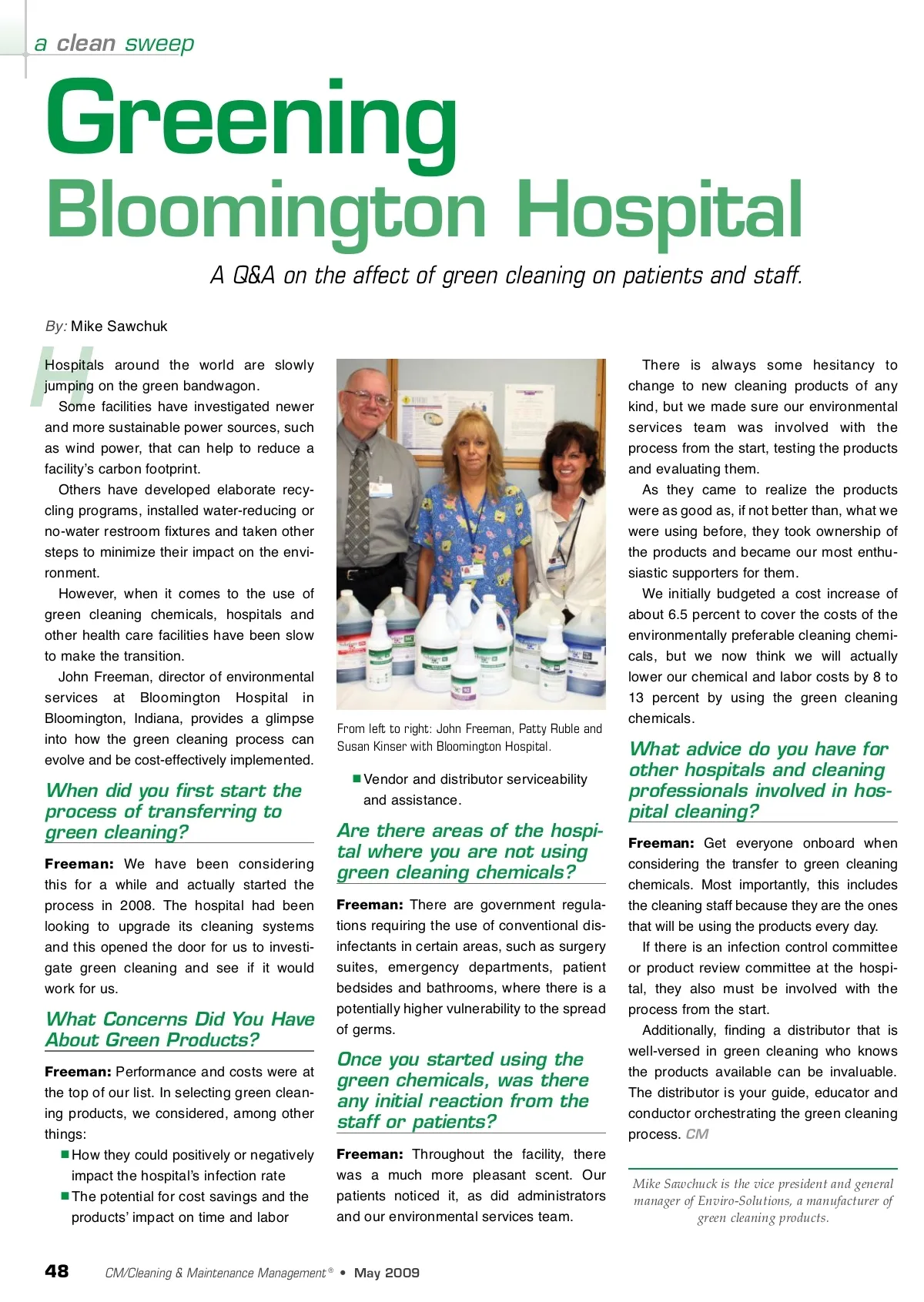
a clean sweep Greening Bloomington Hospital A Q&A on the affect of green cleaning on patients and staff. By: Mike Sawchuk H Hospitals around the world are slowly jumping on the green bandwagon. Some facilities have investigated newer and more sustainable power sources, such as wind power, that can help to reduce a facilityʼs carbon footprint. Others have developed elaborate recy-cling programs, installed water-reducing or no-water restroom fixtures and taken other steps to minimize their impact on the envi-ronment. However, when it comes to the use of green cleaning chemicals, hospitals and other health care facilities have been slow to make the transition. John Freeman, director of environmental services at Bloomington Hospital in Bloomington, Indiana, provides a glimpse into how the green cleaning process can evolve and be cost-effectively implemented. From left to right: John Freeman, Patty Ruble and Susan Kinser with Bloomington Hospital. There is always some hesitancy to change to new cleaning products of any kind, but we made sure our environmental services team was involved with the process from the start, testing the products and evaluating them. As they came to realize the products were as good as, if not better than, what we were using before, they took ownership of the products and became our most enthu-siastic supporters for them. We initially budgeted a cost increase of about 6.5 percent to cover the costs of the environmentally preferable cleaning chemi-cals, but we now think we will actually lower our chemical and labor costs by 8 to 13 percent by using the green cleaning chemicals. When did you first start the process of transferring to green cleaning? Freeman: We have been considering this for a while and actually started the process in 2008. The hospital had been looking to upgrade its cleaning systems and this opened the door for us to investi-gate green cleaning and see if it would work for us. Vendor and distributor serviceability and assistance. What advice do you have for other hospitals and cleaning professionals involved in hos-pital cleaning? Freeman: Get everyone onboard when considering the transfer to green cleaning chemicals. Most importantly, this includes the cleaning staff because they are the ones that will be using the products every day. If there is an infection control committee or product review committee at the hospi-tal, they also must be involved with the process from the start. Additionally, finding a distributor that is well-versed in green cleaning who knows the products available can be invaluable. The distributor is your guide, educator and conductor orchestrating the green cleaning process. CM Are there areas of the hospi-tal where you are not using green cleaning chemicals? Freeman: There are government regula-tions requiring the use of conventional dis-infectants in certain areas, such as surgery suites, emergency departments, patient bedsides and bathrooms, where there is a potentially higher vulnerability to the spread of germs. What Concerns Did You Have About Green Products? Freeman: Performance and costs were at the top of our list. In selecting green clean-ing products, we considered, among other things: How they could positively or negatively impact the hospitalʼs infection rate The potential for cost savings and the productsʼ impact on time and labor Once you started using the green chemicals, was there any initial reaction from the staff or patients? Freeman: Throughout the facility, there was a much more pleasant scent. Our patients noticed it, as did administrators and our environmental services team. Mike Sawchuck is the vice president and general manager of Enviro-Solutions, a manufacturer of green cleaning products. 48 CM/Cleaning & Maintenance Management ® • May 2009
CMM – Archives May 2009: 48