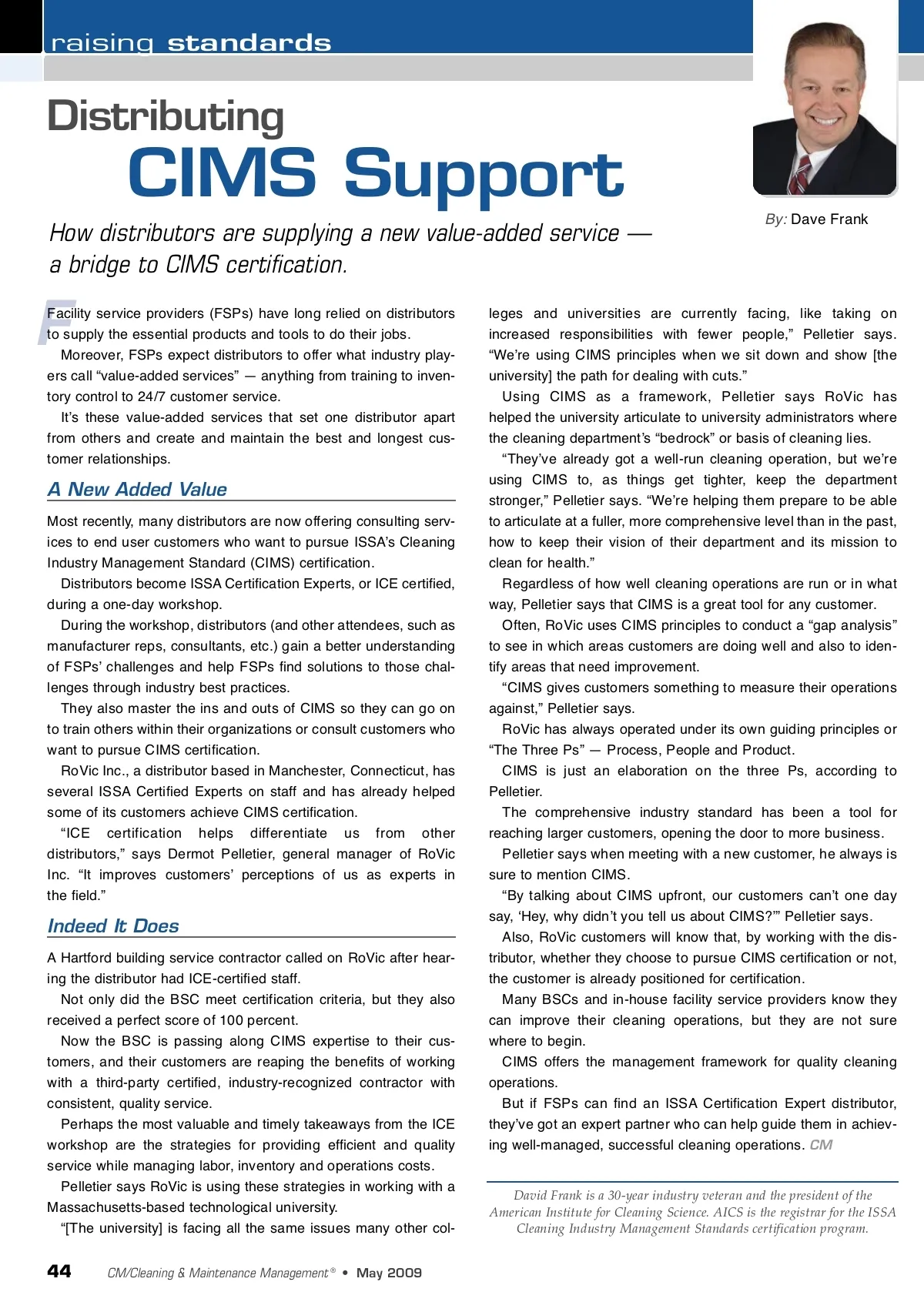
raising standards Distributing CIMS Support How distributors are supplying a new value-added service — a bridge to CIMS certification. By: Dave Frank F Facility service providers (FSPs) have long relied on distributors to supply the essential products and tools to do their jobs. Moreover, FSPs expect distributors to offer what industry play-ers call “value-added services” — anything from training to inven-tory control to 24/7 customer service. Itʼs these value-added services that set one distributor apart from others and create and maintain the best and longest cus-tomer relationships. A New Added Value Most recently, many distributors are now offering consulting serv-ices to end user customers who want to pursue ISSAʼs Cleaning Industry Management Standard (CIMS) certification. Distributors become ISSA Certification Experts, or ICE certified, during a one-day workshop. During the workshop, distributors (and other attendees, such as manufacturer reps, consultants, etc.) gain a better understanding of FSPsʼ challenges and help FSPs find solutions to those chal-lenges through industry best practices. They also master the ins and outs of CIMS so they can go on to train others within their organizations or consult customers who want to pursue CIMS certification. RoVic Inc., a distributor based in Manchester, Connecticut, has several ISSA Certified Experts on staff and has already helped some of its customers achieve CIMS certification. “ICE certification helps differentiate us from other distributors,” says Dermot Pelletier, general manager of RoVic Inc. “It improves customersʼ perceptions of us as experts in the field.” Indeed It Does A Hartford building service contractor called on RoVic after hear-ing the distributor had ICE-certified staff. Not only did the BSC meet certification criteria, but they also received a perfect score of 100 percent. Now the BSC is passing along CIMS expertise to their cus-tomers, and their customers are reaping the benefits of working with a third-party certified, industry-recognized contractor with consistent, quality service. Perhaps the most valuable and timely takeaways from the ICE workshop are the strategies for providing efficient and quality service while managing labor, inventory and operations costs. Pelletier says RoVic is using these strategies in working with a Massachusetts-based technological university. “[The university] is facing all the same issues many other col-leges and universities are currently facing, like taking on increased responsibilities with fewer people,” Pelletier says. “Weʼre using CIMS principles when we sit down and show [the university] the path for dealing with cuts.” Using CIMS as a framework, Pelletier says RoVic has helped the university articulate to university administrators where the cleaning departmentʼs “bedrock” or basis of cleaning lies. “Theyʼve already got a well-run cleaning operation, but weʼre using CIMS to, as things get tighter, keep the department stronger,” Pelletier says. “Weʼre helping them prepare to be able to articulate at a fuller, more comprehensive level than in the past, how to keep their vision of their department and its mission to clean for health.” Regardless of how well cleaning operations are run or in what way, Pelletier says that CIMS is a great tool for any customer. Often, RoVic uses CIMS principles to conduct a “gap analysis” to see in which areas customers are doing well and also to iden-tify areas that need improvement. “CIMS gives customers something to measure their operations against,” Pelletier says. RoVic has always operated under its own guiding principles or “The Three Ps” — Process, People and Product. CIMS is just an elaboration on the three Ps, according to Pelletier. The comprehensive industry standard has been a tool for reaching larger customers, opening the door to more business. Pelletier says when meeting with a new customer, he always is sure to mention CIMS. “By talking about CIMS upfront, our customers canʼt one day say, ʻHey, why didnʼt you tell us about CIMS?ʼ” Pelletier says. Also, RoVic customers will know that, by working with the dis-tributor, whether they choose to pursue CIMS certification or not, the customer is already positioned for certification. Many BSCs and in-house facility service providers know they can improve their cleaning operations, but they are not sure where to begin. CIMS offers the management framework for quality cleaning operations. But if FSPs can find an ISSA Certification Expert distributor, theyʼve got an expert partner who can help guide them in achiev-ing well-managed, successful cleaning operations. CM David Frank is a 30-year industry veteran and the president of the American Institute for Cleaning Science. AICS is the registrar for the ISSA Cleaning Industry Management Standards certification program. 44 CM/Cleaning & Maintenance Management ® • May 2009
CMM – Archives May 2009: 44