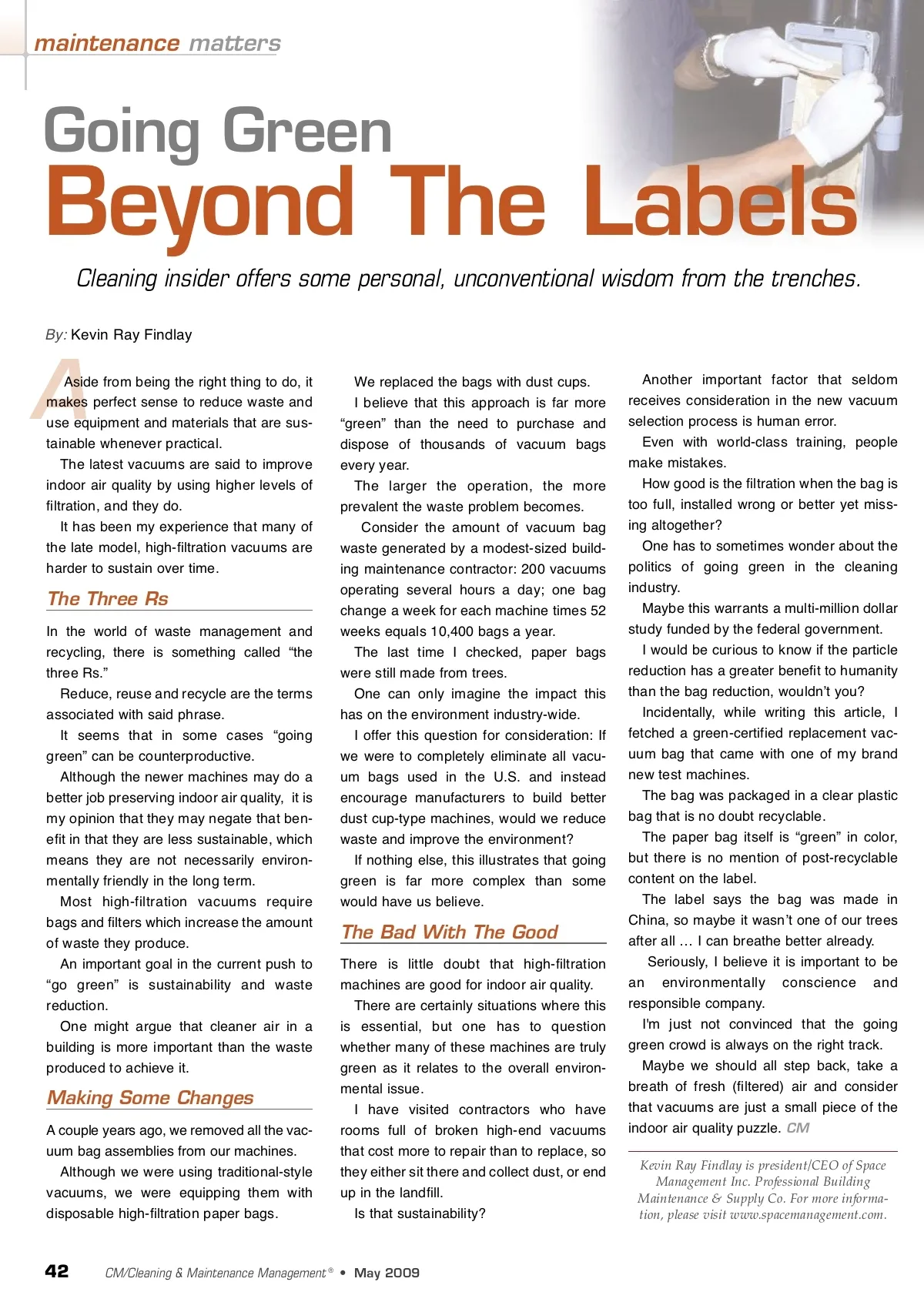
maintenance matters Going Green Beyond The Labels Cleaning insider offers some personal, unconventional wisdom from the trenches. By: Kevin Ray Findlay A Aside from being the right thing to do, it makes perfect sense to reduce waste and use equipment and materials that are sus-tainable whenever practical. The latest vacuums are said to improve indoor air quality by using higher levels of filtration, and they do. It has been my experience that many of the late model, high-filtration vacuums are harder to sustain over time. The Three Rs In the world of waste management and recycling, there is something called “the three Rs.” Reduce, reuse and recycle are the terms associated with said phrase. It seems that in some cases “going green” can be counterproductive. Although the newer machines may do a better job preserving indoor air quality, it is my opinion that they may negate that ben-efit in that they are less sustainable, which means they are not necessarily environ-mentally friendly in the long term. Most high-filtration vacuums require bags and filters which increase the amount of waste they produce. An important goal in the current push to “go green” is sustainability and waste reduction. One might argue that cleaner air in a building is more important than the waste produced to achieve it. We replaced the bags with dust cups. I believe that this approach is far more “green” than the need to purchase and dispose of thousands of vacuum bags every year. The larger the operation, the more prevalent the waste problem becomes. Consider the amount of vacuum bag waste generated by a modest-sized build-ing maintenance contractor: 200 vacuums operating several hours a day; one bag change a week for each machine times 52 weeks equals 10,400 bags a year. The last time I checked, paper bags were still made from trees. One can only imagine the impact this has on the environment industry-wide. I offer this question for consideration: If we were to completely eliminate all vacu-um bags used in the U.S. and instead encourage manufacturers to build better dust cup-type machines, would we reduce waste and improve the environment? If nothing else, this illustrates that going green is far more complex than some would have us believe. The Bad With The Good There is little doubt that high-filtration machines are good for indoor air quality. There are certainly situations where this is essential, but one has to question whether many of these machines are truly green as it relates to the overall environ-mental issue. I have visited contractors who have rooms full of broken high-end vacuums that cost more to repair than to replace, so they either sit there and collect dust, or end up in the landfill. Is that sustainability? Making Some Changes A couple years ago, we removed all the vac-uum bag assemblies from our machines. Although we were using traditional-style vacuums, we were equipping them with disposable high-filtration paper bags. Another important factor that seldom receives consideration in the new vacuum selection process is human error. Even with world-class training, people make mistakes. How good is the filtration when the bag is too full, installed wrong or better yet miss-ing altogether? One has to sometimes wonder about the politics of going green in the cleaning industry. Maybe this warrants a multi-million dollar study funded by the federal government. I would be curious to know if the particle reduction has a greater benefit to humanity than the bag reduction, wouldnʼt you? Incidentally, while writing this article, I fetched a green-certified replacement vac-uum bag that came with one of my brand new test machines. The bag was packaged in a clear plastic bag that is no doubt recyclable. The paper bag itself is “green” in color, but there is no mention of post-recyclable content on the label. The label says the bag was made in China, so maybe it wasnʼt one of our trees after all … I can breathe better already. Seriously, I believe it is important to be an environmentally conscience and responsible company. I'm just not convinced that the going green crowd is always on the right track. Maybe we should all step back, take a breath of fresh (filtered) air and consider that vacuums are just a small piece of the indoor air quality puzzle. CM Kevin Ray Findlay is president/CEO of Space Management Inc. Professional Building Maintenance & Supply Co. For more informa-tion, please visit www.spacemanagement.com. 42 CM/Cleaning & Maintenance Management ® • May 2009
CMM – Archives May 2009: 42