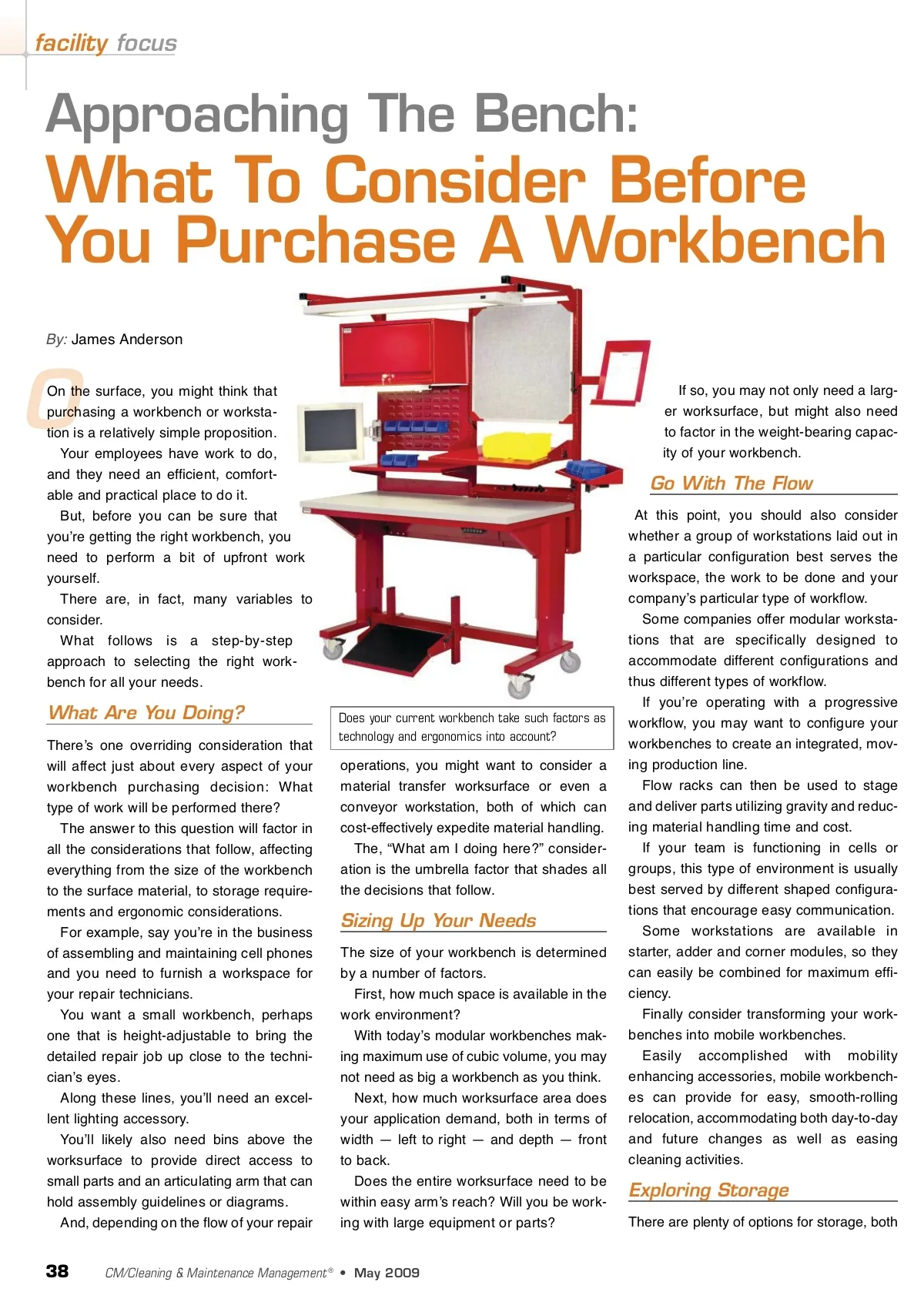
facility focus Approaching The Bench: What To Consider Before You Purchase A Workbench By: James Anderson O On the surface, you might think that purchasing a workbench or worksta-tion is a relatively simple proposition. Your employees have work to do, and they need an efficient, comfort-able and practical place to do it. But, before you can be sure that youʼre getting the right workbench, you need to perform a bit of upfront work yourself. There are, in fact, many variables to consider. What follows is a step-by-step approach to selecting the right work-bench for all your needs. Does your current workbench take such factors as technology and ergonomics into account? If so, you may not only need a larg-er worksurface, but might also need to factor in the weight-bearing capac-ity of your workbench. Go With The Flow At this point, you should also consider whether a group of workstations laid out in a particular configuration best serves the workspace, the work to be done and your companyʼs particular type of workflow. Some companies offer modular worksta-tions that are specifically designed to accommodate different configurations and thus different types of workflow. If youʼre operating with a progressive workflow, you may want to configure your workbenches to create an integrated, mov-ing production line. Flow racks can then be used to stage and deliver parts utilizing gravity and reduc-ing material handling time and cost. If your team is functioning in cells or groups, this type of environment is usually best served by different shaped configura-tions that encourage easy communication. Some workstations are available in starter, adder and corner modules, so they can easily be combined for maximum effi-ciency. Finally consider transforming your work-benches into mobile workbenches. Easily accomplished with mobility enhancing accessories, mobile workbench-es can provide for easy, smooth-rolling relocation, accommodating both day-to-day and future changes as well as easing cleaning activities. What Are You Doing? Thereʼs one overriding consideration that will affect just about every aspect of your workbench purchasing decision: What type of work will be performed there? The answer to this question will factor in all the considerations that follow, affecting everything from the size of the workbench to the surface material, to storage require-ments and ergonomic considerations. For example, say youʼre in the business of assembling and maintaining cell phones and you need to furnish a workspace for your repair technicians. You want a small workbench, perhaps one that is height-adjustable to bring the detailed repair job up close to the techni-cianʼs eyes. Along these lines, youʼll need an excel-lent lighting accessory. Youʼll likely also need bins above the worksurface to provide direct access to small parts and an articulating arm that can hold assembly guidelines or diagrams. And, depending on the flow of your repair operations, you might want to consider a material transfer worksurface or even a conveyor workstation, both of which can cost-effectively expedite material handling. The, “What am I doing here?” consider-ation is the umbrella factor that shades all the decisions that follow. Sizing Up Your Needs The size of your workbench is determined by a number of factors. First, how much space is available in the work environment? With todayʼs modular workbenches mak-ing maximum use of cubic volume, you may not need as big a workbench as you think. Next, how much worksurface area does your application demand, both in terms of width — left to right — and depth — front to back. Does the entire worksurface need to be within easy armʼs reach? Will you be work-ing with large equipment or parts? Exploring Storage There are plenty of options for storage, both 38 CM/Cleaning & Maintenance Management ® • May 2009
CMM – Archives May 2009: 38