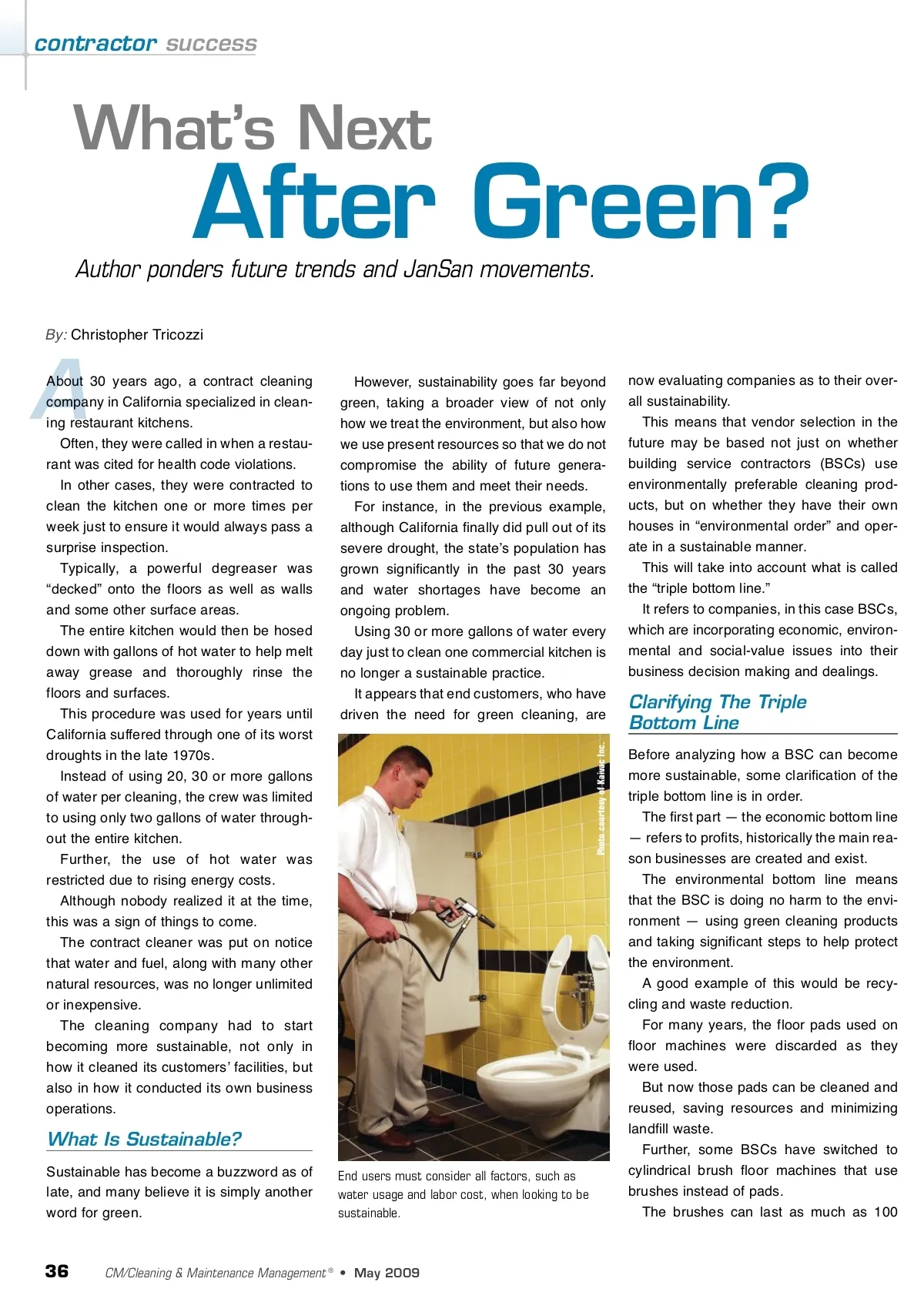
contractor success What’s Next Author ponders future trends and JanSan movements. By: Christopher Tricozzi After Green? However, sustainability goes far beyond green, taking a broader view of not only how we treat the environment, but also how we use present resources so that we do not compromise the ability of future genera-tions to use them and meet their needs. For instance, in the previous example, although California finally did pull out of its severe drought, the stateʼs population has grown significantly in the past 30 years and water shortages have become an ongoing problem. Using 30 or more gallons of water every day just to clean one commercial kitchen is no longer a sustainable practice. It appears that end customers, who have driven the need for green cleaning, are Photo courtesy of Kaivac Inc. A About 30 years ago, a contract cleaning company in California specialized in clean-ing restaurant kitchens. Often, they were called in when a restau-rant was cited for health code violations. In other cases, they were contracted to clean the kitchen one or more times per week just to ensure it would always pass a surprise inspection. Typically, a powerful degreaser was “decked” onto the floors as well as walls and some other surface areas. The entire kitchen would then be hosed down with gallons of hot water to help melt away grease and thoroughly rinse the floors and surfaces. This procedure was used for years until California suffered through one of its worst droughts in the late 1970s. Instead of using 20, 30 or more gallons of water per cleaning, the crew was limited to using only two gallons of water through-out the entire kitchen. Further, the use of hot water was restricted due to rising energy costs. Although nobody realized it at the time, this was a sign of things to come. The contract cleaner was put on notice that water and fuel, along with many other natural resources, was no longer unlimited or inexpensive. The cleaning company had to start becoming more sustainable, not only in how it cleaned its customersʼ facilities, but also in how it conducted its own business operations. now evaluating companies as to their over-all sustainability. This means that vendor selection in the future may be based not just on whether building service contractors (BSCs) use environmentally preferable cleaning prod-ucts, but on whether they have their own houses in “environmental order” and oper-ate in a sustainable manner. This will take into account what is called the “triple bottom line.” It refers to companies, in this case BSCs, which are incorporating economic, environ-mental and social-value issues into their business decision making and dealings. Clarifying The Triple Bottom Line Before analyzing how a BSC can become more sustainable, some clarification of the triple bottom line is in order. The first part — the economic bottom line — refers to profits, historically the main rea-son businesses are created and exist. The environmental bottom line means that the BSC is doing no harm to the envi-ronment — using green cleaning products and taking significant steps to help protect the environment. A good example of this would be recy-cling and waste reduction. For many years, the floor pads used on floor machines were discarded as they were used. But now those pads can be cleaned and reused, saving resources and minimizing landfill waste. Further, some BSCs have switched to cylindrical brush floor machines that use brushes instead of pads. The brushes can last as much as 100 What Is Sustainable? Sustainable has become a buzzword as of late, and many believe it is simply another word for green. End users must consider all factors, such as water usage and labor cost, when looking to be sustainable. 36 CM/Cleaning & Maintenance Management ® • May 2009
CMM – Archives May 2009: 36