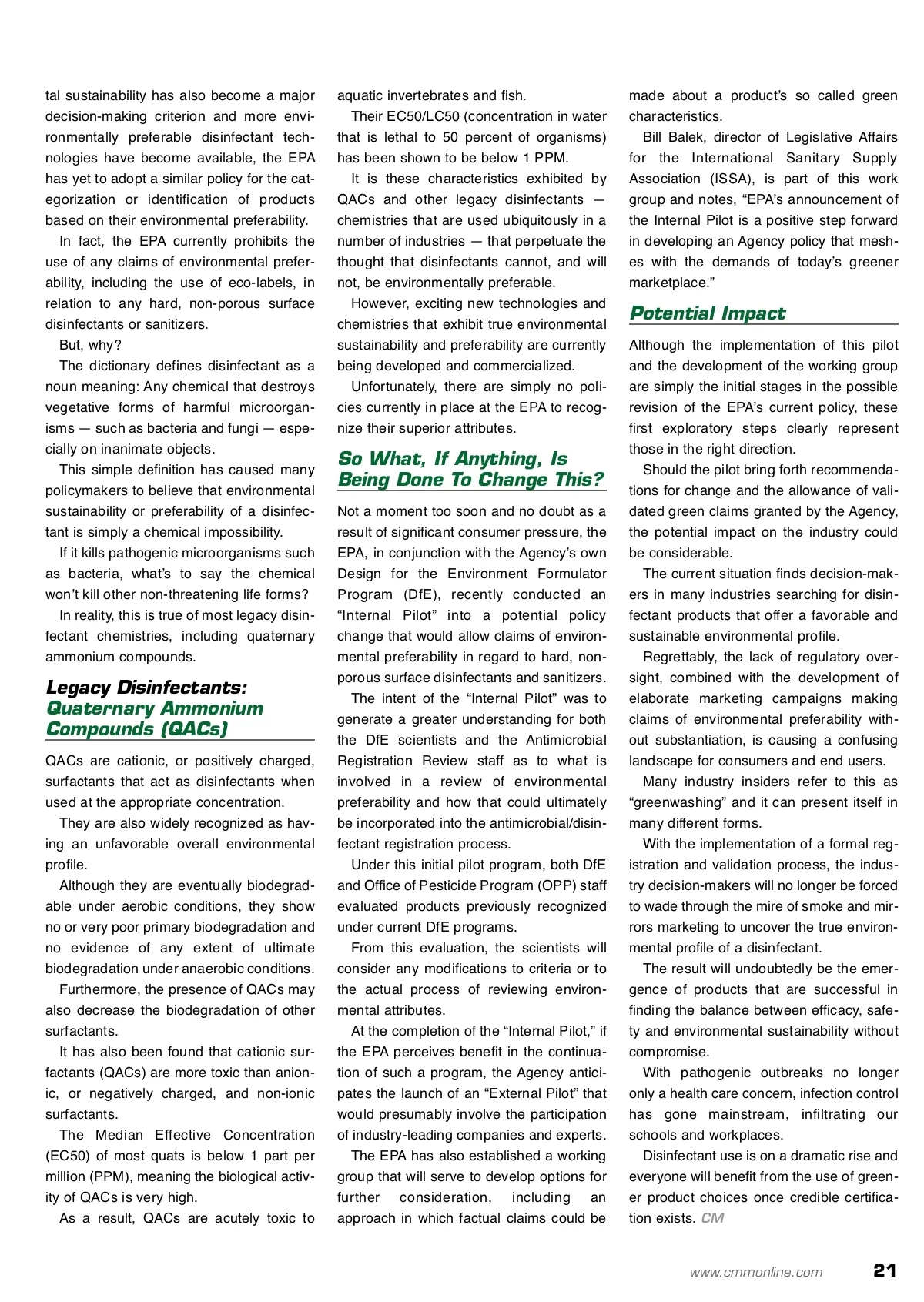
A History Lesson In Green Disinfection Author visits the past to lay the foundation for the future. By: Lee Nesbitt Photo courtesy of Kimberly-Clark Professional A Lee Nesbitt is the manag-er of professional and technical services for Virox Technologies Inc., a Canadian research and development company which developed and currently manufacture the globally patented Accelerated Hydrogen Peroxide ® (AHP ® ) tech-nology for cleaning, disin-fection and sterilization. Although environmentalism and conservatism can be traced back over a century, the modern green movement, as we know it today, truly took rise in the late 1960s and early 1970s. Rachel Carsonʼs bestselling book, Silent Spring , with its exposé on toxic chemicals in con-sumer products, set off a domino effect that saw, amongst other things, the founding of the Environmental Protection Agency (EPA) in 1970. In the decades since, the green movement has picked up pace, reaching fever pitch in recent years, highlighted by the success of “An Inconvenient Truth”. The result: Nearly no industry has been left untouched or unaffected, including that of chemi-cal disinfectants. An industry and its products — which by their very nature were thought impossible to be made environmentally preferable — are forging ahead with new technologies and asking policymakers to follow suit. Concerns about using harmful disinfectants may be soon wiped away with greener solutions. History The EPA was established to consolidate in one agency, a variety of federal research, monitoring, standard-setting and enforcement activities to ensure environmental protection. Throughout its history, the EPA has established guidelines for the regulation of a variety of indus-tries, including auto emissions, toxic substances and water quality. The regulation of chemical disinfectants, some-times referred to as antimicrobials, also came under their purview in 1972 when the responsibil-ity for the Federal Insecticide, Fungicide and Rodenticide Act (FIFRA) was transferred from the U.S. Department of Agriculture to the EPA. Under this legislative act, the EPA is responsi-ble for validating the effectiveness, appropriate dosage and potential hazards of any product for more info Visit www.cmmonline.com and type in search keyword: Disinfection . For more information on related products, visit www.cmmonline.com , select SUPPLIER SEARCH from the main navigation bar, and enter keyword: Disinfectants . intended for use in the U.S. as a hard, non-porous surface disinfectant or sanitizer. Their strict regulation of the content of antimi-crobial product labels is intended to clearly dis-play the productʼs validated attributes and ulti-mately to prevent unconfirmed statements of effi-cacy, safety, etc. As part of this review and approval process, the EPA has already taken further steps to more easi-ly identify products with more favorable personal health and safety profiles. They use a distinct set of parameters to clearly categorize products based on their individual safe-ty profile. Each category represents a certain level of safe-ty; for example, Category IV represents the safest level and identifies those products that require no precautionary labelling. Unfortunately, despite the fact that environmen-20 CM/Cleaning & Maintenance Management ® • May 2009
CMM – Archives May 2009: 20