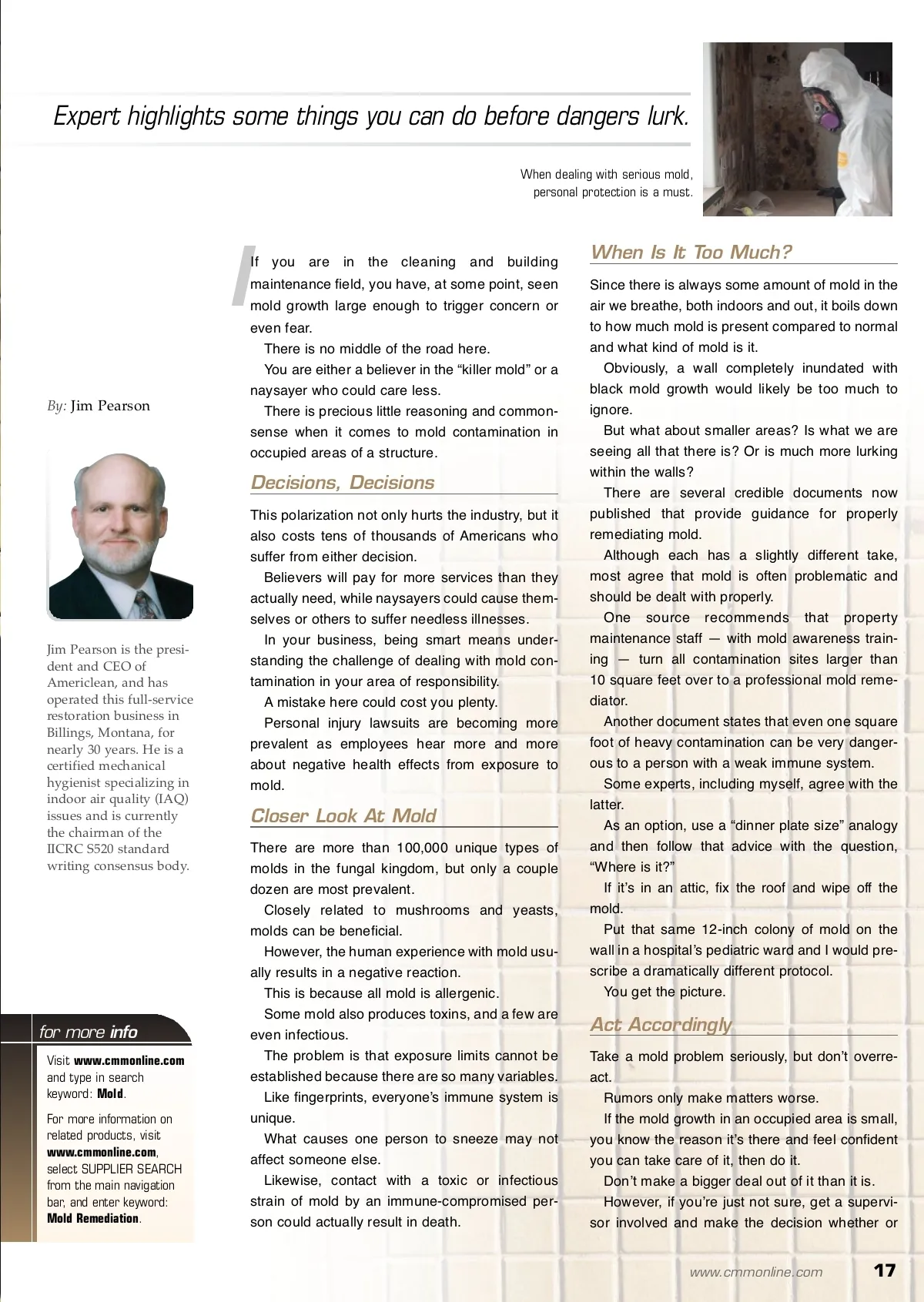
Expert highlights some things you can do before dangers lurk. When dealing with serious mold, personal protection is a must. I By: Jim Pearson If you are in the cleaning and building maintenance field, you have, at some point, seen mold growth large enough to trigger concern or even fear. There is no middle of the road here. You are either a believer in the “killer mold” or a naysayer who could care less. There is precious little reasoning and common-sense when it comes to mold contamination in occupied areas of a structure. When Is It Too Much? Since there is always some amount of mold in the air we breathe, both indoors and out, it boils down to how much mold is present compared to normal and what kind of mold is it. Obviously, a wall completely inundated with black mold growth would likely be too much to ignore. But what about smaller areas? Is what we are seeing all that there is? Or is much more lurking within the walls? There are several credible documents now published that provide guidance for properly remediating mold. Although each has a slightly different take, most agree that mold is often problematic and should be dealt with properly. One source recommends that property maintenance staff — with mold awareness train-ing — turn all contamination sites larger than 10 square feet over to a professional mold reme-diator. Another document states that even one square foot of heavy contamination can be very danger-ous to a person with a weak immune system. Some experts, including myself, agree with the latter. As an option, use a “dinner plate size” analogy and then follow that advice with the question, “Where is it?” If itʼs in an attic, fix the roof and wipe off the mold. Put that same 12-inch colony of mold on the wall in a hospitalʼs pediatric ward and I would pre-scribe a dramatically different protocol. You get the picture. Decisions, Decisions This polarization not only hurts the industry, but it also costs tens of thousands of Americans who suffer from either decision. Believers will pay for more services than they actually need, while naysayers could cause them-selves or others to suffer needless illnesses. In your business, being smart means under-standing the challenge of dealing with mold con-tamination in your area of responsibility. A mistake here could cost you plenty. Personal injury lawsuits are becoming more prevalent as employees hear more and more about negative health effects from exposure to mold. Jim Pearson is the presi-dent and CEO of Americlean, and has operated this full-service restoration business in Billings, Montana, for nearly 30 years. He is a certified mechanical hygienist specializing in indoor air quality (IAQ) issues and is currently the chairman of the IICRC S520 standard writing consensus body. Closer Look At Mold There are more than 100,000 unique types of molds in the fungal kingdom, but only a couple dozen are most prevalent. Closely related to mushrooms and yeasts, molds can be beneficial. However, the human experience with mold usu-ally results in a negative reaction. This is because all mold is allergenic. Some mold also produces toxins, and a few are even infectious. The problem is that exposure limits cannot be established because there are so many variables. Like fingerprints, everyoneʼs immune system is unique. What causes one person to sneeze may not affect someone else. Likewise, contact with a toxic or infectious strain of mold by an immune-compromised per-son could actually result in death. for more info Visit www.cmmonline.com and type in search keyword: Mold . For more information on related products, visit www.cmmonline.com , select SUPPLIER SEARCH from the main navigation bar, and enter keyword: Mold Remediation . Act Accordingly Take a mold problem seriously, but donʼt overre-act. Rumors only make matters worse. If the mold growth in an occupied area is small, you know the reason itʼs there and feel confident you can take care of it, then do it. Donʼt make a bigger deal out of it than it is. However, if youʼre just not sure, get a supervi-sor involved and make the decision whether or www.cmmonline.com 17
CMM – Archives May 2009: 17