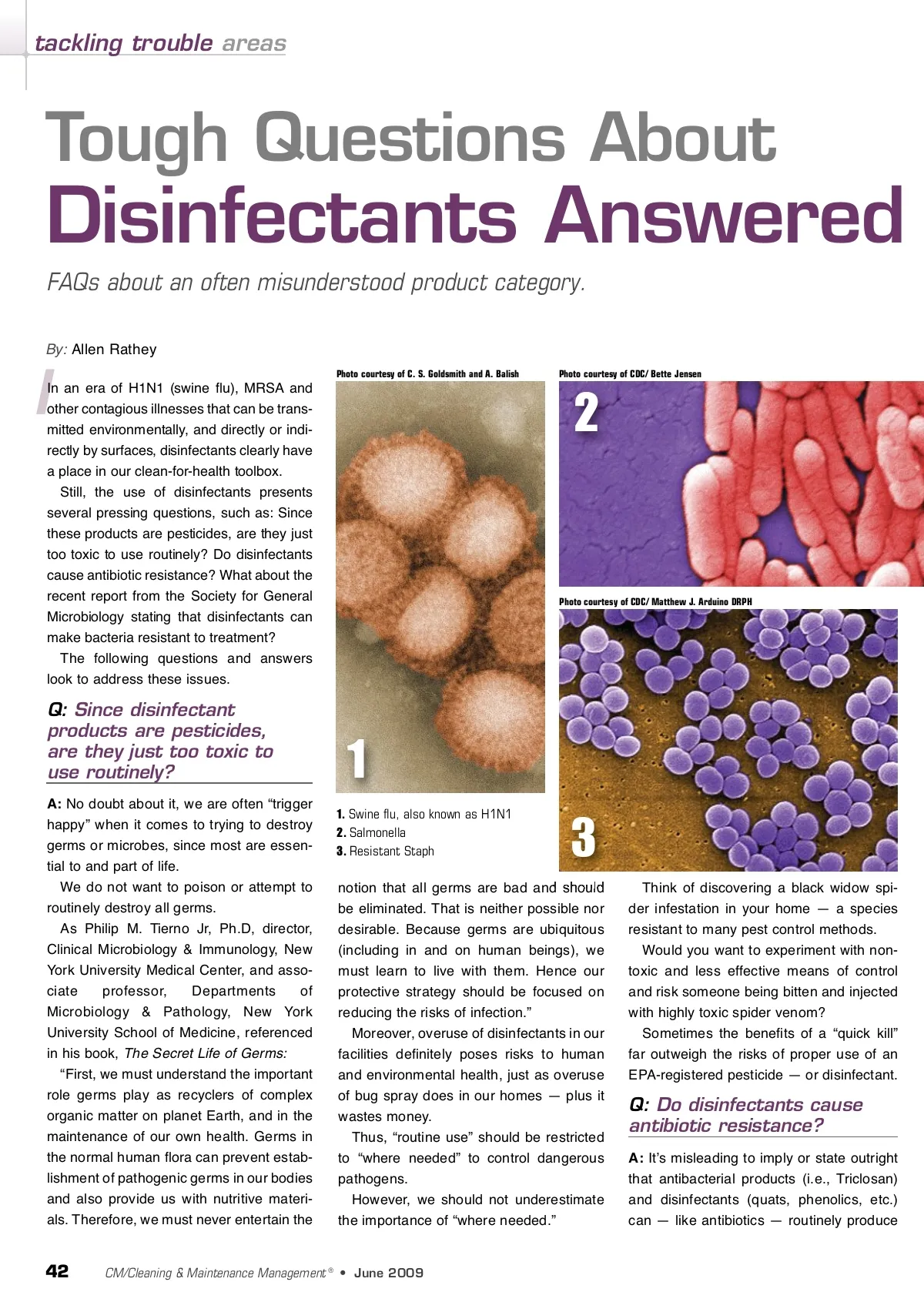
tackling trouble areas Tough Questions About Disinfectants Answered FAQs about an often misunderstood product category. By: Allen Rathey I Photo courtesy of C. S. Goldsmith and A. Balish Photo courtesy of CDC/ Bette Jensen In an era of H1N1 (swine flu), MRSA and other contagious illnesses that can be trans-mitted environmentally, and directly or indi-rectly by surfaces, disinfectants clearly have a place in our clean-for-health toolbox. Still, the use of disinfectants presents several pressing questions, such as: Since these products are pesticides, are they just too toxic to use routinely? Do disinfectants cause antibiotic resistance? What about the recent report from the Society for General Microbiology stating that disinfectants can make bacteria resistant to treatment? The following questions and answers look to address these issues. 2 Photo courtesy of CDC/ Matthew J. Arduino DRPH Q: Since disinfectant products are pesticides, are they just too toxic to use routinely? A: No doubt about it, we are often “trigger happy” when it comes to trying to destroy germs or microbes, since most are essen-tial to and part of life. We do not want to poison or attempt to routinely destroy all germs. As Philip M. Tierno Jr, Ph.D, director, Clinical Microbiology & Immunology, New York University Medical Center, and asso-ciate professor, Departments of Microbiology & Pathology, New York University School of Medicine, referenced in his book, The Secret Life of Germs: “First, we must understand the important role germs play as recyclers of complex organic matter on planet Earth, and in the maintenance of our own health. Germs in the normal human flora can prevent estab-lishment of pathogenic germs in our bodies and also provide us with nutritive materi-als. Therefore, we must never entertain the 1 1. Swine flu, also known as H1N1 2. Salmonella 3. Resistant Staph 3 Think of discovering a black widow spi-der infestation in your home — a species resistant to many pest control methods. Would you want to experiment with non-toxic and less effective means of control and risk someone being bitten and injected with highly toxic spider venom? Sometimes the benefits of a “quick kill” far outweigh the risks of proper use of an EPA-registered pesticide — or disinfectant. notion that all germs are bad and should be eliminated. That is neither possible nor desirable. Because germs are ubiquitous (including in and on human beings), we must learn to live with them. Hence our protective strategy should be focused on reducing the risks of infection.” Moreover, overuse of disinfectants in our facilities definitely poses risks to human and environmental health, just as overuse of bug spray does in our homes — plus it wastes money. Thus, “routine use” should be restricted to “where needed” to control dangerous pathogens. However, we should not underestimate the importance of “where needed.” Q: Do disinfectants cause antibiotic resistance? A: Itʼs misleading to imply or state outright that antibacterial products (i.e., Triclosan) and disinfectants (quats, phenolics, etc.) can — like antibiotics — routinely produce 42 CM/Cleaning & Maintenance Management ® • June 2009
CMM – Archives Jun 2009: 42