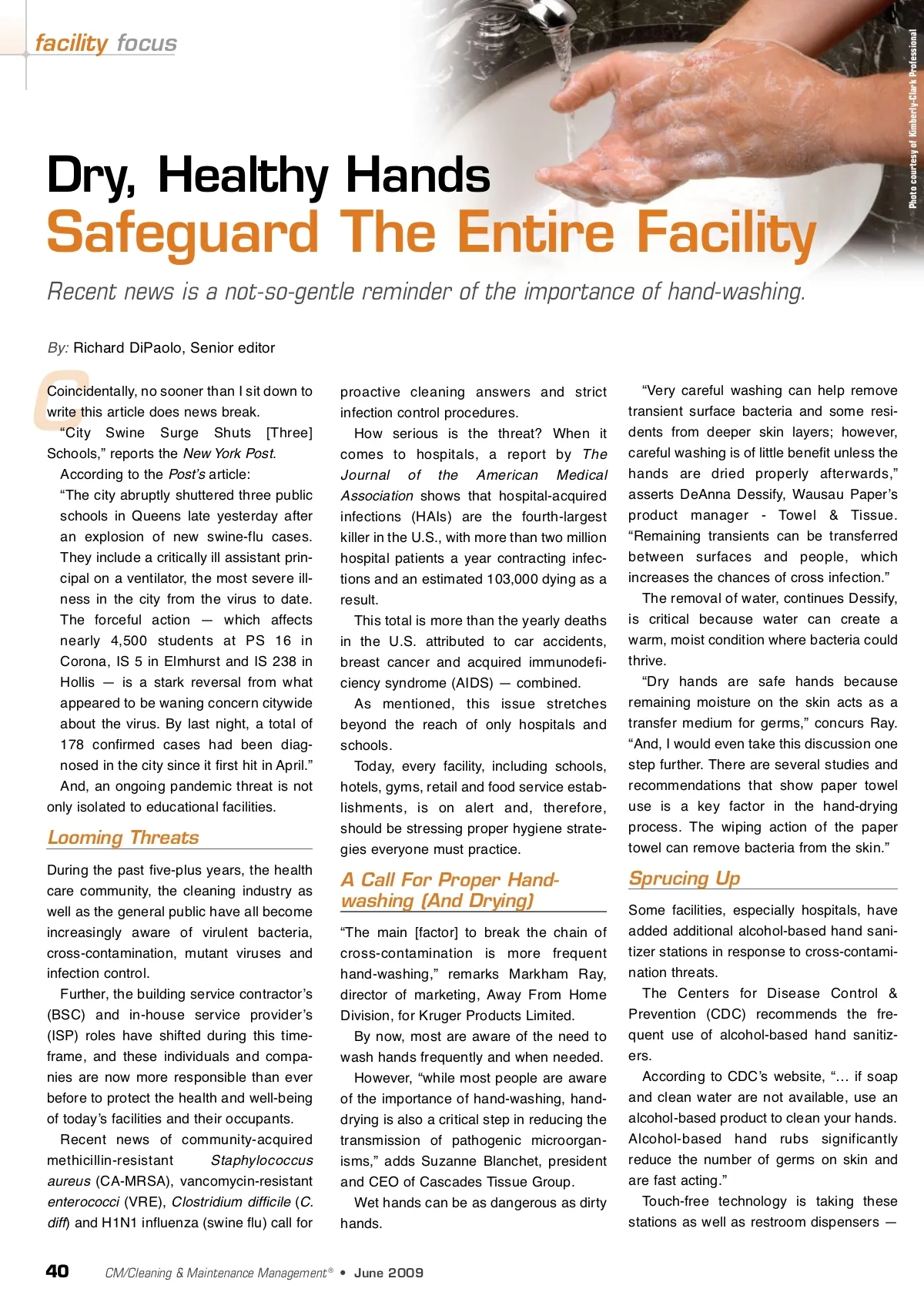
facility focus Dry, Healthy Hands Safeguard The Entire Facility Recent news is a not-so-gentle reminder of the importance of hand-washing. By: Richard DiPaolo, Senior editor C Coincidentally, no sooner than I sit down to write this article does news break. “City Swine Surge Shuts [Three] Schools,” reports the New York Post . According to the Post’s article: “The city abruptly shuttered three public schools in Queens late yesterday after an explosion of new swine-flu cases. They include a critically ill assistant prin-cipal on a ventilator, the most severe ill-ness in the city from the virus to date. The forceful action — which affects nearly 4,500 students at PS 16 in Corona, IS 5 in Elmhurst and IS 238 in Hollis — is a stark reversal from what appeared to be waning concern citywide about the virus. By last night, a total of 178 confirmed cases had been diag-nosed in the city since it first hit in April.” And, an ongoing pandemic threat is not only isolated to educational facilities. Looming Threats During the past five-plus years, the health care community, the cleaning industry as well as the general public have all become increasingly aware of virulent bacteria, cross-contamination, mutant viruses and infection control. Further, the building service contractorʼs (BSC) and in-house service providerʼs (ISP) roles have shifted during this time-frame, and these individuals and compa-nies are now more responsible than ever before to protect the health and well-being of todayʼs facilities and their occupants. Recent news of community-acquired Staphylococcus methicillin-resistant aureus (CA-MRSA), vancomycin-resistant enterococci (VRE), Clostridium difficile ( C. diff ) and H1N1 influenza (swine flu) call for proactive cleaning answers and strict infection control procedures. How serious is the threat? When it comes to hospitals, a report by The Journal of the American Medical Association shows that hospital-acquired infections (HAIs) are the fourth-largest killer in the U.S., with more than two million hospital patients a year contracting infec-tions and an estimated 103,000 dying as a result. This total is more than the yearly deaths in the U.S. attributed to car accidents, breast cancer and acquired immunodefi-ciency syndrome (AIDS) — combined. As mentioned, this issue stretches beyond the reach of only hospitals and schools. Today, every facility, including schools, hotels, gyms, retail and food service estab-lishments, is on alert and, therefore, should be stressing proper hygiene strate-gies everyone must practice. “Very careful washing can help remove transient surface bacteria and some resi-dents from deeper skin layers; however, careful washing is of little benefit unless the hands are dried properly afterwards,” asserts DeAnna Dessify, Wausau Paperʼs product manager -Towel & Tissue. “Remaining transients can be transferred between surfaces and people, which increases the chances of cross infection.” The removal of water, continues Dessify, is critical because water can create a warm, moist condition where bacteria could thrive. “Dry hands are safe hands because remaining moisture on the skin acts as a transfer medium for germs,” concurs Ray. “And, I would even take this discussion one step further. There are several studies and recommendations that show paper towel use is a key factor in the hand-drying process. The wiping action of the paper towel can remove bacteria from the skin.” A Call For Proper Hand-washing (And Drying) “The main [factor] to break the chain of cross-contamination is more frequent hand-washing,” remarks Markham Ray, director of marketing, Away From Home Division, for Kruger Products Limited. By now, most are aware of the need to wash hands frequently and when needed. However, “while most people are aware of the importance of hand-washing, hand-drying is also a critical step in reducing the transmission of pathogenic microorgan-isms,” adds Suzanne Blanchet, president and CEO of Cascades Tissue Group. Wet hands can be as dangerous as dirty hands. Sprucing Up Some facilities, especially hospitals, have added additional alcohol-based hand sani-tizer stations in response to cross-contami-nation threats. The Centers for Disease Control & Prevention (CDC) recommends the fre-quent use of alcohol-based hand sanitiz-ers. According to CDCʼs website, “… if soap and clean water are not available, use an alcohol-based product to clean your hands. Alcohol-based hand rubs significantly reduce the number of germs on skin and are fast acting.” Touch-free technology is taking these stations as well as restroom dispensers — 40 CM/Cleaning & Maintenance Management ® • June 2009 Photo courtesy of Kimberly-Clark Professional
CMM – Archives Jun 2009: 40