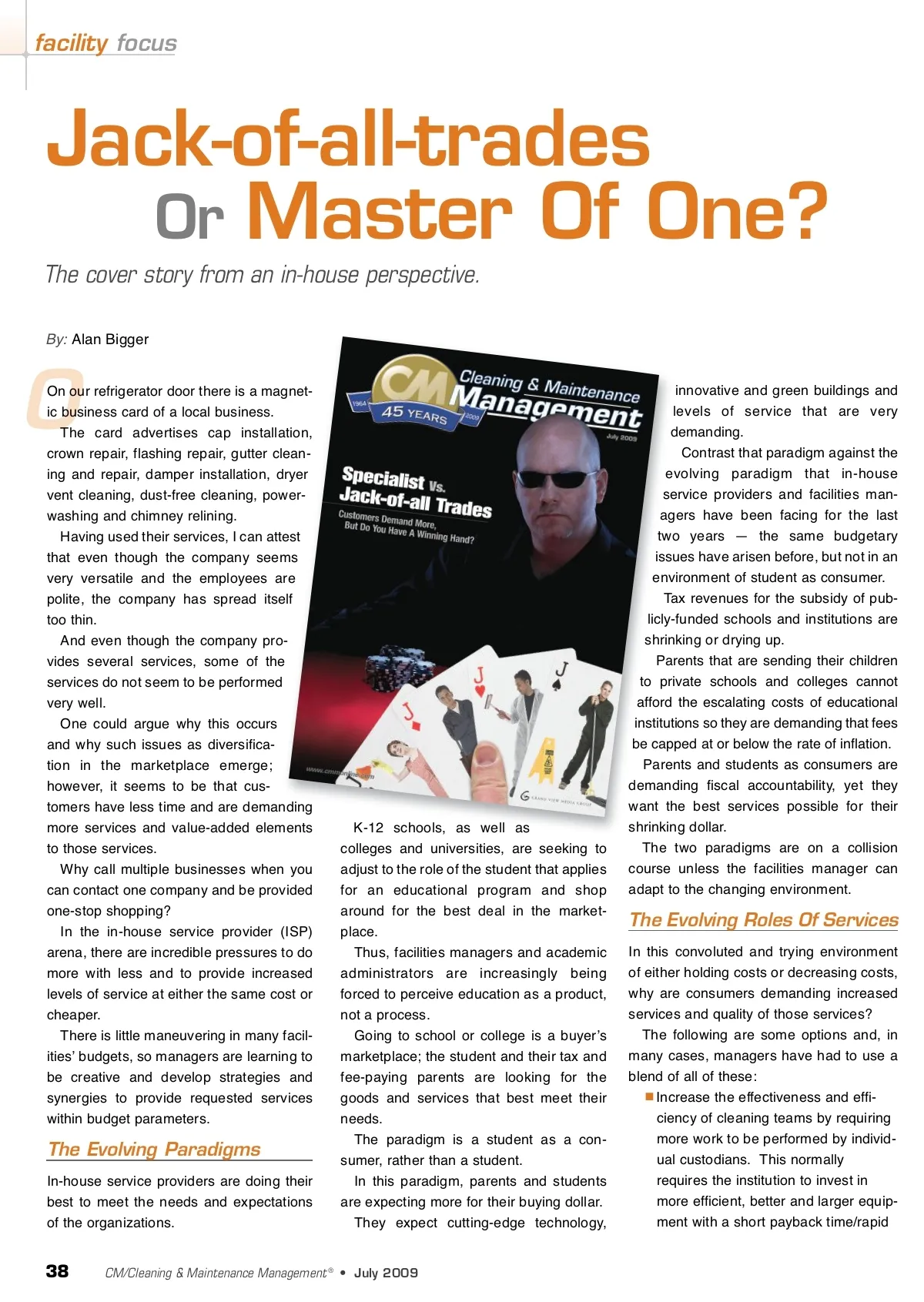
facility focus Jack-of-all-trades Or Master Of One? The cover story from an in-house perspective. By: Alan Bigger O On our refrigerator door there is a magnet-ic business card of a local business. The card advertises cap installation, crown repair, flashing repair, gutter clean-ing and repair, damper installation, dryer vent cleaning, dust-free cleaning, power-washing and chimney relining. Having used their services, I can attest that even though the company seems very versatile and the employees are polite, the company has spread itself too thin. And even though the company pro-vides several services, some of the services do not seem to be performed very well. One could argue why this occurs and why such issues as diversifica-tion in the marketplace emerge; however, it seems to be that cus-tomers have less time and are demanding more services and value-added elements to those services. Why call multiple businesses when you can contact one company and be provided one-stop shopping? In the in-house service provider (ISP) arena, there are incredible pressures to do more with less and to provide increased levels of service at either the same cost or cheaper. There is little maneuvering in many facil-itiesʼ budgets, so managers are learning to be creative and develop strategies and synergies to provide requested services within budget parameters. The Evolving Paradigms In-house service providers are doing their best to meet the needs and expectations of the organizations. K-12 schools, as well as colleges and universities, are seeking to adjust to the role of the student that applies for an educational program and shop around for the best deal in the market-place. Thus, facilities managers and academic administrators are increasingly being forced to perceive education as a product, not a process. Going to school or college is a buyerʼs marketplace; the student and their tax and fee-paying parents are looking for the goods and services that best meet their needs. The paradigm is a student as a con-sumer, rather than a student. In this paradigm, parents and students are expecting more for their buying dollar. They expect cutting-edge technology, innovative and green buildings and levels of service that are very demanding. Contrast that paradigm against the evolving paradigm that in-house service providers and facilities man-agers have been facing for the last two years — the same budgetary issues have arisen before, but not in an environment of student as consumer. Tax revenues for the subsidy of pub-licly-funded schools and institutions are shrinking or drying up. Parents that are sending their children to private schools and colleges cannot afford the escalating costs of educational institutions so they are demanding that fees be capped at or below the rate of inflation. Parents and students as consumers are demanding fiscal accountability, yet they want the best services possible for their shrinking dollar. The two paradigms are on a collision course unless the facilities manager can adapt to the changing environment. The Evolving Roles Of Services In this convoluted and trying environment of either holding costs or decreasing costs, why are consumers demanding increased services and quality of those services? The following are some options and, in many cases, managers have had to use a blend of all of these: Increase the effectiveness and effi-ciency of cleaning teams by requiring more work to be performed by individ-ual custodians. This normally requires the institution to invest in more efficient, better and larger equip-ment with a short payback time/rapid 38 CM/Cleaning & Maintenance Management ® • July 2009
CMM – Archives Jul 2009: 38