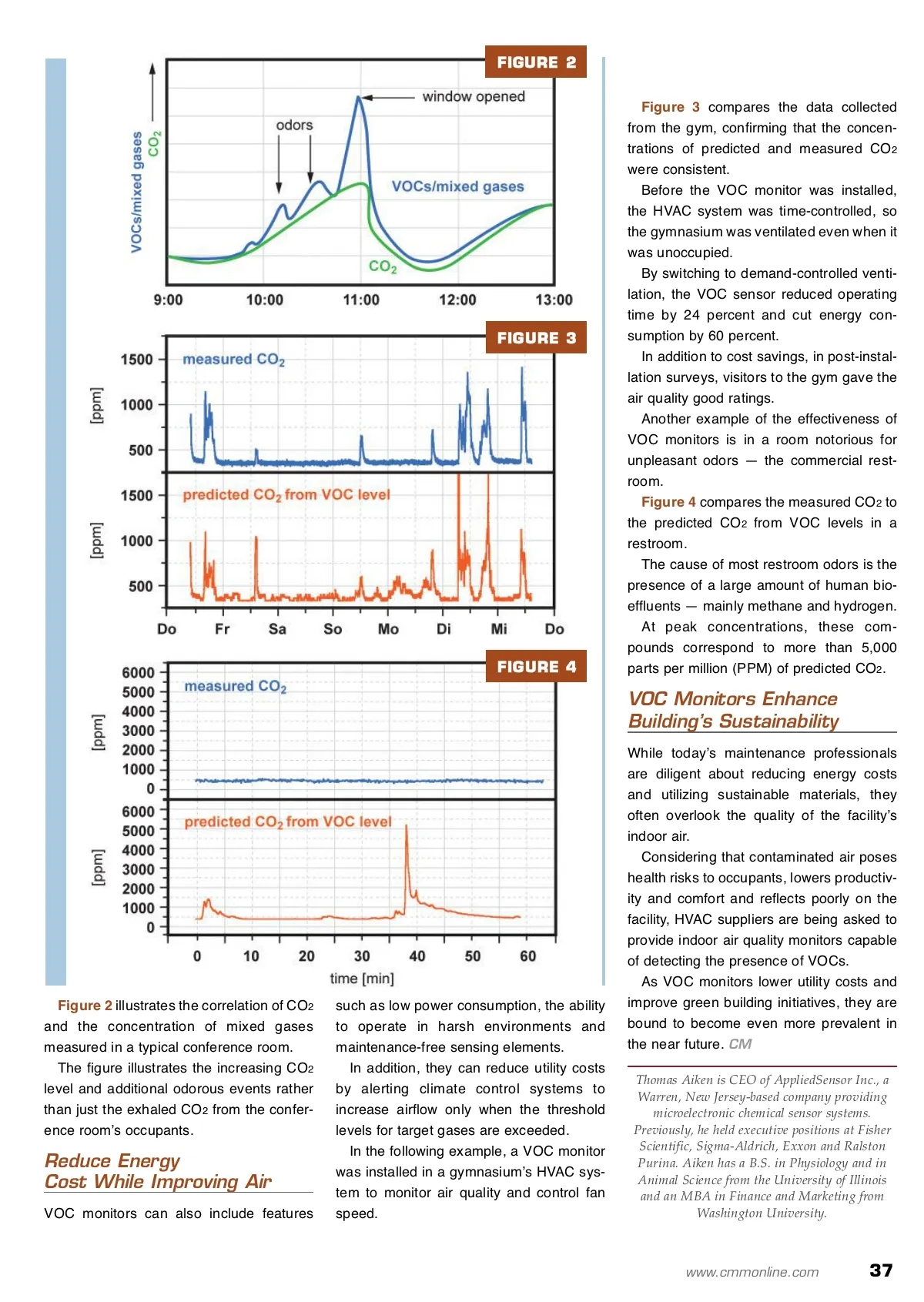
F I G U R E 2 Figure 3 compares the data collected from the gym, confirming that the concen-trations of predicted and measured CO 2 were consistent. Before the VOC monitor was installed, the HVAC system was time-controlled, so the gymnasium was ventilated even when it was unoccupied. By switching to demand-controlled venti-lation, the VOC sensor reduced operating time by 24 percent and cut energy con-sumption by 60 percent. In addition to cost savings, in post-instal-lation surveys, visitors to the gym gave the air quality good ratings. Another example of the effectiveness of VOC monitors is in a room notorious for unpleasant odors — the commercial rest-room. Figure 4 compares the measured CO 2 to the predicted CO 2 from VOC levels in a restroom. The cause of most restroom odors is the presence of a large amount of human bio-effluents — mainly methane and hydrogen. At peak concentrations, these com-pounds correspond to more than 5,000 parts per million (PPM) of predicted CO 2 . F I G U R E 3 F I G U R E 4 VOC Monitors Enhance Building’s Sustainability While todayʼs maintenance professionals are diligent about reducing energy costs and utilizing sustainable materials, they often overlook the quality of the facilityʼs indoor air. Considering that contaminated air poses health risks to occupants, lowers productiv-ity and comfort and reflects poorly on the facility, HVAC suppliers are being asked to provide indoor air quality monitors capable of detecting the presence of VOCs. As VOC monitors lower utility costs and improve green building initiatives, they are bound to become even more prevalent in the near future. CM Thomas Aiken is CEO of AppliedSensor Inc., a Warren, New Jersey-based company providing microelectronic chemical sensor systems. Previously, he held executive positions at Fisher Scientific, Sigma-Aldrich, Exxon and Ralston Purina. Aiken has a B.S. in Physiology and in Animal Science from the University of Illinois and an MBA in Finance and Marketing from Washington University. Figure 2 illustrates the correlation of CO 2 and the concentration of mixed gases measured in a typical conference room. The figure illustrates the increasing CO 2 level and additional odorous events rather than just the exhaled CO 2 from the confer-ence roomʼs occupants. Reduce Energy Cost While Improving Air VOC monitors can also include features such as low power consumption, the ability to operate in harsh environments and maintenance-free sensing elements. In addition, they can reduce utility costs by alerting climate control systems to increase airflow only when the threshold levels for target gases are exceeded. In the following example, a VOC monitor was installed in a gymnasiumʼs HVAC sys-tem to monitor air quality and control fan speed. www.cmmonline.com 37
CMM – Archives Jul 2009: 37