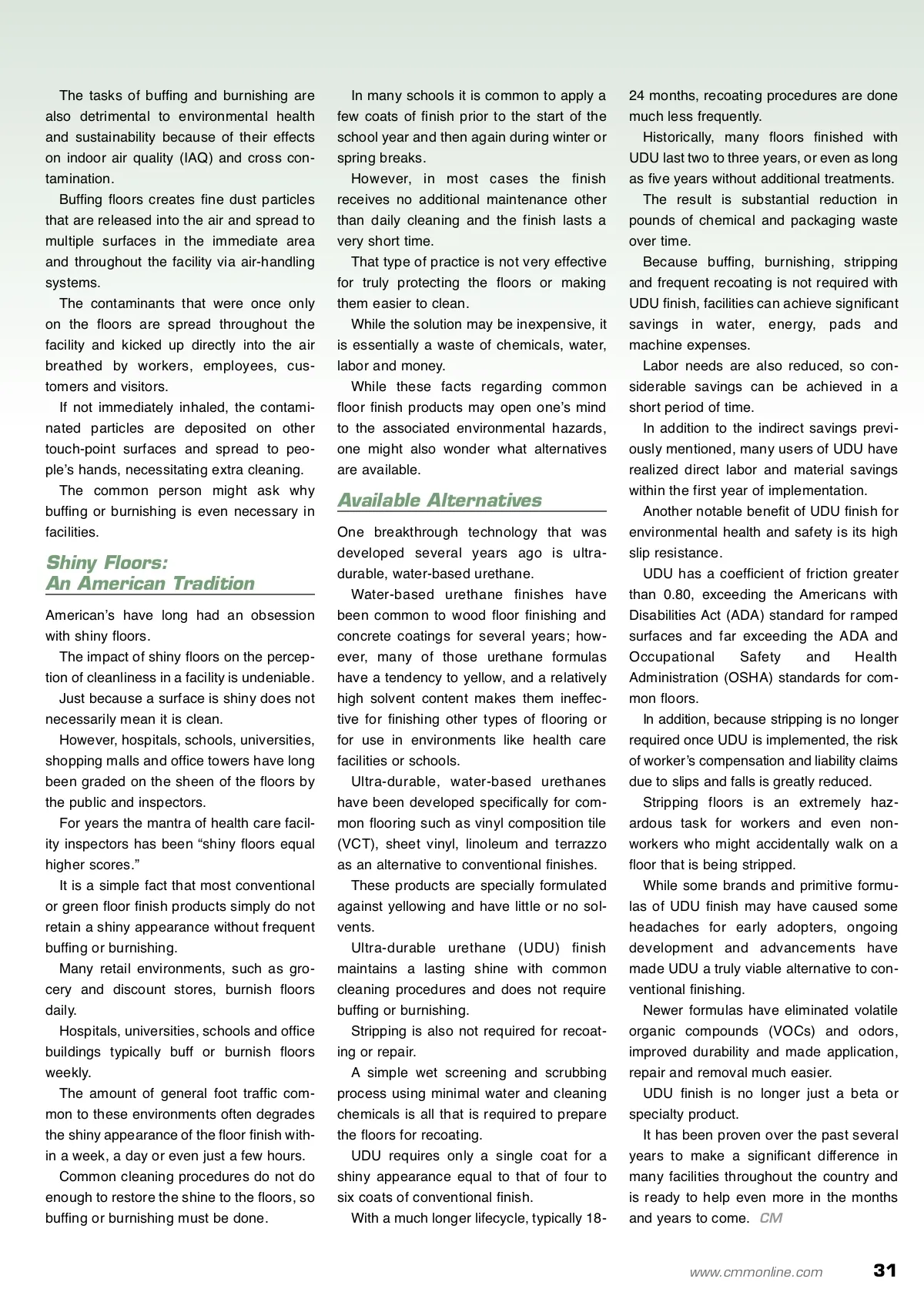
The tasks of buffing and burnishing are also detrimental to environmental health and sustainability because of their effects on indoor air quality (IAQ) and cross con-tamination. Buffing floors creates fine dust particles that are released into the air and spread to multiple surfaces in the immediate area and throughout the facility via air-handling systems. The contaminants that were once only on the floors are spread throughout the facility and kicked up directly into the air breathed by workers, employees, cus-tomers and visitors. If not immediately inhaled, the contami-nated particles are deposited on other touch-point surfaces and spread to peo-pleʼs hands, necessitating extra cleaning. The common person might ask why buffing or burnishing is even necessary in facilities. In many schools it is common to apply a few coats of finish prior to the start of the school year and then again during winter or spring breaks. However, in most cases the finish receives no additional maintenance other than daily cleaning and the finish lasts a very short time. That type of practice is not very effective for truly protecting the floors or making them easier to clean. While the solution may be inexpensive, it is essentially a waste of chemicals, water, labor and money. While these facts regarding common floor finish products may open oneʼs mind to the associated environmental hazards, one might also wonder what alternatives are available. Available Alternatives One breakthrough technology that was developed several years ago is ultra-durable, water-based urethane. Water-based urethane finishes have been common to wood floor finishing and concrete coatings for several years; how-ever, many of those urethane formulas have a tendency to yellow, and a relatively high solvent content makes them ineffec-tive for finishing other types of flooring or for use in environments like health care facilities or schools. Ultra-durable, water-based urethanes have been developed specifically for com-mon flooring such as vinyl composition tile (VCT), sheet vinyl, linoleum and terrazzo as an alternative to conventional finishes. These products are specially formulated against yellowing and have little or no sol-vents. Ultra-durable urethane (UDU) finish maintains a lasting shine with common cleaning procedures and does not require buffing or burnishing. Stripping is also not required for recoat-ing or repair. A simple wet screening and scrubbing process using minimal water and cleaning chemicals is all that is required to prepare the floors for recoating. UDU requires only a single coat for a shiny appearance equal to that of four to six coats of conventional finish. With a much longer lifecycle, typically 18-Shiny Floors: An American Tradition Americanʼs have long had an obsession with shiny floors. The impact of shiny floors on the percep-tion of cleanliness in a facility is undeniable. Just because a surface is shiny does not necessarily mean it is clean. However, hospitals, schools, universities, shopping malls and office towers have long been graded on the sheen of the floors by the public and inspectors. For years the mantra of health care facil-ity inspectors has been “shiny floors equal higher scores.” It is a simple fact that most conventional or green floor finish products simply do not retain a shiny appearance without frequent buffing or burnishing. Many retail environments, such as gro-cery and discount stores, burnish floors daily. Hospitals, universities, schools and office buildings typically buff or burnish floors weekly. The amount of general foot traffic com-mon to these environments often degrades the shiny appearance of the floor finish with-in a week, a day or even just a few hours. Common cleaning procedures do not do enough to restore the shine to the floors, so buffing or burnishing must be done. 24 months, recoating procedures are done much less frequently. Historically, many floors finished with UDU last two to three years, or even as long as five years without additional treatments. The result is substantial reduction in pounds of chemical and packaging waste over time. Because buffing, burnishing, stripping and frequent recoating is not required with UDU finish, facilities can achieve significant savings in water, energy, pads and machine expenses. Labor needs are also reduced, so con-siderable savings can be achieved in a short period of time. In addition to the indirect savings previ-ously mentioned, many users of UDU have realized direct labor and material savings within the first year of implementation. Another notable benefit of UDU finish for environmental health and safety is its high slip resistance. UDU has a coefficient of friction greater than 0.80, exceeding the Americans with Disabilities Act (ADA) standard for ramped surfaces and far exceeding the ADA and Occupational Safety and Health Administration (OSHA) standards for com-mon floors. In addition, because stripping is no longer required once UDU is implemented, the risk of workerʼs compensation and liability claims due to slips and falls is greatly reduced. Stripping floors is an extremely haz-ardous task for workers and even non-workers who might accidentally walk on a floor that is being stripped. While some brands and primitive formu-las of UDU finish may have caused some headaches for early adopters, ongoing development and advancements have made UDU a truly viable alternative to con-ventional finishing. Newer formulas have eliminated volatile organic compounds (VOCs) and odors, improved durability and made application, repair and removal much easier. UDU finish is no longer just a beta or specialty product. It has been proven over the past several years to make a significant difference in many facilities throughout the country and is ready to help even more in the months and years to come. CM www.cmmonline.com 31
CMM – Archives Jul 2009: 31