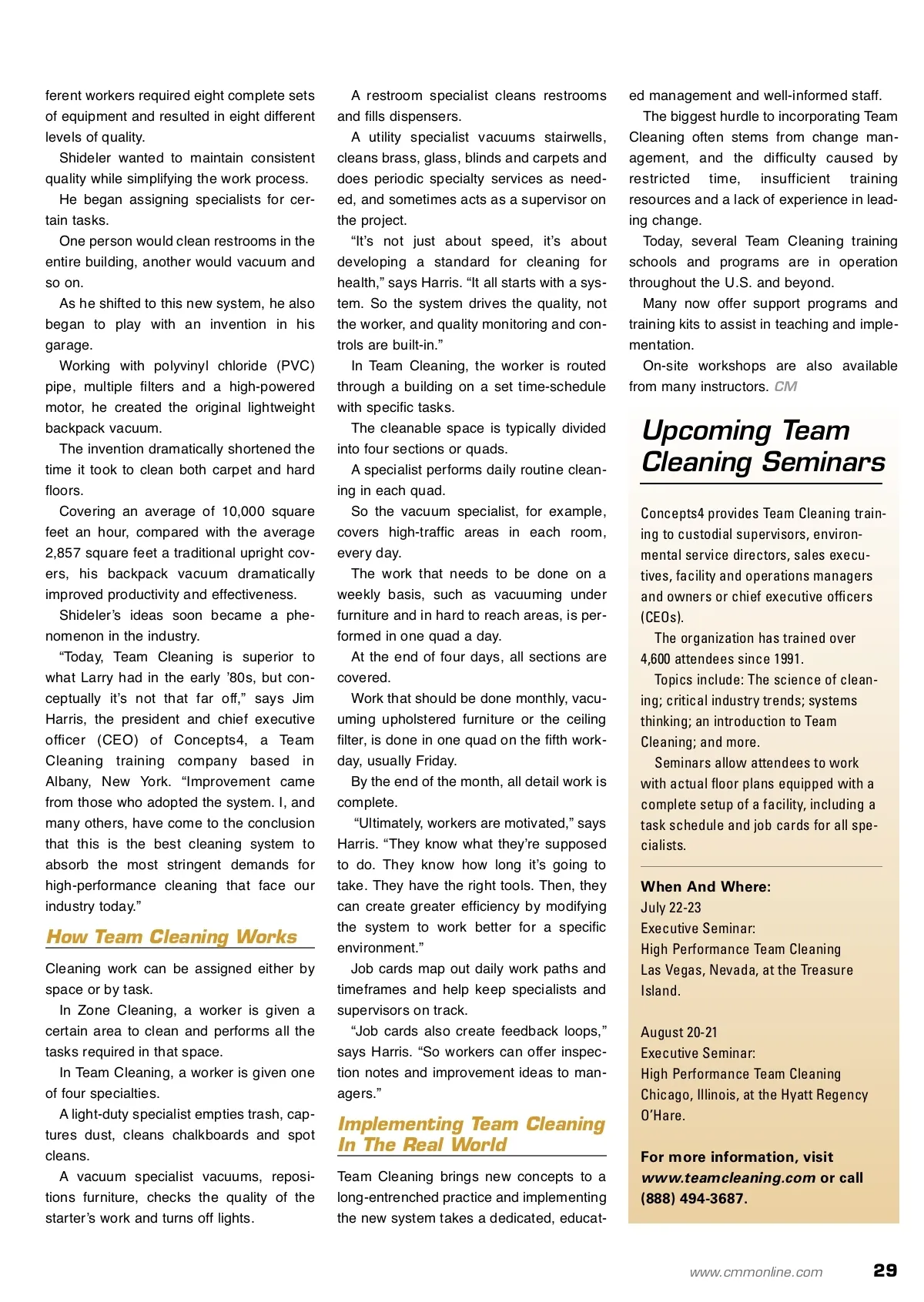
ferent workers required eight complete sets of equipment and resulted in eight different levels of quality. Shideler wanted to maintain consistent quality while simplifying the work process. He began assigning specialists for cer-tain tasks. One person would clean restrooms in the entire building, another would vacuum and so on. As he shifted to this new system, he also began to play with an invention in his garage. Working with polyvinyl chloride (PVC) pipe, multiple filters and a high-powered motor, he created the original lightweight backpack vacuum. The invention dramatically shortened the time it took to clean both carpet and hard floors. Covering an average of 10,000 square feet an hour, compared with the average 2,857 square feet a traditional upright cov-ers, his backpack vacuum dramatically improved productivity and effectiveness. Shidelerʼs ideas soon became a phe-nomenon in the industry. “Today, Team Cleaning is superior to what Larry had in the early ʼ80s, but con-ceptually itʼs not that far off,” says Jim Harris, the president and chief executive officer (CEO) of Concepts4, a Team Cleaning training company based in Albany, New York. “Improvement came from those who adopted the system. I, and many others, have come to the conclusion that this is the best cleaning system to absorb the most stringent demands for high-performance cleaning that face our industry today.” How Team Cleaning Works Cleaning work can be assigned either by space or by task. In Zone Cleaning, a worker is given a certain area to clean and performs all the tasks required in that space. In Team Cleaning, a worker is given one of four specialties. A light-duty specialist empties trash, cap-tures dust, cleans chalkboards and spot cleans. A vacuum specialist vacuums, reposi-tions furniture, checks the quality of the starterʼs work and turns off lights. A restroom specialist cleans restrooms and fills dispensers. A utility specialist vacuums stairwells, cleans brass, glass, blinds and carpets and does periodic specialty services as need-ed, and sometimes acts as a supervisor on the project. “Itʼs not just about speed, itʼs about developing a standard for cleaning for health,” says Harris. “It all starts with a sys-tem. So the system drives the quality, not the worker, and quality monitoring and con-trols are built-in.” In Team Cleaning, the worker is routed through a building on a set time-schedule with specific tasks. The cleanable space is typically divided into four sections or quads. A specialist performs daily routine clean-ing in each quad. So the vacuum specialist, for example, covers high-traffic areas in each room, every day. The work that needs to be done on a weekly basis, such as vacuuming under furniture and in hard to reach areas, is per-formed in one quad a day. At the end of four days, all sections are covered. Work that should be done monthly, vacu-uming upholstered furniture or the ceiling filter, is done in one quad on the fifth work-day, usually Friday. By the end of the month, all detail work is complete. “Ultimately, workers are motivated,” says Harris. “They know what theyʼre supposed to do. They know how long itʼs going to take. They have the right tools. Then, they can create greater efficiency by modifying the system to work better for a specific environment.” Job cards map out daily work paths and timeframes and help keep specialists and supervisors on track. “Job cards also create feedback loops,” says Harris. “So workers can offer inspec-tion notes and improvement ideas to man-agers.” ed management and well-informed staff. The biggest hurdle to incorporating Team Cleaning often stems from change man-agement, and the difficulty caused by restricted time, insufficient training resources and a lack of experience in lead-ing change. Today, several Team Cleaning training schools and programs are in operation throughout the U.S. and beyond. Many now offer support programs and training kits to assist in teaching and imple-mentation. On-site workshops are also available from many instructors. CM Upcoming Team Cleaning Seminars Concepts4 provides Team Cleaning train-ing to custodial supervisors, environ-mental service directors, sales execu-tives, facility and operations managers and owners or chief executive officers (CEOs). The organization has trained over 4,600 attendees since 1991. Topics include: The science of clean-ing; critical industry trends; systems thinking; an introduction to Team Cleaning; and more. Seminars allow attendees to work with actual floor plans equipped with a complete setup of a facility, including a task schedule and job cards for all spe-cialists. When And Where: July 22-23 Executive Seminar: High Performance Team Cleaning Las Vegas, Nevada, at the Treasure Island. August 20-21 Executive Seminar: High Performance Team Cleaning Chicago, Illinois, at the Hyatt Regency O’Hare. For more information, visit www.teamcleaning.com or call (888) 494-3687. Implementing Team Cleaning In The Real World Team Cleaning brings new concepts to a long-entrenched practice and implementing the new system takes a dedicated, educat-www.cmmonline.com 29
CMM – Archives Jul 2009: 29