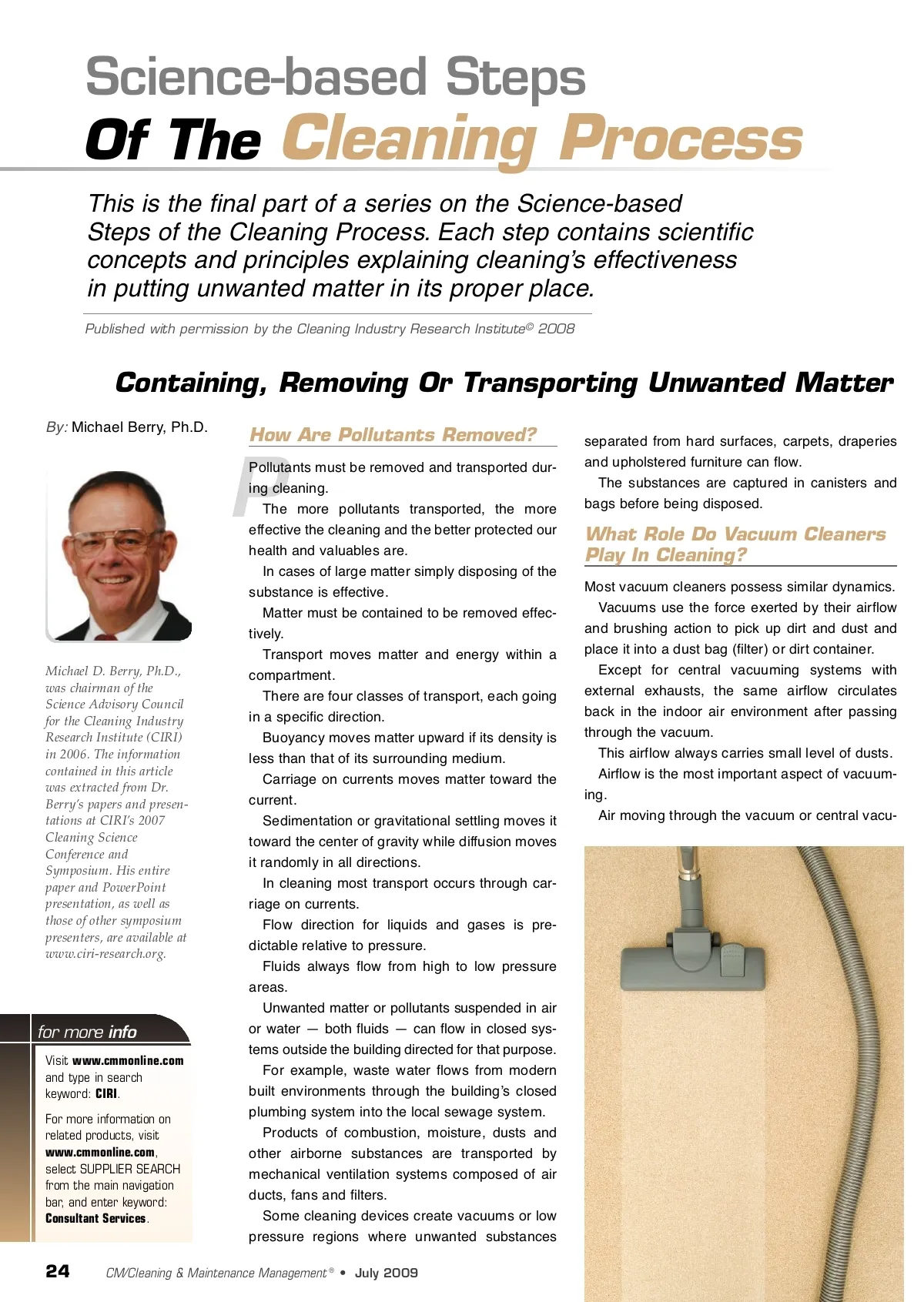
Science-based Steps Of The Cleaning Process This is the final part of a series on the Science-based Steps of the Cleaning Process. Each step contains scientific concepts and principles explaining cleaning’s effectiveness in putting unwanted matter in its proper place. Published with permission by the Cleaning Industry Research Institute © 2008 Containing, Removing Or Transporting Unwanted Matter By: Michael Berry, Ph.D. How Are Pollutants Removed? P Michael D. Berry, Ph.D., was chairman of the Science Advisory Council for the Cleaning Industry Research Institute (CIRI) in 2006. The information contained in this article was extracted from Dr. Berry’s papers and presen-tations at CIRI’s 2007 Cleaning Science Conference and Symposium. His entire paper and PowerPoint presentation, as well as those of other symposium presenters, are available at www.ciri-research.org. for more info Visit www.cmmonline.com and type in search keyword: CIRI . For more information on related products, visit www.cmmonline.com , select SUPPLIER SEARCH from the main navigation bar, and enter keyword: Consultant Services . Pollutants must be removed and transported dur-ing cleaning. The more pollutants transported, the more effective the cleaning and the better protected our health and valuables are. In cases of large matter simply disposing of the substance is effective. Matter must be contained to be removed effec-tively. Transport moves matter and energy within a compartment. There are four classes of transport, each going in a specific direction. Buoyancy moves matter upward if its density is less than that of its surrounding medium. Carriage on currents moves matter toward the current. Sedimentation or gravitational settling moves it toward the center of gravity while diffusion moves it randomly in all directions. In cleaning most transport occurs through car-riage on currents. Flow direction for liquids and gases is pre-dictable relative to pressure. Fluids always flow from high to low pressure areas. Unwanted matter or pollutants suspended in air or water — both fluids — can flow in closed sys-tems outside the building directed for that purpose. For example, waste water flows from modern built environments through the buildingʼs closed plumbing system into the local sewage system. Products of combustion, moisture, dusts and other airborne substances are transported by mechanical ventilation systems composed of air ducts, fans and filters. Some cleaning devices create vacuums or low pressure regions where unwanted substances separated from hard surfaces, carpets, draperies and upholstered furniture can flow. The substances are captured in canisters and bags before being disposed. What Role Do Vacuum Cleaners Play In Cleaning? Most vacuum cleaners possess similar dynamics. Vacuums use the force exerted by their airflow and brushing action to pick up dirt and dust and place it into a dust bag (filter) or dirt container. Except for central vacuuming systems with external exhausts, the same airflow circulates back in the indoor air environment after passing through the vacuum. This airflow always carries small level of dusts. Airflow is the most important aspect of vacuum-ing. Air moving through the vacuum or central vacu-24 CM/Cleaning & Maintenance Management ® • July 2009
CMM – Archives Jul 2009: 24