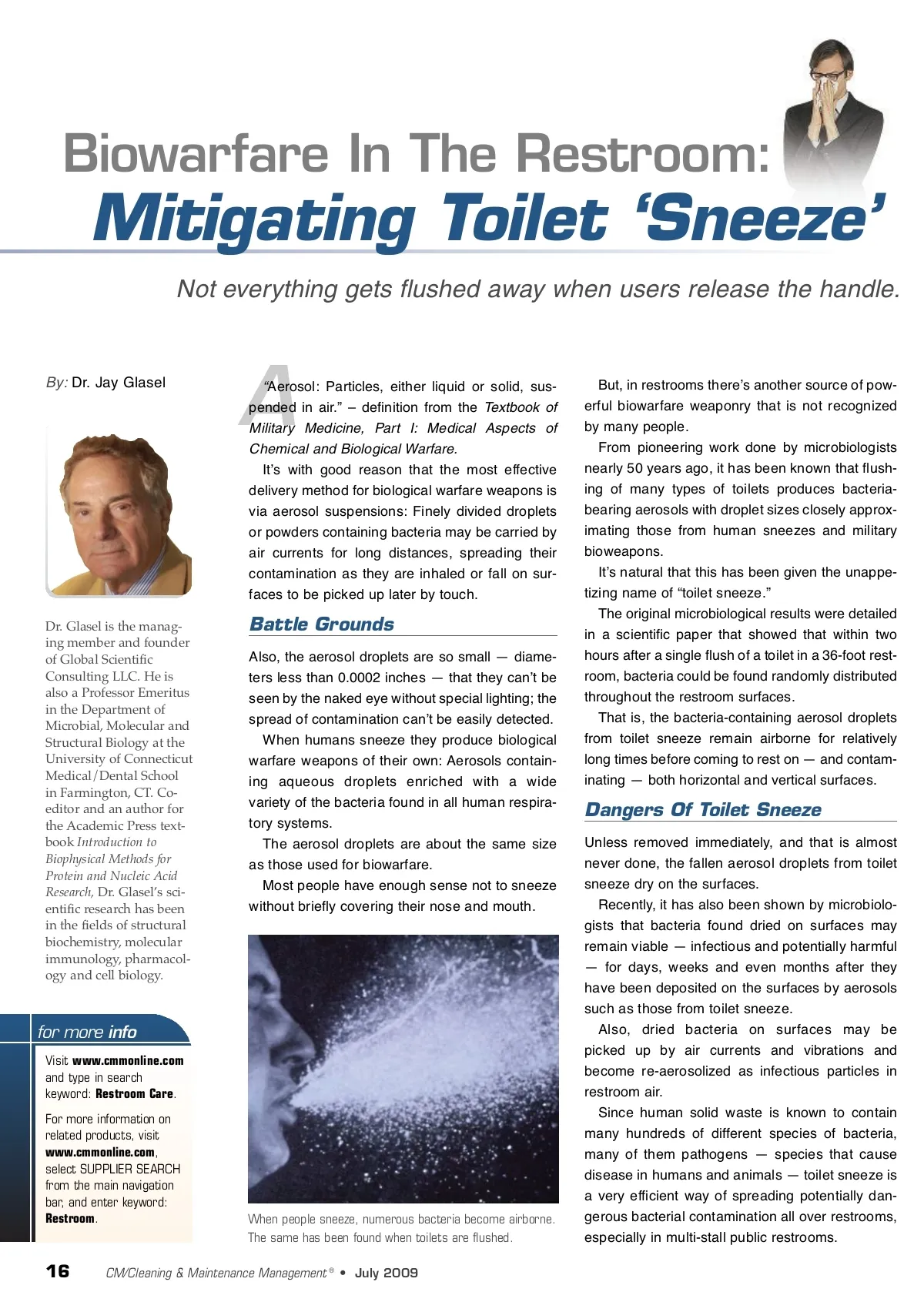
Biowarfare In The Restroom: Mitigating Toilet ‘Sneeze’ Not everything gets flushed away when users release the handle. By: Dr. Jay Glasel A “ Aerosol: Particles, either liquid or solid, sus-pended in air.” – definition from the Textbook of Military Medicine, Part I: Medical Aspects of Chemical and Biological Warfare. Itʼs with good reason that the most effective delivery method for biological warfare weapons is via aerosol suspensions: Finely divided droplets or powders containing bacteria may be carried by air currents for long distances, spreading their contamination as they are inhaled or fall on sur-faces to be picked up later by touch. Dr. Glasel is the manag-ing member and founder of Global Scientific Consulting LLC. He is also a Professor Emeritus in the Department of Microbial, Molecular and Structural Biology at the University of Connecticut Medical/Dental School in Farmington, CT. Co-editor and an author for the Academic Press text-book Introduction to Biophysical Methods for Protein and Nucleic Acid Research, Dr. Glasel’s sci-entific research has been in the fields of structural biochemistry, molecular immunology, pharmacol-ogy and cell biology. Battle Grounds Also, the aerosol droplets are so small — diame-ters less than 0.0002 inches — that they canʼt be seen by the naked eye without special lighting; the spread of contamination canʼt be easily detected. When humans sneeze they produce biological warfare weapons of their own: Aerosols contain-ing aqueous droplets enriched with a wide variety of the bacteria found in all human respira-tory systems. The aerosol droplets are about the same size as those used for biowarfare. Most people have enough sense not to sneeze without briefly covering their nose and mouth. But, in restrooms thereʼs another source of pow-erful biowarfare weaponry that is not recognized by many people. From pioneering work done by microbiologists nearly 50 years ago, it has been known that flush-ing of many types of toilets produces bacteria-bearing aerosols with droplet sizes closely approx-imating those from human sneezes and military bioweapons. Itʼs natural that this has been given the unappe-tizing name of “toilet sneeze.” The original microbiological results were detailed in a scientific paper that showed that within two hours after a single flush of a toilet in a 36-foot rest-room, bacteria could be found randomly distributed throughout the restroom surfaces. That is, the bacteria-containing aerosol droplets from toilet sneeze remain airborne for relatively long times before coming to rest on — and contam-inating — both horizontal and vertical surfaces. Dangers Of Toilet Sneeze Unless removed immediately, and that is almost never done, the fallen aerosol droplets from toilet sneeze dry on the surfaces. Recently, it has also been shown by microbiolo-gists that bacteria found dried on surfaces may remain viable — infectious and potentially harmful — for days, weeks and even months after they have been deposited on the surfaces by aerosols such as those from toilet sneeze. Also, dried bacteria on surfaces may be picked up by air currents and vibrations and become re-aerosolized as infectious particles in restroom air. Since human solid waste is known to contain many hundreds of different species of bacteria, many of them pathogens — species that cause disease in humans and animals — toilet sneeze is a very efficient way of spreading potentially dan-gerous bacterial contamination all over restrooms, especially in multi-stall public restrooms. for more info Visit www.cmmonline.com and type in search keyword: Restroom Care . For more information on related products, visit www.cmmonline.com , select SUPPLIER SEARCH from the main navigation bar, and enter keyword: Restroom . When people sneeze, numerous bacteria become airborne. The same has been found when toilets are flushed. 16 CM/Cleaning & Maintenance Management ® • July 2009
CMM – Archives Jul 2009: 16