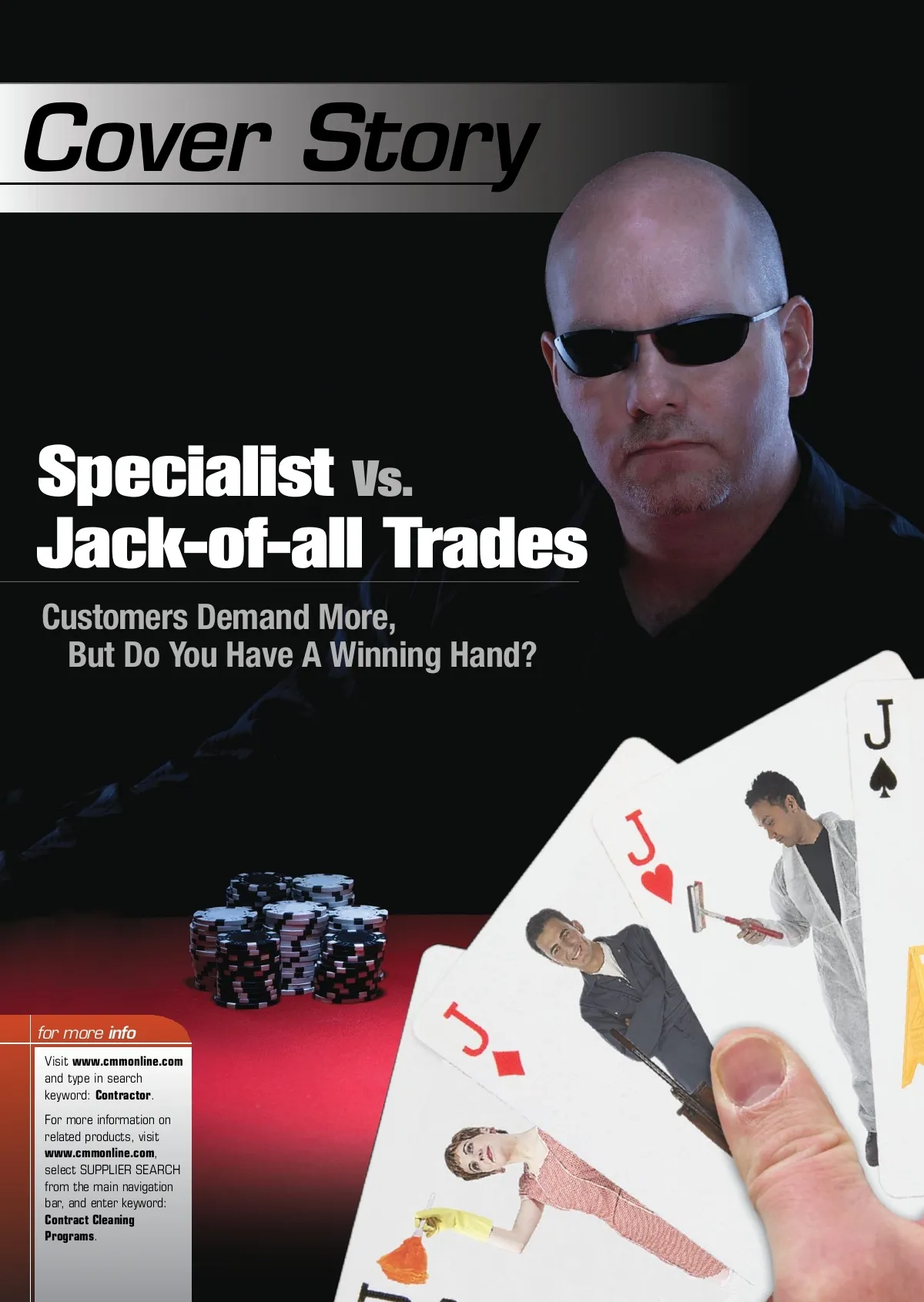
Which hand should you deal to customers? E By: Dawn Shoemaker Dawn Shoemaker is a writer for the professional cleaning and building industries. She may be reached at [email protected]. Even though the professional cleaning industry tends to be less affected than other industries during financial meltdowns, we are no longer immune. This means that astute building service contrac-tors (BSCs) must take a close look at their busi-nesses and determine not only what steps they should take now to weather the current storm, but also what they can do to actually build their busi-nesses during these uncertain economic times. After all, in past downturns, many leading com-panies have actually come out stronger — with more market share and profits — than before. Many BSCs are now much more cautious about spending, usually making purchases only for products that are necessary or that are per-ceived to be a good value. Further, many firms have stepped up their efforts to pay off their debt and have been reluc-tant to assume new debt. Additionally, contractors are reevaluating their businesses to see if it might be better to offer more services for their customers or spe-cialize in just one or two. For instance, many carpet cleaners have expanded their services to offer restoration work in addition to carpet cleaning and floor care. Others have found that specializing in just one field, such as restoration, has proven to be more lucrative and reduces equipment needs and the amount of worker training necessary. Some BSCs now offer a range of servic-es, from parking lot and elevator mainte-nance to lighting and landscaping services. Others once offered additional servic-es but found it best to let them go and just specialize in what they do best: Cleaning. across the nation have analyzed and debated these questions. In 2008, Alexander Chernev, an associate pro-fessor of marketing at the Kellogg School of Management near Chicago, conducted a study to evaluate these and related business strategies. Customers were asked what they perceive to be a better product or service: One that special-izes in just one task or service or one that can be used to handle a variety of tasks or services. These were the studyʼs findings: Most customers believe that a “single-attrib-ute” product or service, one that specializes in one service or task, is better than an all-in-one product or service that can do many things. This was true even when the end customers were told that the two different types of products were essentially the same. For this group of customers, it is only when the price of the single-attribute product or service is perceived to be excessive does the customer select the all-in-one product or service, and only then if it is significantly less expensive. In other words, Chernev found that a product specializing in a single attribute is perceived to be superior in that attribute relative to an all-in-one product having the same attribute but multiple other features as well. In this case, specializing paid off as long as there was no — or a minor — difference in costs. When comparing toothpaste, for instance, he found that consumers expect whitening-only toothpaste to whiten teeth better than toothpaste that both whitens and prevents cavities — again, even though the two productsʼ whitening agents are essentially equivalent in effectiveness. Up Economy To Down Economy As to whether being a jack-of-all trades or spe-cializing in one or two services is better, “there probably is not one ʻcorrectʼ answer,” says Michael Schaffer, president of Tornado Industries. “There are many variables to consider, from employee skills [and] equipment used to geogra-phy. In a big city it might work well to specialize; in a smaller area, offering multiple services would probably be imperative.” Schaffer suggests that BSCs that offer only Ace Or Wild Card? Which is the right direction for your business? Should you be an all-in-one clean-ing company or a master of one — specializing in offering a specific task or service? This is a more complicated issue than you might suspect; even leading business schools www.cmmonline.com 13
CMM – Archives Jul 2009: 13