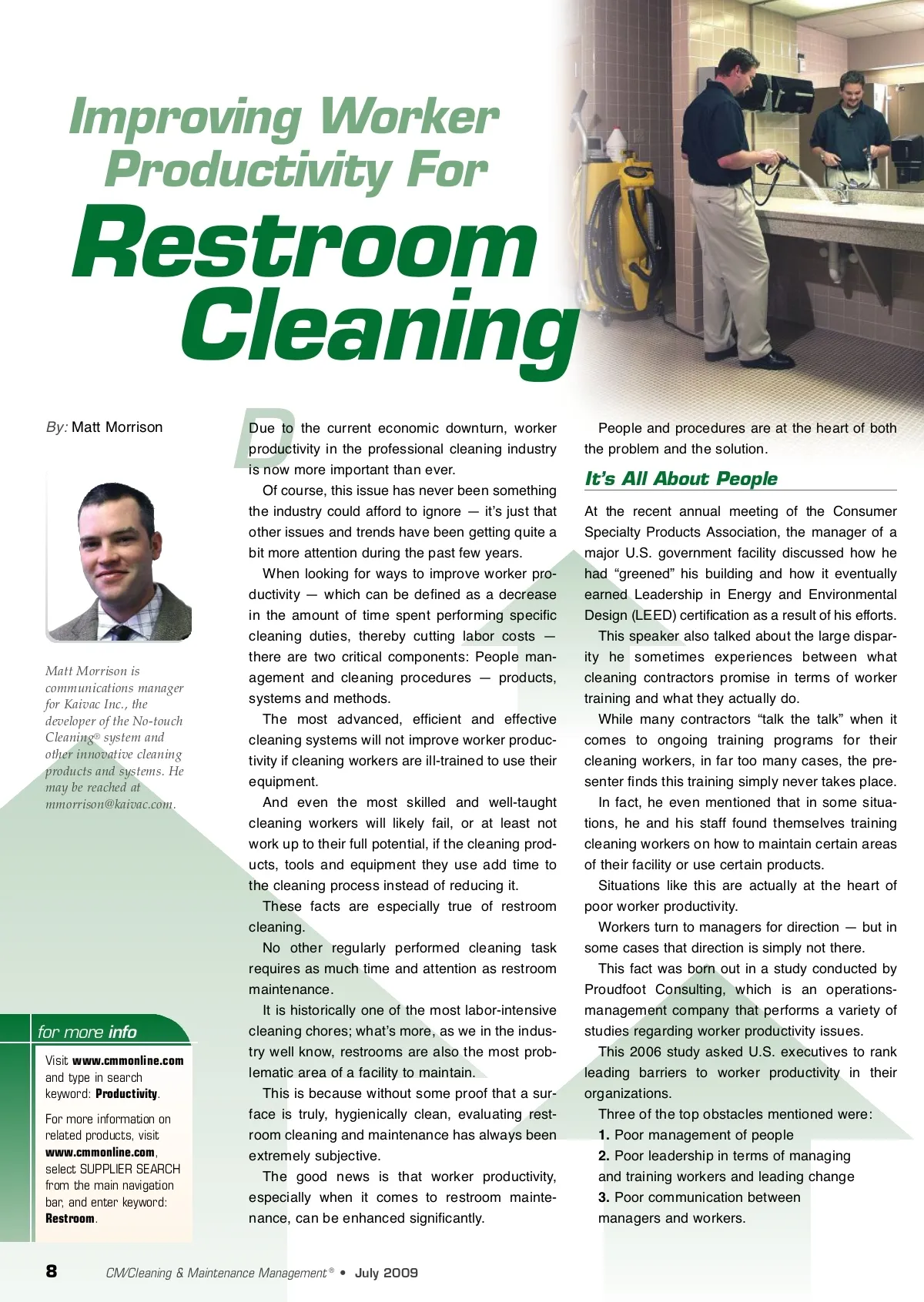
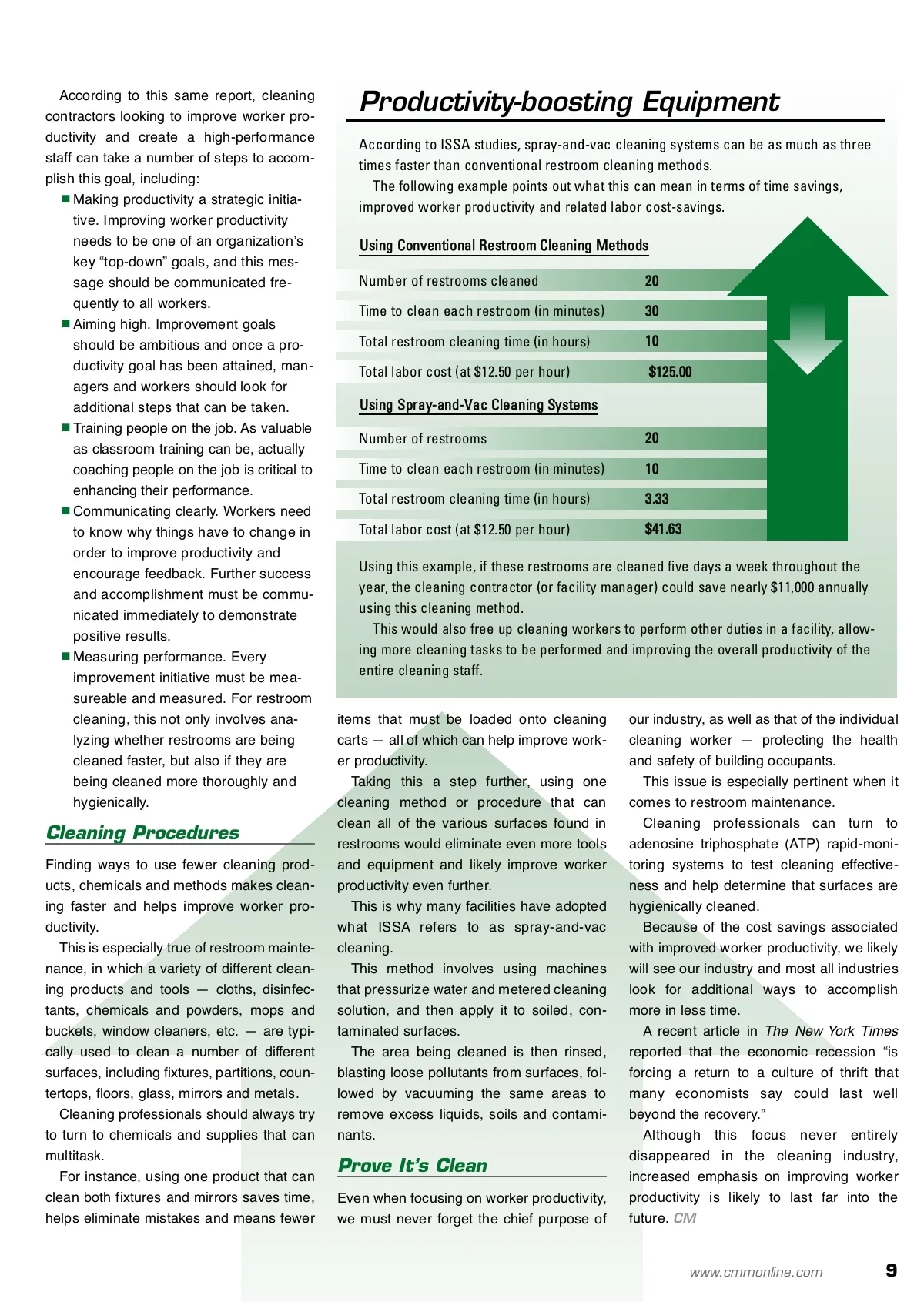
According to this same report, cleaning contractors looking to improve worker pro-ductivity and create a high-performance staff can take a number of steps to accom-plish this goal, including: Making productivity a strategic initia-tive. Improving worker productivity needs to be one of an organizationʼs key “top-down” goals, and this mes-sage should be communicated fre-quently to all workers. Aiming high. Improvement goals should be ambitious and once a pro-ductivity goal has been attained, man-agers and workers should look for additional steps that can be taken. Training people on the job. As valuable as classroom training can be, actually coaching people on the job is critical to enhancing their performance. Communicating clearly. Workers need to know why things have to change in order to improve productivity and encourage feedback. Further success and accomplishment must be commu-nicated immediately to demonstrate positive results. Measuring performance. Every improvement initiative must be mea-sureable and measured. For restroom cleaning, this not only involves ana-lyzing whether restrooms are being cleaned faster, but also if they are being cleaned more thoroughly and hygienically. Productivity-boosting Equipment According to ISSA studies, spray-and-vac cleaning systems can be as much as three times faster than conventional restroom cleaning methods. The following example points out what this can mean in terms of time savings, improved worker productivity and related labor cost-savings. U s i n g C o n v e n t i o n a l R e s t r o o m Cl e a n i n g M e t h o d s Number of restrooms cleaned Time to clean each restroom (in minutes) Total restroom cleaning time (in hours) Total labor cost (at $12.50 per hour) U s i n g S p r a y -a n d -V a c C l e a n i n g Sy s t e m s Number of restrooms Time to clean each restroom (in minutes) Total restroom cleaning time (in hours) Total labor cost (at $12.50 per hour) 2 0 1 0 3 . 3 3 $ 4 1 . 6 3 2 0 3 0 1 0 $ 1 2 5 . 0 0 Using this example, if these restrooms are cleaned five days a week throughout the year, the cleaning contractor (or facility manager) could save nearly $11,000 annually using this cleaning method. This would also free up cleaning workers to perform other duties in a facility, allow-ing more cleaning tasks to be performed and improving the overall productivity of the entire cleaning staff. items that must be loaded onto cleaning carts — all of which can help improve work-er productivity. Taking this a step further, using one cleaning method or procedure that can clean all of the various surfaces found in restrooms would eliminate even more tools and equipment and likely improve worker productivity even further. This is why many facilities have adopted what ISSA refers to as spray-and-vac cleaning. This method involves using machines that pressurize water and metered cleaning solution, and then apply it to soiled, con-taminated surfaces. The area being cleaned is then rinsed, blasting loose pollutants from surfaces, fol-lowed by vacuuming the same areas to remove excess liquids, soils and contami-nants. our industry, as well as that of the individual cleaning worker — protecting the health and safety of building occupants. This issue is especially pertinent when it comes to restroom maintenance. Cleaning professionals can turn to adenosine triphosphate (ATP) rapid-moni-toring systems to test cleaning effective-ness and help determine that surfaces are hygienically cleaned. Because of the cost savings associated with improved worker productivity, we likely will see our industry and most all industries look for additional ways to accomplish more in less time. A recent article in The New York Times reported that the economic recession “is forcing a return to a culture of thrift that many economists say could last well beyond the recovery.” Although this focus never entirely disappeared in the cleaning industry, increased emphasis on improving worker productivity is likely to last far into the future. CM Cleaning Procedures Finding ways to use fewer cleaning prod-ucts, chemicals and methods makes clean-ing faster and helps improve worker pro-ductivity. This is especially true of restroom mainte-nance, in which a variety of different clean-ing products and tools — cloths, disinfec-tants, chemicals and powders, mops and buckets, window cleaners, etc. — are typi-cally used to clean a number of different surfaces, including fixtures, partitions, coun-tertops, floors, glass, mirrors and metals. Cleaning professionals should always try to turn to chemicals and supplies that can multitask. For instance, using one product that can clean both fixtures and mirrors saves time, helps eliminate mistakes and means fewer Prove It’s Clean Even when focusing on worker productivity, we must never forget the chief purpose of www.cmmonline.com 9
CMM – Archives Jul 2009: 9