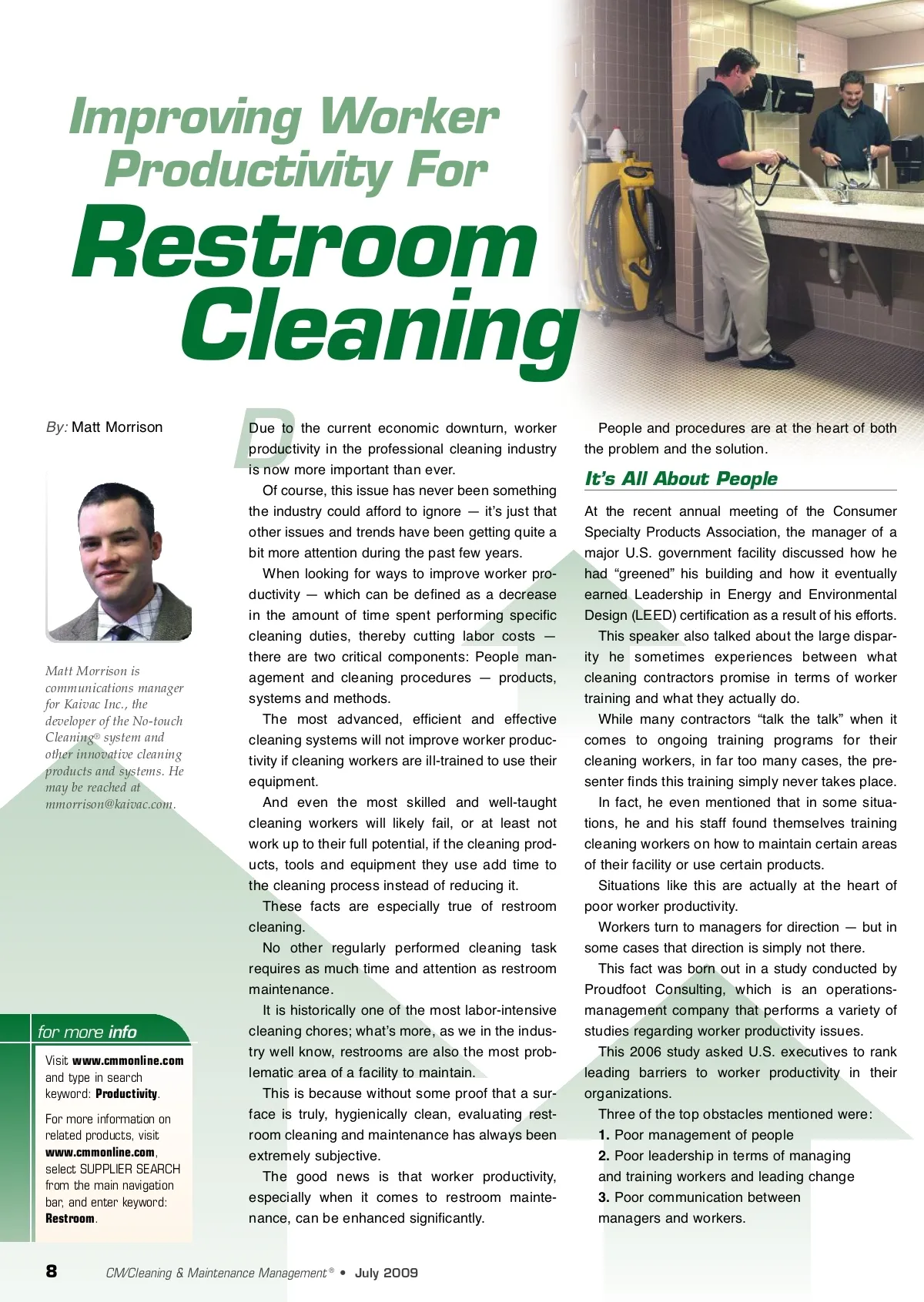
Improving Worker Productivity For Restroom Cleaning By: Matt Morrison D Matt Morrison is communications manager for Kaivac Inc., the developer of the No-touch Cleaning ® system and other innovative cleaning products and systems. He may be reached at [email protected]. for more info Visit www.cmmonline.com and type in search keyword: Productivity . For more information on related products, visit www.cmmonline.com , select SUPPLIER SEARCH from the main navigation bar, and enter keyword: Restroom . Due to the current economic downturn, worker productivity in the professional cleaning industry is now more important than ever. Of course, this issue has never been something the industry could afford to ignore — itʼs just that other issues and trends have been getting quite a bit more attention during the past few years. When looking for ways to improve worker pro-ductivity — which can be defined as a decrease in the amount of time spent performing specific cleaning duties, thereby cutting labor costs — there are two critical components: People man-agement and cleaning procedures — products, systems and methods. The most advanced, efficient and effective cleaning systems will not improve worker produc-tivity if cleaning workers are ill-trained to use their equipment. And even the most skilled and well-taught cleaning workers will likely fail, or at least not work up to their full potential, if the cleaning prod-ucts, tools and equipment they use add time to the cleaning process instead of reducing it. These facts are especially true of restroom cleaning. No other regularly performed cleaning task requires as much time and attention as restroom maintenance. It is historically one of the most labor-intensive cleaning chores; whatʼs more, as we in the indus-try well know, restrooms are also the most prob-lematic area of a facility to maintain. This is because without some proof that a sur-face is truly, hygienically clean, evaluating rest-room cleaning and maintenance has always been extremely subjective. The good news is that worker productivity, especially when it comes to restroom mainte-nance, can be enhanced significantly. People and procedures are at the heart of both the problem and the solution. It’s All About People At the recent annual meeting of the Consumer Specialty Products Association, the manager of a major U.S. government facility discussed how he had “greened” his building and how it eventually earned Leadership in Energy and Environmental Design (LEED) certification as a result of his efforts. This speaker also talked about the large dispar-ity he sometimes experiences between what cleaning contractors promise in terms of worker training and what they actually do. While many contractors “talk the talk” when it comes to ongoing training programs for their cleaning workers, in far too many cases, the pre-senter finds this training simply never takes place. In fact, he even mentioned that in some situa-tions, he and his staff found themselves training cleaning workers on how to maintain certain areas of their facility or use certain products. Situations like this are actually at the heart of poor worker productivity. Workers turn to managers for direction — but in some cases that direction is simply not there. This fact was born out in a study conducted by Proudfoot Consulting, which is an operations-management company that performs a variety of studies regarding worker productivity issues. This 2006 study asked U.S. executives to rank leading barriers to worker productivity in their organizations. Three of the top obstacles mentioned were: 1. Poor management of people 2. Poor leadership in terms of managing and training workers and leading change 3. Poor communication between managers and workers. 8 CM/Cleaning & Maintenance Management ® • July 2009
CMM – Archives Jul 2009: 8