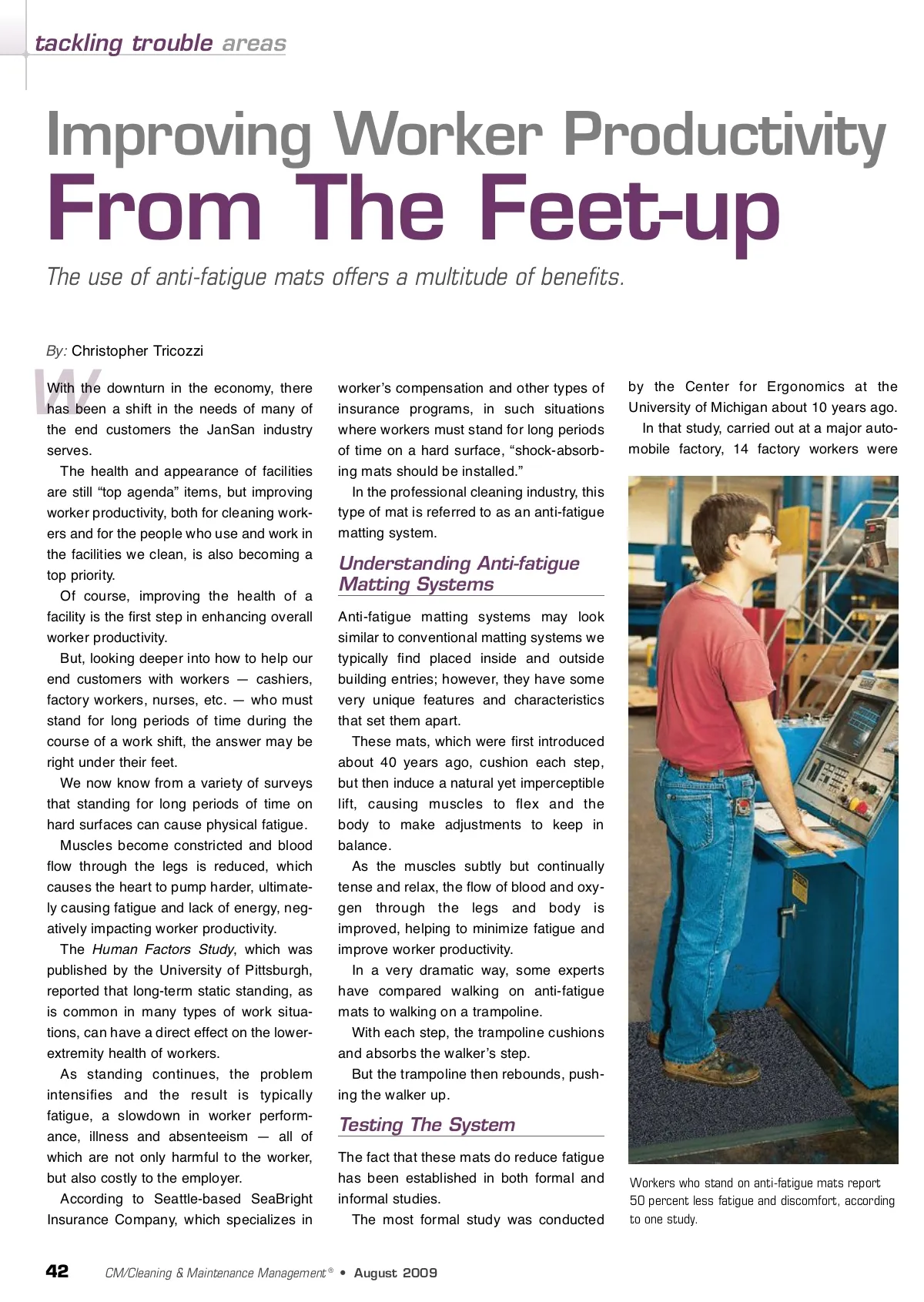
tackling trouble areas Improving Worker Productivity From The Feet-up The use of anti-fatigue mats offers a multitude of benefits. By: Christopher Tricozzi W With the downturn in the economy, there has been a shift in the needs of many of the end customers the JanSan industry serves. The health and appearance of facilities are still “top agenda” items, but improving worker productivity, both for cleaning work-ers and for the people who use and work in the facilities we clean, is also becoming a top priority. Of course, improving the health of a facility is the first step in enhancing overall worker productivity. But, looking deeper into how to help our end customers with workers — cashiers, factory workers, nurses, etc. — who must stand for long periods of time during the course of a work shift, the answer may be right under their feet. We now know from a variety of surveys that standing for long periods of time on hard surfaces can cause physical fatigue. Muscles become constricted and blood flow through the legs is reduced, which causes the heart to pump harder, ultimate-ly causing fatigue and lack of energy, neg-atively impacting worker productivity. The Human Factors Study , which was published by the University of Pittsburgh, reported that long-term static standing, as is common in many types of work situa-tions, can have a direct effect on the lower-extremity health of workers. As standing continues, the problem intensifies and the result is typically fatigue, a slowdown in worker perform-ance, illness and absenteeism — all of which are not only harmful to the worker, but also costly to the employer. According to Seattle-based SeaBright Insurance Company, which specializes in workerʼs compensation and other types of insurance programs, in such situations where workers must stand for long periods of time on a hard surface, “shock-absorb-ing mats should be installed.” In the professional cleaning industry, this type of mat is referred to as an anti-fatigue matting system. by the Center for Ergonomics at the University of Michigan about 10 years ago. In that study, carried out at a major auto-mobile factory, 14 factory workers were Understanding Anti-fatigue Matting Systems Anti-fatigue matting systems may look similar to conventional matting systems we typically find placed inside and outside building entries; however, they have some very unique features and characteristics that set them apart. These mats, which were first introduced about 40 years ago, cushion each step, but then induce a natural yet imperceptible lift, causing muscles to flex and the body to make adjustments to keep in balance. As the muscles subtly but continually tense and relax, the flow of blood and oxy-gen through the legs and body is improved, helping to minimize fatigue and improve worker productivity. In a very dramatic way, some experts have compared walking on anti-fatigue mats to walking on a trampoline. With each step, the trampoline cushions and absorbs the walkerʼs step. But the trampoline then rebounds, push-ing the walker up. Testing The System The fact that these mats do reduce fatigue has been established in both formal and informal studies. The most formal study was conducted Workers who stand on anti-fatigue mats report 50 percent less fatigue and discomfort, according to one study. 42 CM/Cleaning & Maintenance Management ® • August 2009
CMM – Archives Aug 2009: 42