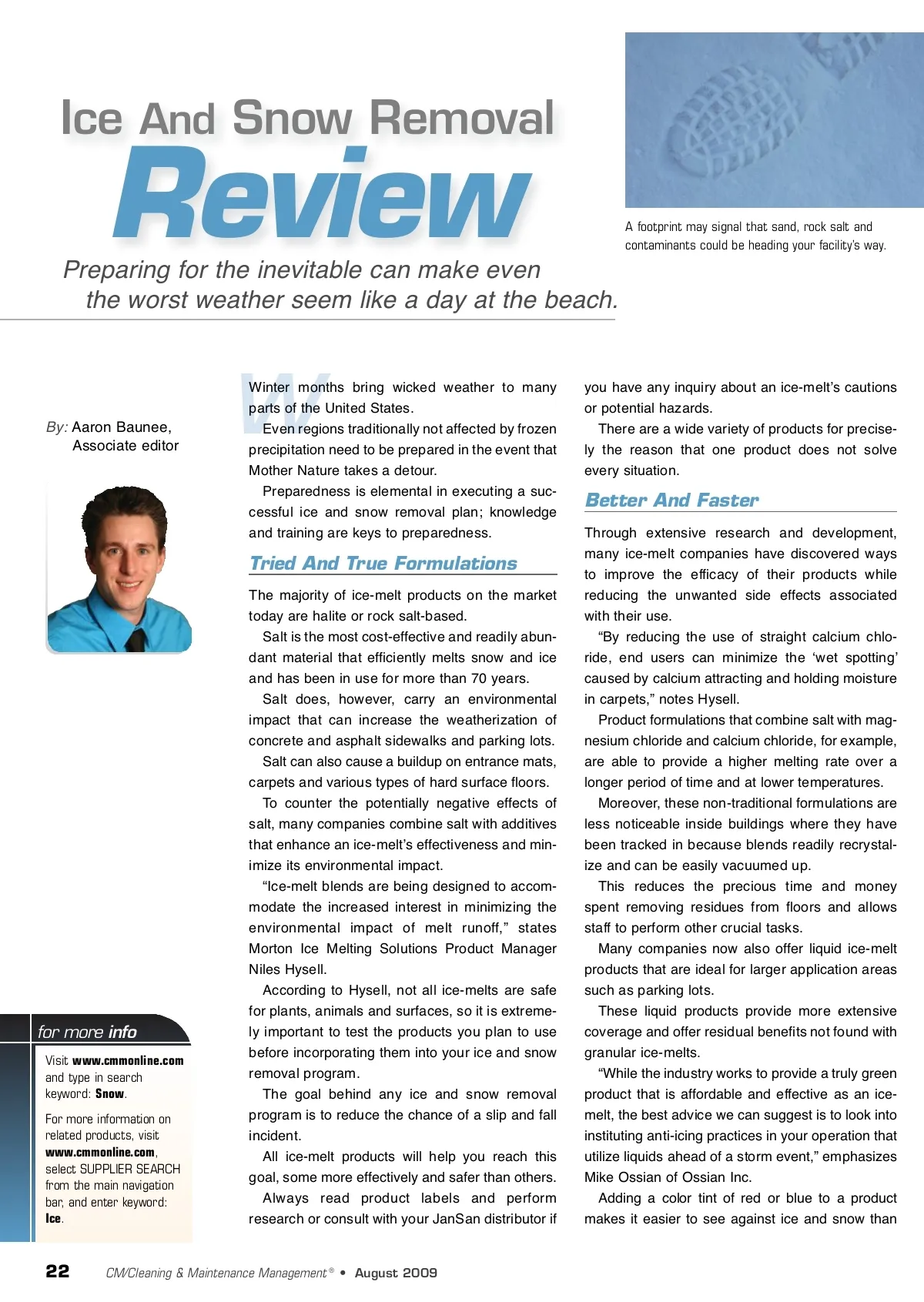
Ice And Snow Removal Review Preparing for the inevitable can make even the worst weather seem like a day at the beach. By: Aaron Baunee, Associate editor A footprint may signal that sand, rock salt and contaminants could be heading your facility’s way. W Winter months bring wicked weather to many parts of the United States. Even regions traditionally not affected by frozen precipitation need to be prepared in the event that Mother Nature takes a detour. Preparedness is elemental in executing a suc-cessful ice and snow removal plan; knowledge and training are keys to preparedness. you have any inquiry about an ice-meltʼs cautions or potential hazards. There are a wide variety of products for precise-ly the reason that one product does not solve every situation. Better And Faster Through extensive research and development, many ice-melt companies have discovered ways to improve the efficacy of their products while reducing the unwanted side effects associated with their use. “By reducing the use of straight calcium chlo-ride, end users can minimize the ʻwet spottingʼ caused by calcium attracting and holding moisture in carpets,” notes Hysell. Product formulations that combine salt with mag-nesium chloride and calcium chloride, for example, are able to provide a higher melting rate over a longer period of time and at lower temperatures. Moreover, these non-traditional formulations are less noticeable inside buildings where they have been tracked in because blends readily recrystal-ize and can be easily vacuumed up. This reduces the precious time and money spent removing residues from floors and allows staff to perform other crucial tasks. Many companies now also offer liquid ice-melt products that are ideal for larger application areas such as parking lots. These liquid products provide more extensive coverage and offer residual benefits not found with granular ice-melts. “While the industry works to provide a truly green product that is affordable and effective as an ice-melt, the best advice we can suggest is to look into instituting anti-icing practices in your operation that utilize liquids ahead of a storm event,” emphasizes Mike Ossian of Ossian Inc. Adding a color tint of red or blue to a product makes it easier to see against ice and snow than Tried And True Formulations The majority of ice-melt products on the market today are halite or rock salt-based. Salt is the most cost-effective and readily abun-dant material that efficiently melts snow and ice and has been in use for more than 70 years. Salt does, however, carry an environmental impact that can increase the weatherization of concrete and asphalt sidewalks and parking lots. Salt can also cause a buildup on entrance mats, carpets and various types of hard surface floors. To counter the potentially negative effects of salt, many companies combine salt with additives that enhance an ice-meltʼs effectiveness and min-imize its environmental impact. “Ice-melt blends are being designed to accom-modate the increased interest in minimizing the environmental impact of melt runoff,” states Morton Ice Melting Solutions Product Manager Niles Hysell. According to Hysell, not all ice-melts are safe for plants, animals and surfaces, so it is extreme-ly important to test the products you plan to use before incorporating them into your ice and snow removal program. The goal behind any ice and snow removal program is to reduce the chance of a slip and fall incident. All ice-melt products will help you reach this goal, some more effectively and safer than others. Always read product labels and perform research or consult with your JanSan distributor if for more info Visit www.cmmonline.com and type in search keyword: Snow . For more information on related products, visit www.cmmonline.com , select SUPPLIER SEARCH from the main navigation bar, and enter keyword: Ice . 22 CM/Cleaning & Maintenance Management ® • August 2009
CMM – Archives Aug 2009: 22