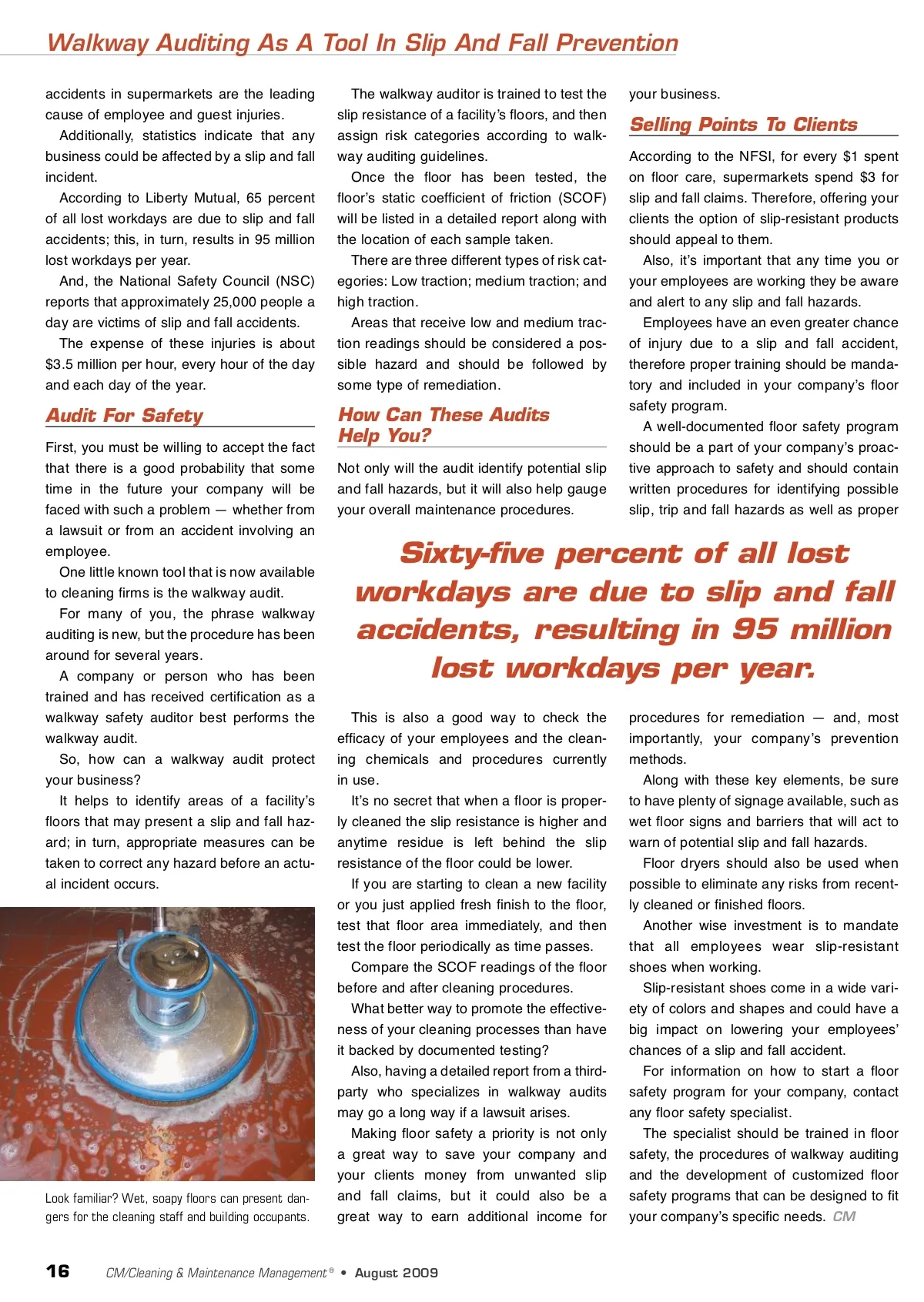
Walkway Auditing As A Tool In Slip And Fall Prevention accidents in supermarkets are the leading cause of employee and guest injuries. Additionally, statistics indicate that any business could be affected by a slip and fall incident. According to Liberty Mutual, 65 percent of all lost workdays are due to slip and fall accidents; this, in turn, results in 95 million lost workdays per year. And, the National Safety Council (NSC) reports that approximately 25,000 people a day are victims of slip and fall accidents. The expense of these injuries is about $3.5 million per hour, every hour of the day and each day of the year. The walkway auditor is trained to test the slip resistance of a facilityʼs floors, and then assign risk categories according to walk-way auditing guidelines. Once the floor has been tested, the floorʼs static coefficient of friction (SCOF) will be listed in a detailed report along with the location of each sample taken. There are three different types of risk cat-egories: Low traction; medium traction; and high traction. Areas that receive low and medium trac-tion readings should be considered a pos-sible hazard and should be followed by some type of remediation. your business. Selling Points To Clients According to the NFSI, for every $1 spent on floor care, supermarkets spend $3 for slip and fall claims. Therefore, offering your clients the option of slip-resistant products should appeal to them. Also, itʼs important that any time you or your employees are working they be aware and alert to any slip and fall hazards. Employees have an even greater chance of injury due to a slip and fall accident, therefore proper training should be manda-tory and included in your companyʼs floor safety program. A well-documented floor safety program should be a part of your companyʼs proac-tive approach to safety and should contain written procedures for identifying possible slip, trip and fall hazards as well as proper Audit For Safety First, you must be willing to accept the fact that there is a good probability that some time in the future your company will be faced with such a problem — whether from a lawsuit or from an accident involving an employee. One little known tool that is now available to cleaning firms is the walkway audit. For many of you, the phrase walkway auditing is new, but the procedure has been around for several years. A company or person who has been trained and has received certification as a walkway safety auditor best performs the walkway audit. So, how can a walkway audit protect your business? It helps to identify areas of a facilityʼs floors that may present a slip and fall haz-ard; in turn, appropriate measures can be taken to correct any hazard before an actu-al incident occurs. How Can These Audits Help You? Not only will the audit identify potential slip and fall hazards, but it will also help gauge your overall maintenance procedures. Sixty-five percent of all lost workdays are due to slip and fall accidents, resulting in 95 million lost workdays per year. This is also a good way to check the efficacy of your employees and the clean-ing chemicals and procedures currently in use. Itʼs no secret that when a floor is proper-ly cleaned the slip resistance is higher and anytime residue is left behind the slip resistance of the floor could be lower. If you are starting to clean a new facility or you just applied fresh finish to the floor, test that floor area immediately, and then test the floor periodically as time passes. Compare the SCOF readings of the floor before and after cleaning procedures. What better way to promote the effective-ness of your cleaning processes than have it backed by documented testing? Also, having a detailed report from a third-party who specializes in walkway audits may go a long way if a lawsuit arises. Making floor safety a priority is not only a great way to save your company and your clients money from unwanted slip and fall claims, but it could also be a great way to earn additional income for procedures for remediation — and, most importantly, your companyʼs prevention methods. Along with these key elements, be sure to have plenty of signage available, such as wet floor signs and barriers that will act to warn of potential slip and fall hazards. Floor dryers should also be used when possible to eliminate any risks from recent-ly cleaned or finished floors. Another wise investment is to mandate that all employees wear slip-resistant shoes when working. Slip-resistant shoes come in a wide vari-ety of colors and shapes and could have a big impact on lowering your employeesʼ chances of a slip and fall accident. For information on how to start a floor safety program for your company, contact any floor safety specialist. The specialist should be trained in floor safety, the procedures of walkway auditing and the development of customized floor safety programs that can be designed to fit your companyʼs specific needs. CM Look familiar? Wet, soapy floors can present dan-gers for the cleaning staff and building occupants. 16 CM/Cleaning & Maintenance Management ® • August 2009
CMM – Archives Aug 2009: 16