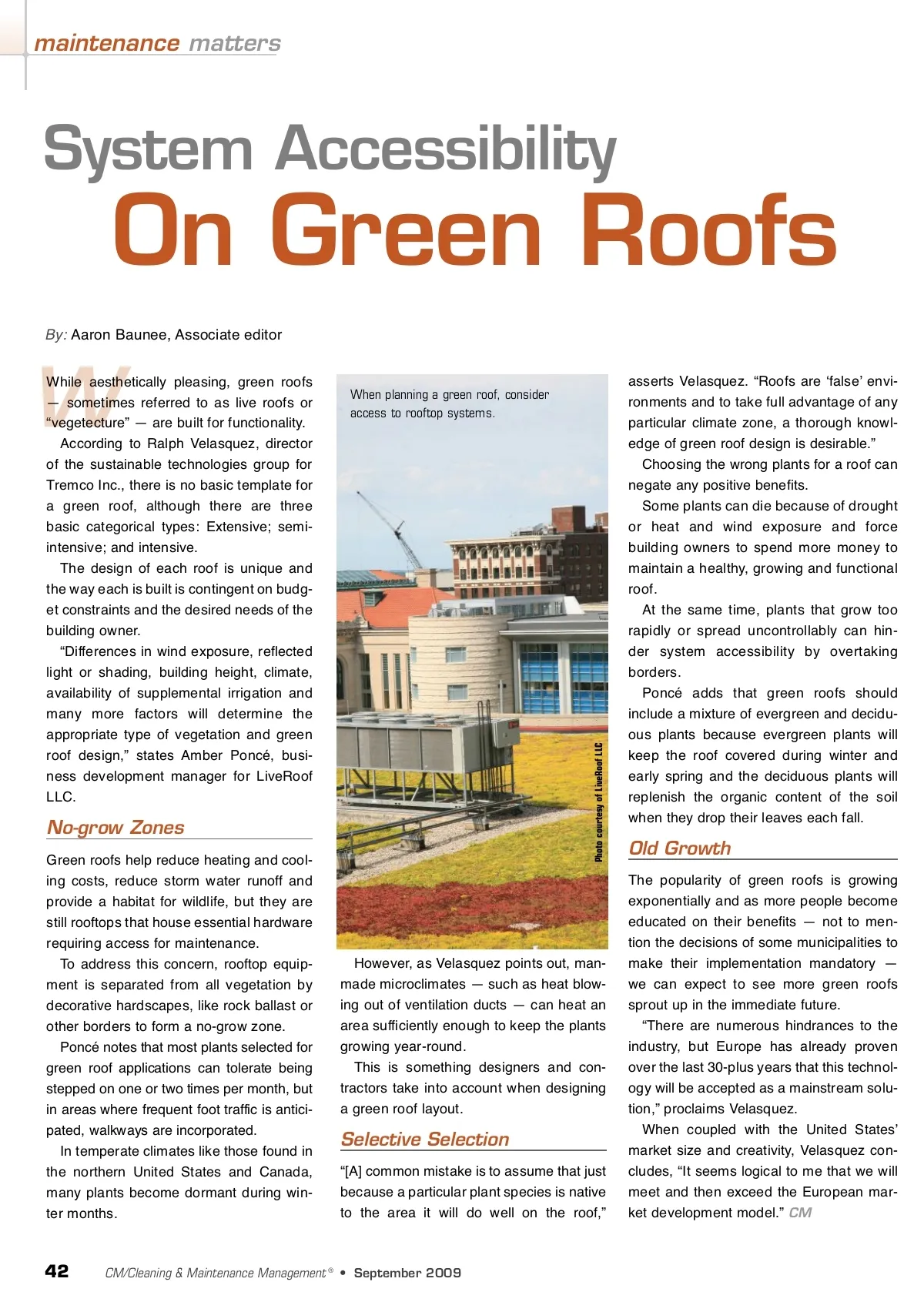
maintenance matters System Accessibility On Green Roofs By: Aaron Baunee, Associate editor W No-grow Zones Green roofs help reduce heating and cool-ing costs, reduce storm water runoff and provide a habitat for wildlife, but they are still rooftops that house essential hardware requiring access for maintenance. To address this concern, rooftop equip-ment is separated from all vegetation by decorative hardscapes, like rock ballast or other borders to form a no-grow zone. Poncé notes that most plants selected for green roof applications can tolerate being stepped on one or two times per month, but in areas where frequent foot traffic is antici-pated, walkways are incorporated. In temperate climates like those found in the northern United States and Canada, many plants become dormant during win-ter months. Photo courtesy of LiveRoof LLC While aesthetically pleasing, green roofs — sometimes referred to as live roofs or “vegetecture” — are built for functionality. According to Ralph Velasquez, director of the sustainable technologies group for Tremco Inc., there is no basic template for a green roof, although there are three basic categorical types: Extensive; semi-intensive; and intensive. The design of each roof is unique and the way each is built is contingent on budg-et constraints and the desired needs of the building owner. “Differences in wind exposure, reflected light or shading, building height, climate, availability of supplemental irrigation and many more factors will determine the appropriate type of vegetation and green roof design,” states Amber Poncé, busi-ness development manager for LiveRoof LLC. When planning a green roof, consider access to rooftop systems. asserts Velasquez. “Roofs are ʻfalseʼ envi-ronments and to take full advantage of any particular climate zone, a thorough knowl-edge of green roof design is desirable.” Choosing the wrong plants for a roof can negate any positive benefits. Some plants can die because of drought or heat and wind exposure and force building owners to spend more money to maintain a healthy, growing and functional roof. At the same time, plants that grow too rapidly or spread uncontrollably can hin-der system accessibility by overtaking borders. Poncé adds that green roofs should include a mixture of evergreen and decidu-ous plants because evergreen plants will keep the roof covered during winter and early spring and the deciduous plants will replenish the organic content of the soil when they drop their leaves each fall. Old Growth The popularity of green roofs is growing exponentially and as more people become educated on their benefits — not to men-tion the decisions of some municipalities to make their implementation mandatory — we can expect to see more green roofs sprout up in the immediate future. “There are numerous hindrances to the industry, but Europe has already proven over the last 30-plus years that this technol-ogy will be accepted as a mainstream solu-tion,” proclaims Velasquez. When coupled with the United Statesʼ market size and creativity, Velasquez con-cludes, “It seems logical to me that we will meet and then exceed the European mar-ket development model.” CM However, as Velasquez points out, man-made microclimates — such as heat blow-ing out of ventilation ducts — can heat an area sufficiently enough to keep the plants growing year-round. This is something designers and con-tractors take into account when designing a green roof layout. Selective Selection “[A] common mistake is to assume that just because a particular plant species is native to the area it will do well on the roof,” 42 CM/Cleaning & Maintenance Management ® • September 2009
CMM – Archives Sept 2009: 42