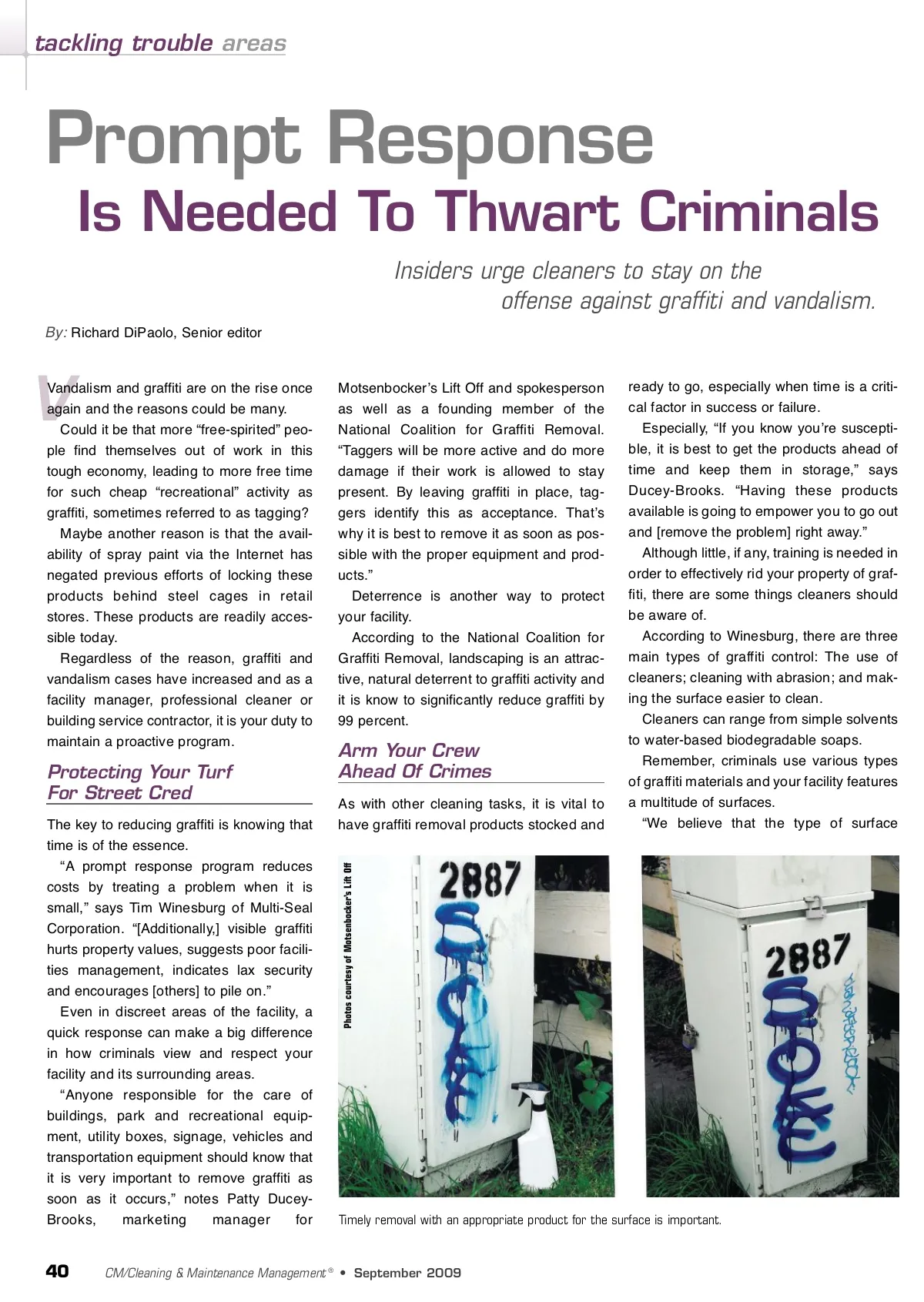
defines the best product to use,” advises Winesburg. The means of abrasion in graffiti removal have varied over the years, such as using sandblasting, pressurized water and softer abrasive materials like baking soda. “These techniques can work, but are lim-ited in what surfaces they can serve,” notes Winesburg. “Also, you run the cost of the equipment and they require more training to avoid personnel injury and surface [dam-age].” The final stage in graffiti removal is to make the surface easier to clean. “Both sacrificial and permanent top coat-ing sealers make cleaning faster, frequent-ly without the use of cleaning chemicals at all. Manufacturers are also starting to make graffiti-proof surfaces. Long-term, protected surfaces will lower costs and discourage taggers.” Examples of indoor graffiti include marks left behind from pens, markers and pencils. However, experts warn strict caution when selecting a graffiti removal product for the job because the wrong product can lead to more problems, including surface damage. “Because some surfaces are more deli-cate than others, the product should always be tested first to see not only that it is effec-tive, but that it does not cause further dam-age to the surface,” advises Parillo. Professional cleaners should be armed with an adequate amount of supplies, knowledge of surfaces and an awareness of the different types of graffiti. Cases are on the rise and chances are that your crew must answer the call in a timely fashion. Have you given them a head start? CM Dealing With Different Surfaces And Vandalism Knowing the surface, the type of vandalism and your options are critical in a graffiti removal and prevention program. “For each application of graffiti there is a means to remove it. With painted surfaces, try to match the paint as closely as possi-ble, so it doesnʼt give the appearance that itʼs been tagged,” suggests Ducey-Brooks. “We also recommend that you first remove the graffiti with a graffiti remover so that it doesnʼt bleed through the fresh paint.” For unpainted brick and concrete sur-faces, which are porous, a wire brush and a high-pressure water system (1,500 pounds of pressure per square inch (PSI) with a 10-15 degree nozzle) can prove beneficial. “Agitate the paint/graffiti with a wire brush and then use the high-pressure water sys-tem to get underneath the paint/graffiti. Remember, the paint has been absorbed because of the porous surface. We recom-mend that you work ʻtop-downʼ when using the high-pressure water system,” says Ducey-Brooks. Just as important is being able to identify the different types of graffiti and vandalism that can plague your property. According to Rich Parillo, building service contractor specialist at Pro-Link, there are actually two types of graffiti: Indoor graffiti and outdoor graffiti. Circle Product Information no. 209 on page 32 www.cmmonline.com 41
CMM – Archives Sept 2009: 41