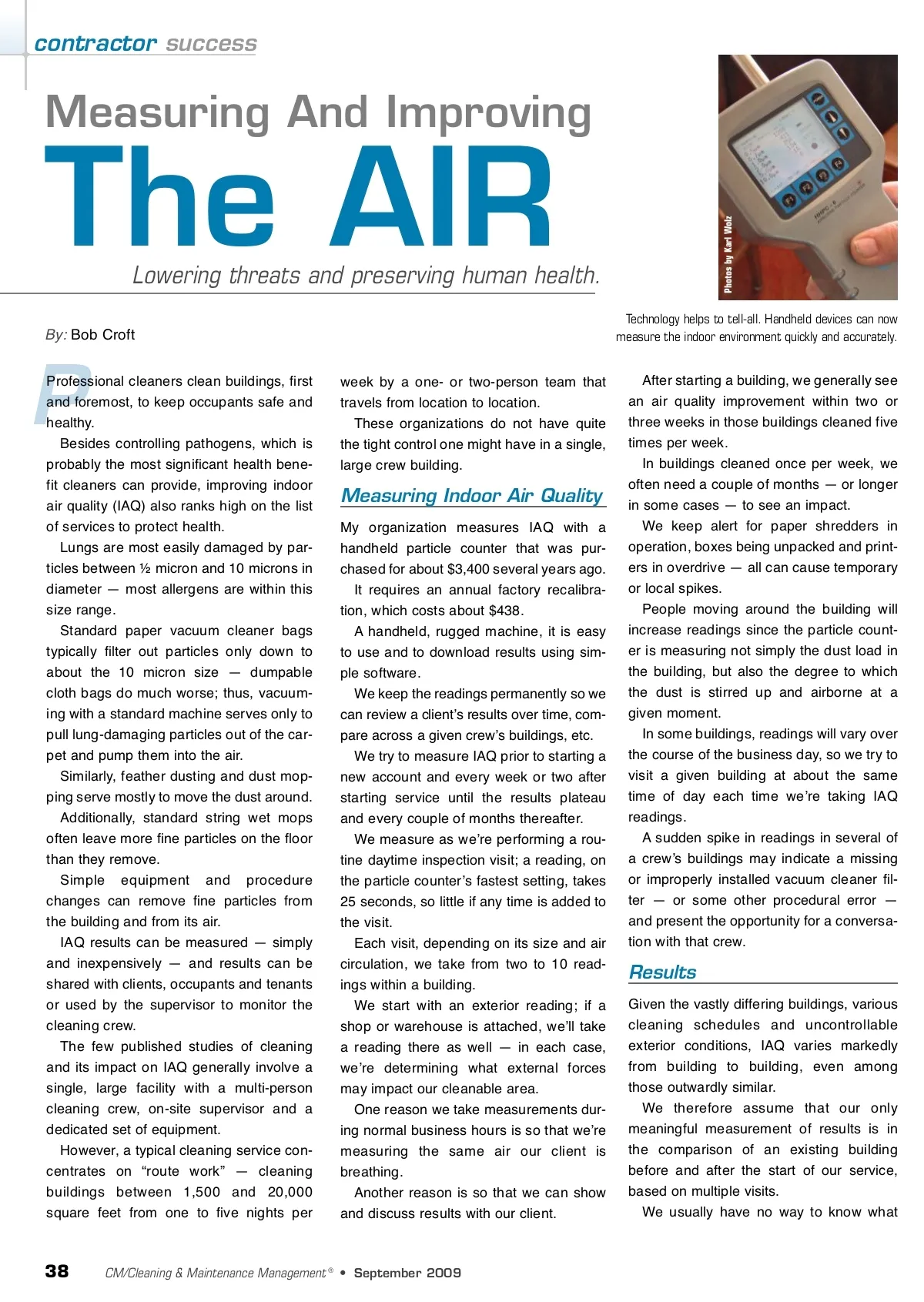
equipment and procedures our predeces-sors were using. Also, the usage of a building could have changed at about the time the account was taken on. Cleaning frequency might differ from your predecessorʼs or external conditions could overwhelm your efforts. Thus, measured IAQ improvements — before start of service versus ongoing — can vary widely. About one-sixth of our buildings show lit-tle or no results; one-third show particle count reductions in the 30 to 55 percent range; and about half show reductions of 55 to 85 percent. These results are only from cases in which we can compare our results to our predecessorʼs. Comparing our results to those of a con-struction cleanup — whether good or bad — seems meaningless. We have not yet seen particle counts rise after the start of our service, as one might expect if the system were having little Simple Changes To Impact Air Quality High-efficiency particulate air (HEPA) filter equipped back-pack vacuums, used for both carpet and hard floors Microfiber damp mops that are changed and laundered often Dust wiping (not feather dusting) using microfiber cloths that are laundered often Avoiding aerosols, spray bottles, scouring powders and other products containing high levels of volatile organic com-pounds (VOCs). impact — that is, if varied readings were entirely attributable to chance. Cleaning for health and safety, with a strong focus on indoor air quality, produces a healthier building. It produces a cleaner looking building as well — after all, removing dust from the air also keeps dust from landing on surfaces. Additionally, ongoing cleaning costs tend to be reduced. A cleaner building when we service tonight gives us a cleaner building to be serviced tomorrow. Monitoring indoor air quality provides a measure of cleaning effectiveness that is quantifiable and can be shared with the client or tenant. A quantifiably cleaner building sets a cleaning contractor apart from his competi-tion and sets the building apart as well. CM Bob Croft ([email protected]) is president of CBN Building Maintenance, a 34-year-old jan-itorial service in Phoenix. He holds BSCAI’s CBSE designation and is quoted extensively in BSCAI’s “Guide to Green Cleaning.” He’s a member of the Phoenix Environmental Quality Commission, the American Indoor Air Quality Council and arbitrates for the BBB. Follow Bob’s blog at http://cbnclean.typepad.com/blog. Circle Product Information no. 260 on page 32 www.cmmonline.com 39
CMM – Archives Sept 2009: 39