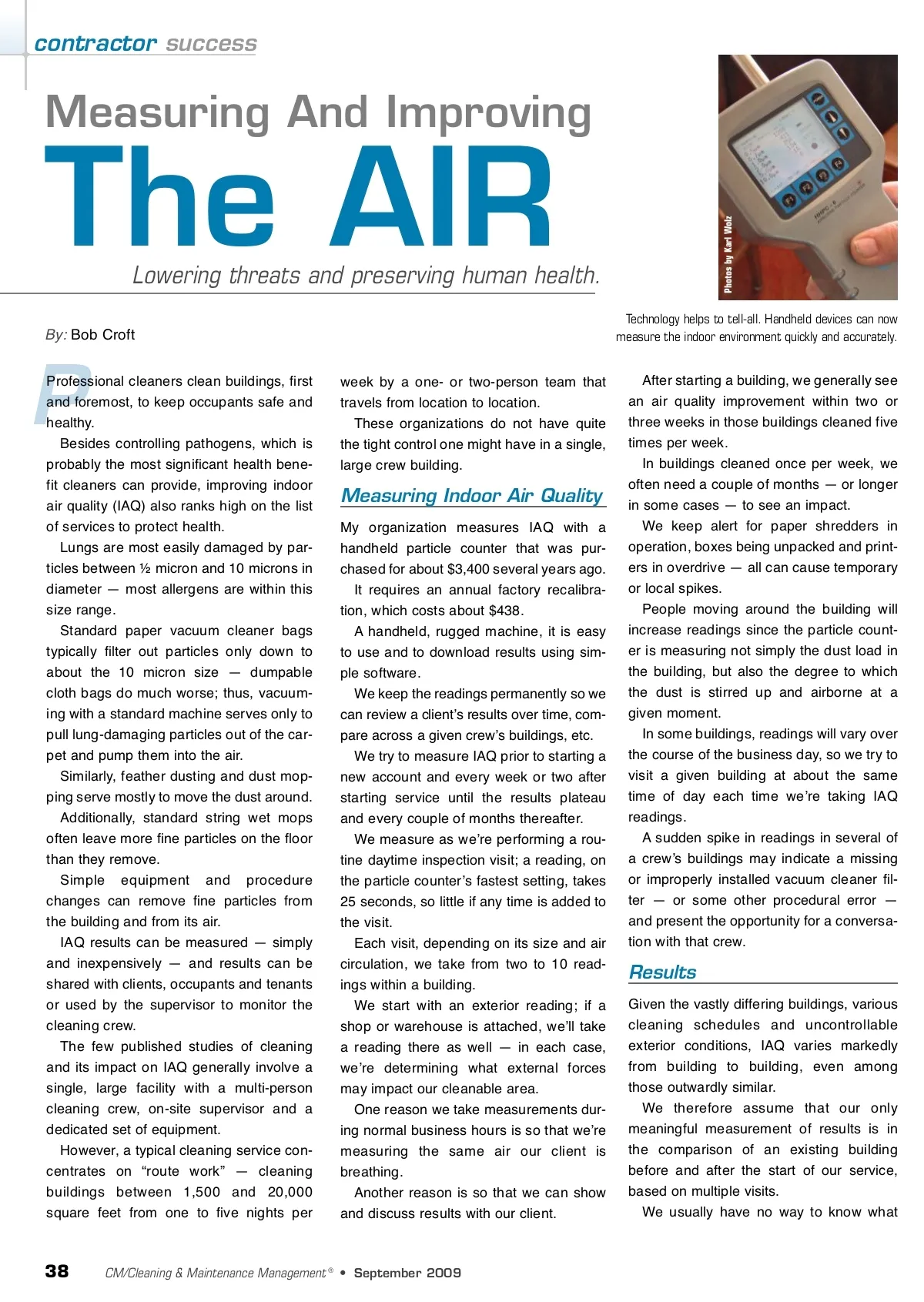
contractor success Measuring And Improving Photos by Karl Wolz The AIR By: Bob Croft Lowering threats and preserving human health. Technology helps to tell-all. Handheld devices can now measure the indoor environment quickly and accurately. P Professional cleaners clean buildings, first and foremost, to keep occupants safe and healthy. Besides controlling pathogens, which is probably the most significant health bene-fit cleaners can provide, improving indoor air quality (IAQ) also ranks high on the list of services to protect health. Lungs are most easily damaged by par-ticles between ½ micron and 10 microns in diameter — most allergens are within this size range. Standard paper vacuum cleaner bags typically filter out particles only down to about the 10 micron size — dumpable cloth bags do much worse; thus, vacuum-ing with a standard machine serves only to pull lung-damaging particles out of the car-pet and pump them into the air. Similarly, feather dusting and dust mop-ping serve mostly to move the dust around. Additionally, standard string wet mops often leave more fine particles on the floor than they remove. Simple equipment and procedure changes can remove fine particles from the building and from its air. IAQ results can be measured — simply and inexpensively — and results can be shared with clients, occupants and tenants or used by the supervisor to monitor the cleaning crew. The few published studies of cleaning and its impact on IAQ generally involve a single, large facility with a multi-person cleaning crew, on-site supervisor and a dedicated set of equipment. However, a typical cleaning service con-centrates on “route work” — cleaning buildings between 1,500 and 20,000 square feet from one to five nights per week by a one-or two-person team that travels from location to location. These organizations do not have quite the tight control one might have in a single, large crew building. Measuring Indoor Air Quality My organization measures IAQ with a handheld particle counter that was pur-chased for about $3,400 several years ago. It requires an annual factory recalibra-tion, which costs about $438. A handheld, rugged machine, it is easy to use and to download results using sim-ple software. We keep the readings permanently so we can review a clientʼs results over time, com-pare across a given crewʼs buildings, etc. We try to measure IAQ prior to starting a new account and every week or two after starting service until the results plateau and every couple of months thereafter. We measure as weʼre performing a rou-tine daytime inspection visit; a reading, on the particle counterʼs fastest setting, takes 25 seconds, so little if any time is added to the visit. Each visit, depending on its size and air circulation, we take from two to 10 read-ings within a building. We start with an exterior reading; if a shop or warehouse is attached, weʼll take a reading there as well — in each case, weʼre determining what external forces may impact our cleanable area. One reason we take measurements dur-ing normal business hours is so that weʼre measuring the same air our client is breathing. Another reason is so that we can show and discuss results with our client. After starting a building, we generally see an air quality improvement within two or three weeks in those buildings cleaned five times per week. In buildings cleaned once per week, we often need a couple of months — or longer in some cases — to see an impact. We keep alert for paper shredders in operation, boxes being unpacked and print-ers in overdrive — all can cause temporary or local spikes. People moving around the building will increase readings since the particle count-er is measuring not simply the dust load in the building, but also the degree to which the dust is stirred up and airborne at a given moment. In some buildings, readings will vary over the course of the business day, so we try to visit a given building at about the same time of day each time weʼre taking IAQ readings. A sudden spike in readings in several of a crewʼs buildings may indicate a missing or improperly installed vacuum cleaner fil-ter — or some other procedural error — and present the opportunity for a conversa-tion with that crew. Results Given the vastly differing buildings, various cleaning schedules and uncontrollable exterior conditions, IAQ varies markedly from building to building, even among those outwardly similar. We therefore assume that our only meaningful measurement of results is in the comparison of an existing building before and after the start of our service, based on multiple visits. We usually have no way to know what 38 CM/Cleaning & Maintenance Management ® • September 2009
CMM – Archives Sept 2009: 38