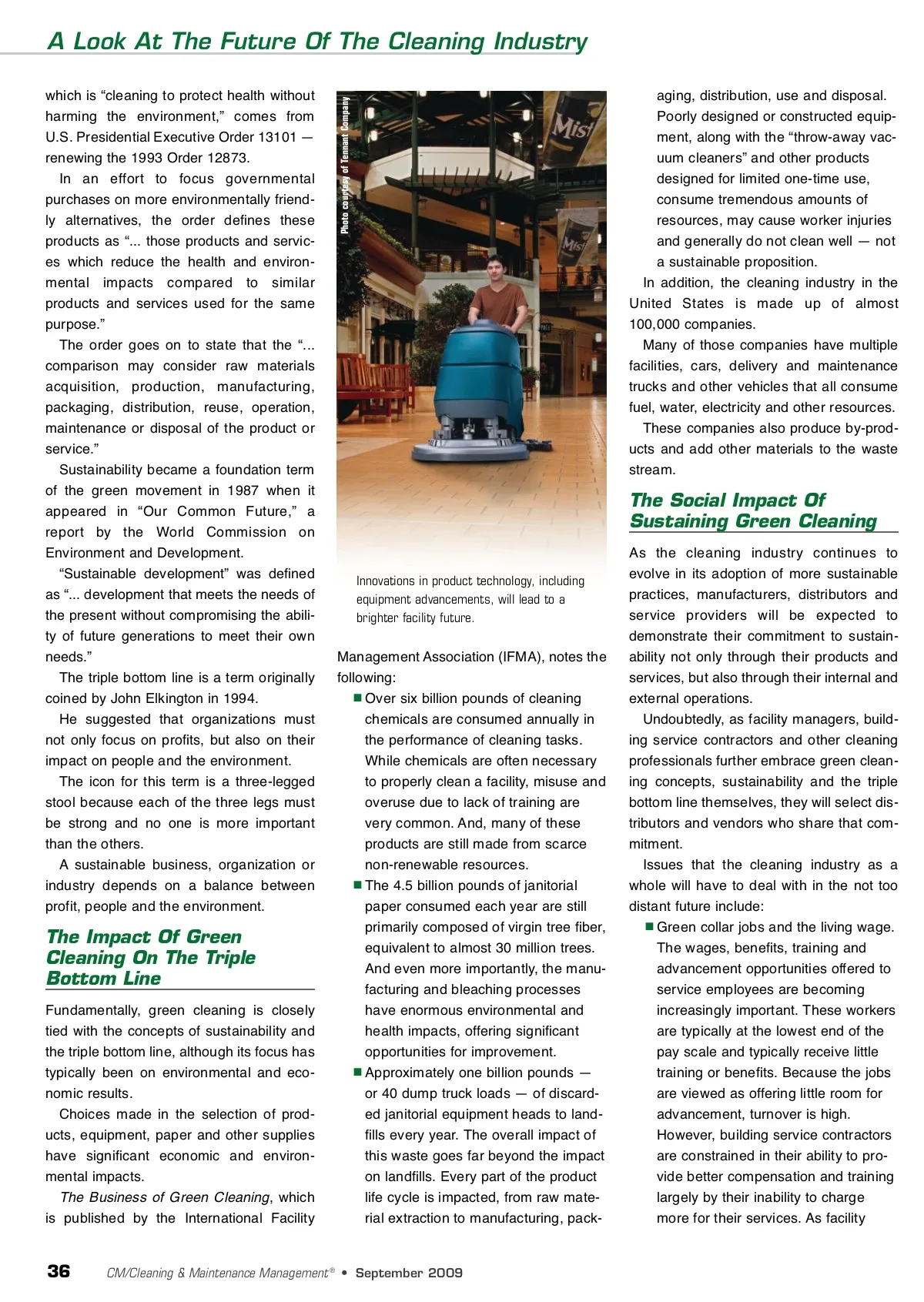
A Look At The Future Of The Cleaning Industry which is “cleaning to protect health without harming the environment,” comes from U.S. Presidential Executive Order 13101 — renewing the 1993 Order 12873. In an effort to focus governmental purchases on more environmentally friend-ly alternatives, the order defines these products as “... those products and servic-es which reduce the health and environ-mental impacts compared to similar products and services used for the same purpose.” The order goes on to state that the “... comparison may consider raw materials acquisition, production, manufacturing, packaging, distribution, reuse, operation, maintenance or disposal of the product or service.” Sustainability became a foundation term of the green movement in 1987 when it appeared in “Our Common Future,” a report by the World Commission on Environment and Development. “Sustainable development” was defined as “... development that meets the needs of the present without compromising the abili-ty of future generations to meet their own needs.” The triple bottom line is a term originally coined by John Elkington in 1994. He suggested that organizations must not only focus on profits, but also on their impact on people and the environment. The icon for this term is a three-legged stool because each of the three legs must be strong and no one is more important than the others. A sustainable business, organization or industry depends on a balance between profit, people and the environment. aging, distribution, use and disposal. Poorly designed or constructed equip-ment, along with the “throw-away vac-uum cleaners” and other products designed for limited one-time use, consume tremendous amounts of resources, may cause worker injuries and generally do not clean well — not a sustainable proposition. In addition, the cleaning industry in the United States is made up of almost 100,000 companies. Many of those companies have multiple facilities, cars, delivery and maintenance trucks and other vehicles that all consume fuel, water, electricity and other resources. These companies also produce by-prod-ucts and add other materials to the waste stream. Photo courtesy of Tennant Company The Social Impact Of Sustaining Green Cleaning Innovations in product technology, including equipment advancements, will lead to a brighter facility future. The Impact Of Green Cleaning On The Triple Bottom Line Fundamentally, green cleaning is closely tied with the concepts of sustainability and the triple bottom line, although its focus has typically been on environmental and eco-nomic results. Choices made in the selection of prod-ucts, equipment, paper and other supplies have significant economic and environ-mental impacts. The Business of Green Cleaning , which is published by the International Facility Management Association (IFMA), notes the following: Over six billion pounds of cleaning chemicals are consumed annually in the performance of cleaning tasks. While chemicals are often necessary to properly clean a facility, misuse and overuse due to lack of training are very common. And, many of these products are still made from scarce non-renewable resources. The 4.5 billion pounds of janitorial paper consumed each year are still primarily composed of virgin tree fiber, equivalent to almost 30 million trees. And even more importantly, the manu-facturing and bleaching processes have enormous environmental and health impacts, offering significant opportunities for improvement. Approximately one billion pounds — or 40 dump truck loads — of discard-ed janitorial equipment heads to land-fills every year. The overall impact of this waste goes far beyond the impact on landfills. Every part of the product life cycle is impacted, from raw mate-rial extraction to manufacturing, pack-As the cleaning industry continues to evolve in its adoption of more sustainable practices, manufacturers, distributors and service providers will be expected to demonstrate their commitment to sustain-ability not only through their products and services, but also through their internal and external operations. Undoubtedly, as facility managers, build-ing service contractors and other cleaning professionals further embrace green clean-ing concepts, sustainability and the triple bottom line themselves, they will select dis-tributors and vendors who share that com-mitment. Issues that the cleaning industry as a whole will have to deal with in the not too distant future include: Green collar jobs and the living wage. The wages, benefits, training and advancement opportunities offered to service employees are becoming increasingly important. These workers are typically at the lowest end of the pay scale and typically receive little training or benefits. Because the jobs are viewed as offering little room for advancement, turnover is high. However, building service contractors are constrained in their ability to pro-vide better compensation and training largely by their inability to charge more for their services. As facility 36 CM/Cleaning & Maintenance Management ® • September 2009
CMM – Archives Sept 2009: 36