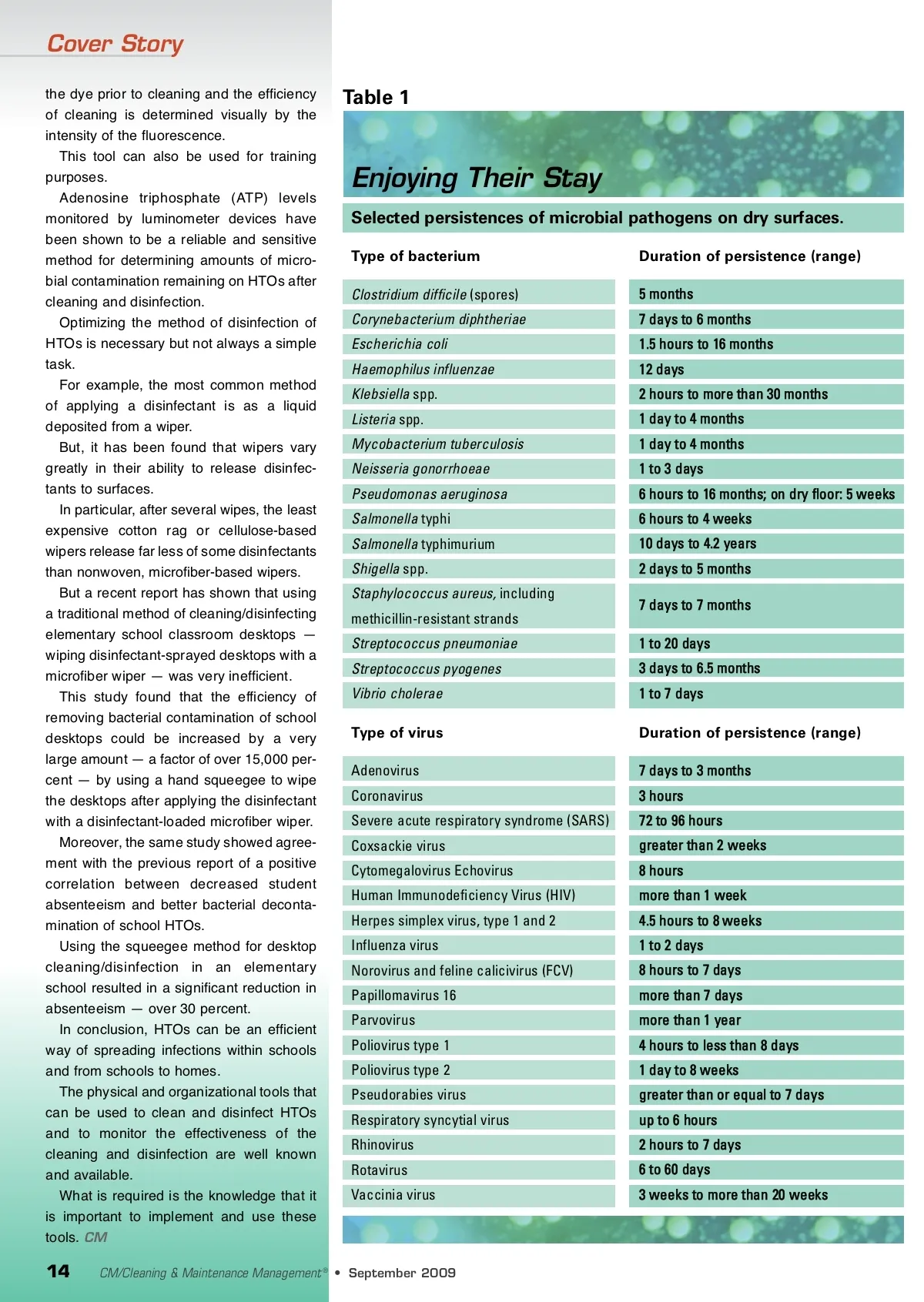
Cover Story the dye prior to cleaning and the efficiency of cleaning is determined visually by the intensity of the fluorescence. This tool can also be used for training purposes. Adenosine triphosphate (ATP) levels monitored by luminometer devices have been shown to be a reliable and sensitive method for determining amounts of micro-bial contamination remaining on HTOs after cleaning and disinfection. Optimizing the method of disinfection of HTOs is necessary but not always a simple task. For example, the most common method of applying a disinfectant is as a liquid deposited from a wiper. But, it has been found that wipers vary greatly in their ability to release disinfec-tants to surfaces. In particular, after several wipes, the least expensive cotton rag or cellulose-based wipers release far less of some disinfectants than nonwoven, microfiber-based wipers. But a recent report has shown that using a traditional method of cleaning/disinfecting elementary school classroom desktops — wiping disinfectant-sprayed desktops with a microfiber wiper — was very inefficient. This study found that the efficiency of removing bacterial contamination of school desktops could be increased by a very large amount — a factor of over 15,000 per-cent — by using a hand squeegee to wipe the desktops after applying the disinfectant with a disinfectant-loaded microfiber wiper. Moreover, the same study showed agree-ment with the previous report of a positive correlation between decreased student absenteeism and better bacterial deconta-mination of school HTOs. Using the squeegee method for desktop cleaning/disinfection in an elementary school resulted in a significant reduction in absenteeism — over 30 percent. In conclusion, HTOs can be an efficient way of spreading infections within schools and from schools to homes. The physical and organizational tools that can be used to clean and disinfect HTOs and to monitor the effectiveness of the cleaning and disinfection are well known and available. What is required is the knowledge that it is important to implement and use these tools. CM Table 1 Enjoying Their Stay Selected persistences of microbial pathogens on dry surfaces. Type of bacterium Duration of persistence (range) 5 m o n t h s 7 d a y s t o 6 mo n t h s 1 . 5 h o u r s t o 1 6 m o n t h s 1 2 d a y s 2 h o u r s t o m o r e th a n 3 0 m o n t h s 1 d a y t o 4 mo n t h s 1 d a y t o 4 mo n t h s 1 t o 3 d a y s 6 h o u r s t o 1 6 mo n t h s ; o n d r y f l o o r : 5 w e e k s 6 h o u r s t o 4 we e k s 1 0 d a y s t o 4 . 2 y e a r s 2 d a y s t o 5 mo n t h s 7 d a y s t o 7 mo n t h s 1 t o 2 0 d a y s 3 d a y s t o 6 . 5 m o n t h s 1 t o 7 d a y s Duration of persistence (range) 7 d a y s t o 3 mo n t h s 3 h o u r s 7 2 t o 9 6 h o u r s g r e a t e r t h a n 2 w e e k s 8 h o u r s m o r e t h a n 1 w e e k 4 . 5 h o u r s t o 8 we e k s 1 t o 2 d a y s 8 h o u r s t o 7 da y s m o r e t h a n 7 d a y s m o r e t h a n 1 y e a r 4 h o u r s t o l e s s th a n 8 d a y s 1 d a y t o 8 we e k s g r e a t e r t h a n o r e q u a l to 7 d a y s u p t o 6 h o u r s 2 h o u r s t o 7 da y s 6 t o 6 0 d a y s 3 w e e k s t o m o r e th a n 2 0 w e e k s Clostridium difficile (spores) Corynebacterium diphtheriae Escherichia coli Haemophilus influenzae Klebsiella spp. Listeria spp. Mycobacterium tuberculosis Neisseria gonorrhoeae Pseudomonas aeruginosa Salmonella typhi Salmonella typhimurium Shigella spp. Staphylococcus aureus, including methicillin-resistant strands Streptococcus pneumoniae Streptococcus pyogenes Vibrio cholerae Type of virus Adenovirus Coronavirus Severe acute respiratory syndrome (SARS) Coxsackie virus Cytomegalovirus Echovirus Human Immunodeficiency Virus (HIV) Herpes simplex virus, type 1 and 2 Influenza virus Norovirus and feline calicivirus (FCV) Papillomavirus 16 Parvovirus Poliovirus type 1 Poliovirus type 2 Pseudorabies virus Respiratory syncytial virus Rhinovirus Rotavirus Vaccinia virus 14 CM/Cleaning & Maintenance Management ® • September 2009
CMM – Archives Sept 2009: 14