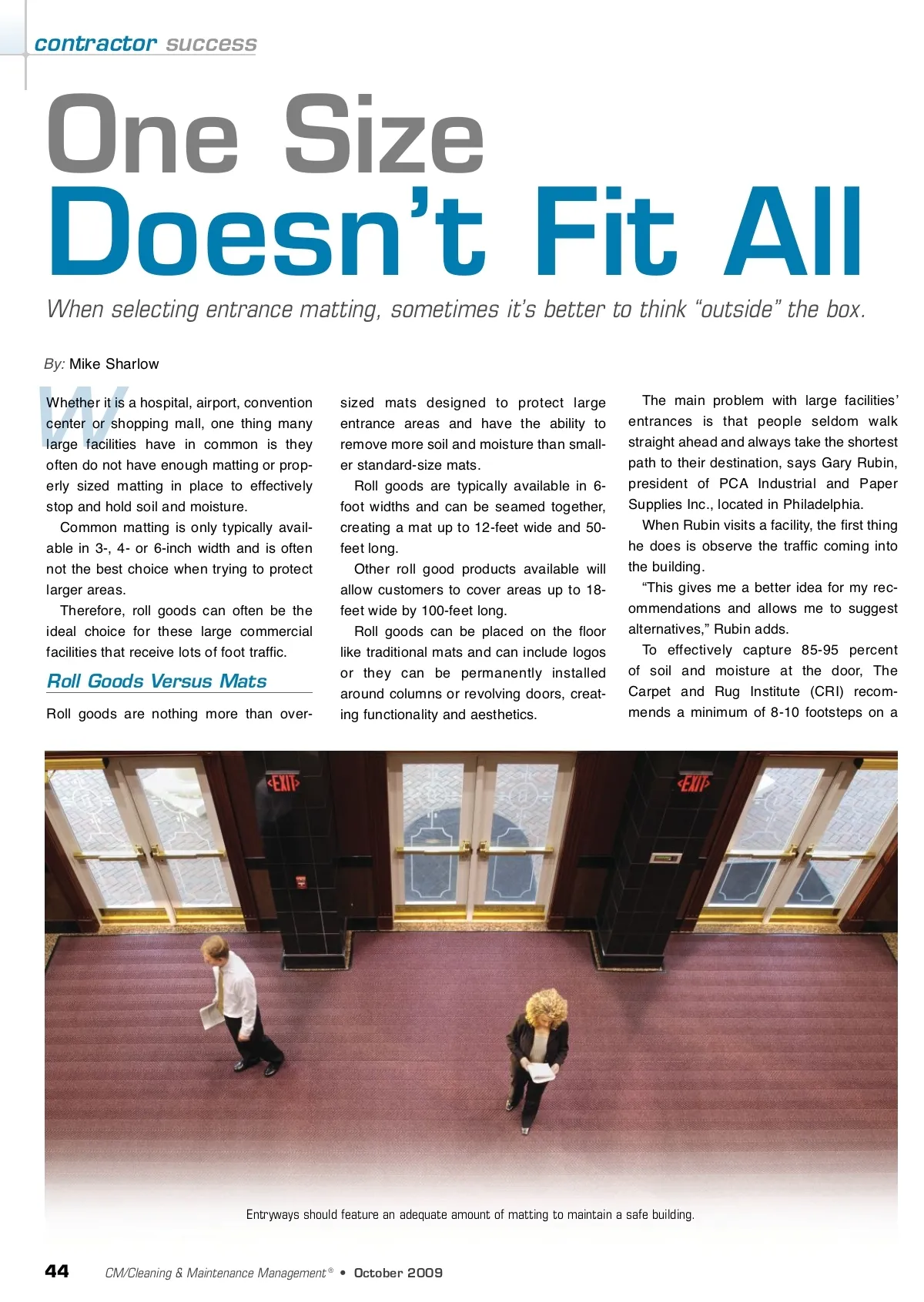
mat before stepping off onto the floor in any direction. “That typically represents at least a mini-mum of 12 feet of matting across large entrances,” says Rubin. Consider Safety An important consideration when choosing effective roll goods is that it should have a permanent bi-level surface to effectively hold and hide soil and moisture to prevent it from migrating further into the building; it should also be reinforced with rubber to prevent crushing. Roll goods are heavier and less likely to move on the floor, creating a safer surface with less risk for tripping hazards compared to smaller mats. The use of smaller mats creates more cleaning for the building service contractor (BSC) as a result of soil being tracked fur-ther into the building. Also, facilities that use multiple small mats to cover large areas often create a tripping hazard, as mentioned, and expose the facility to a potential liability. other parts of the building. Cleaning roll goods are easy for the BSC because they are typically treated just like carpet and cleaned “in place.” They should be vacuumed daily and water-extracted as needed to maintain a like-new appearance. So, the next time you need to consider matting for your entrances, sometimes itʼs better to think “outside” the box. CM Mike Sharlow is region manager for The Andersen Company, manufacturer of high-per-formance matting. Their newest product, Waterhog Eco and Enviro Plus, features a 100 percent recycled PET Polyester carpet top reclaimed from plastic drink bottles and a rubber backings from 15-89 percent recycled rubber reclaimed from used car tires. Mike is an ISSA CIMS Certified I.C.E. and has 25 years of experi-ence in the cleaning industry — 12 years as a BSC — and can be reached at [email protected]. Environmental Responsibility And Savings The use of green products continues to be an important consideration for many facili-ties; roll goods are no exception as manu-facturers are now offering products that have carpet surfaces produced from plastic drink bottles and rubber backings from recycled car tires. These practices reduce landfill waste by over 400 tons annually and also conserve the natural resources and energy that would normally be required for their pro-duction. These types of mats are also a good choice for any green building program. An ISSA study found that it costs several hundred dollars to find and remove one pound of dirt. The BSC can also save 44 percent of its cleaning time simply by having the right size mats in the main entrance area. Roll goods can also benefit BSCs as a result of having enough — and properly sized — matting in these high-traffic areas making their cleaning job easier, keeping their floors shiny longer and extending car-pet cleaning or floor stripping cycles in Circle Product Information no. 217 on page 32 www.cmmonline.com 45
CMM – Archives Oct 2009: 45