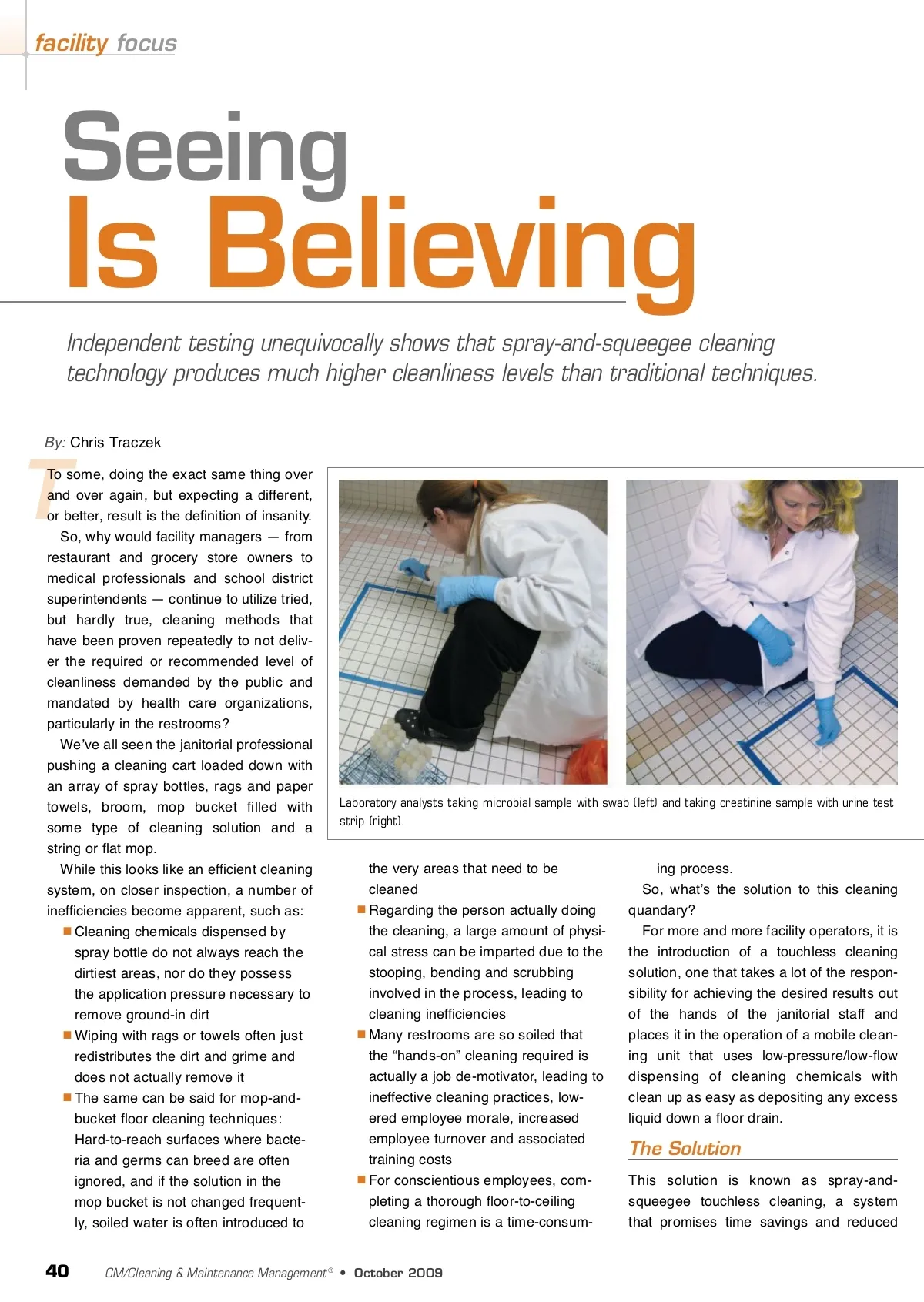
physical stress when compared to traditional mop-and-bucket cleaning, in addition to cleaner, more sanitary facilities. The efficacy of the techniqueʼs cleaning capabilities is available in a recent report titled, “Cleaning Effectiveness of the Spray-and-Squeegee Touchless Cleaning Systems Versus Conventional Mopping.” The report was generated by Advanced Testing Laboratory, an independent laboratory based in Cincinnati, which tested the effec-tiveness of spray-and-squeegee touchless cleaning technology against the cleaning capabilities of string and flat mops. The Results The results of the study found that spray-and-squeegee touchless cleaning technology showed dramatically cleaner tile and grout sur-faces in restrooms when compared to cleaning those surfaces with string or flat mops. Specific key results show that using spray-and-squeegee touch-less cleaning technology: Reduced the amount of microbial residue on tile by 99.9 per-cent — compared to 81 percent when using a string mop and 82.2 percent when using a flat mop Reduced the amount of microbial residue on grout by 98.1 percent — compared to 43.1 percent when using a string mop and 56.8 percent when using a flat mop Reduced the amount of simulated-urine residue on tile by 97.4 percent — compared to 53.1 percent when using a string mop and 57.4 percent when using a flat mop Reduced the amount of simulated-urine residue on grout by 98.3 percent — compared to 38.5 percent when using a string mop and 21.6 percent when using a flat mop. In other words, the string mop left 36 times more microbial bacte-ria on the grout surface, while the flat mop left 40 times more simu-lated-urine residue on the grout surface when both were compared to spray-and-squeegee touchless cleaning technology (Figure 1). The testing took place in a restroom on a typical tile floor where specific sections were marked off for use by the spray-and-squeegee touchless cleaning unit, a cotton-string mop and a polyester microfiber flat mop. Equal amounts of microbial bacteria and a chemical solution rep-resenting human urine were applied to each area before each cleaning tool and process were applied to the designated area. Freshly opened, never-used mop heads were used for each trial, along with a commercially available spray-and-squeegee touchless cleaning unit. The studyʼs conclusion states, “The data in this cleaning study clearly shows that the spray-and-squeegee touchless cleaning equipment does a superior job in removing both microbiological and chemical soils, as compared to conventional mopping. Overall, the spray-and-squeegee touchless cleaning technology removed 36 times more bacteria and 40 times more chemical residue than the string and flat mops on the hardest-to-clean grout surfaces. Therefore, the use of spray-and-squeegee touchless cleaning tech-nology instead of conventional mops should result in cleaner, more sanitary and fresher-smelling bathrooms.” To the general public, these results are probably eye-opening. Circle Product Information no. 220 on page 32 www.cmmonline.com 41
CMM – Archives Oct 2009: 41