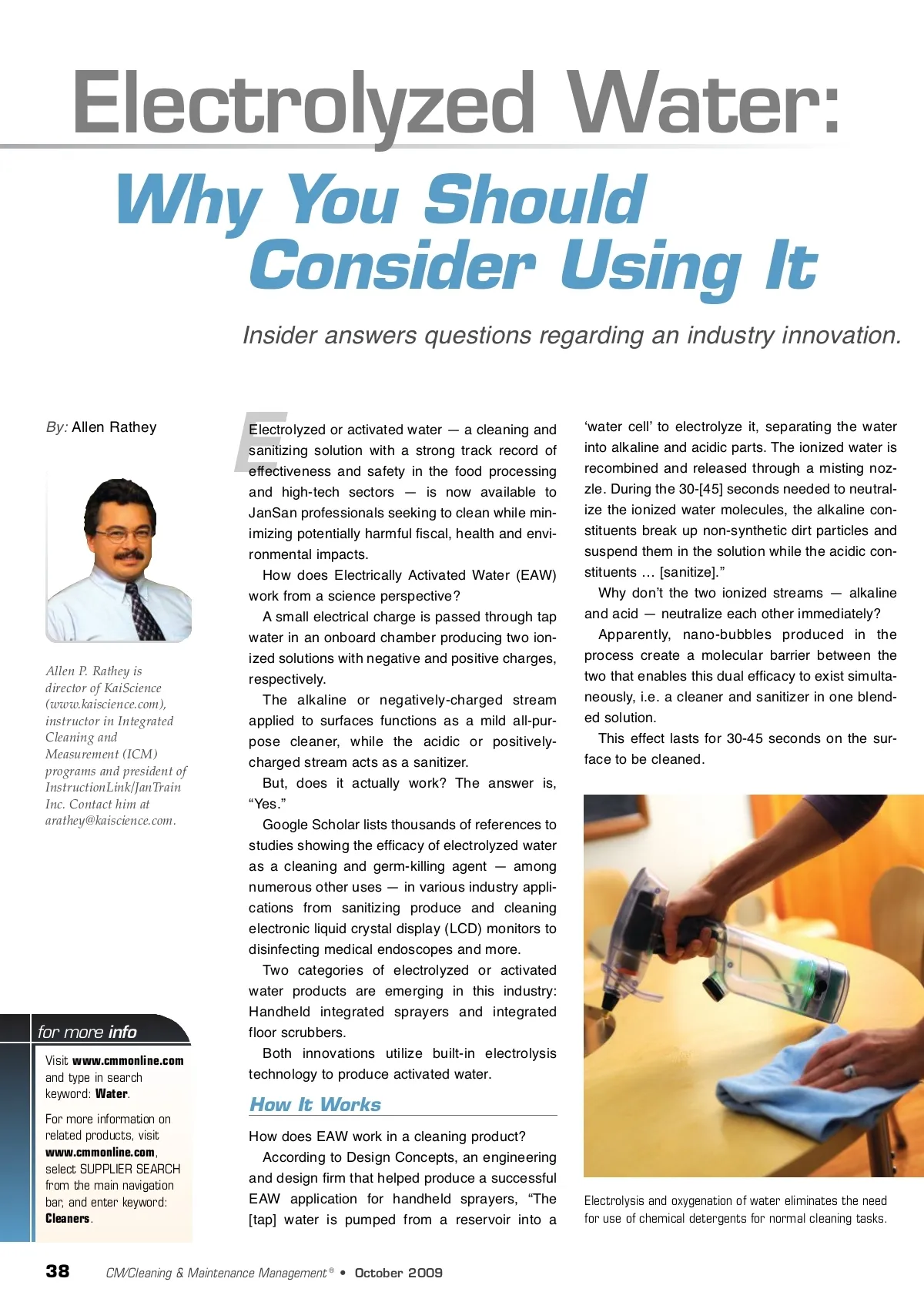
What else do the tiny bubbles do? According to Bill Nye, popular science educator and television host, “Nano-bub-bles carry an electric charge that electro-chemically interacts with the ions on dirt particles; the bubbles thus attach to dirt and lift it from surfaces.” Where And Why Activated water in a handheld sprayer device can be used for effectively cleaning and sanitizing glass, stainless steel, stone, marble, plastic and many other hard or resilient surfaces, plus acting as a spotter for carpet. Activated water in an automatic scrubber is used on hard or resilient floor surfaces as a replacement for standard floor cleaning detergents. Beyond the potential savings and posi-tive health impacts that come with buying and using fewer chemicals, independent testing of identical walk-behind autoscrub-bers on the same floor at the Target Center in Minneapolis, Minnesota, demonstrated that the machine using activated water matched or surpassed the cleaning per-formance of the standard detergent-based system over a three-month test period. A number of other users have conducted and documented studies side-by-side with conventional cleaning systems to compare cleaning efficacy and cost savings and have adopted the activated water technolo-gy in sprayers and/or autoscrubbers. Other reported benefits include improved traction on walking surfaces as well as a reduction in resoiling, both related to the elimination of residual chemical often left behind when using conventional methods. CM When More Than Water Is Required While activated water works well for general or all-purpose cleaning, it is not a replacement for heavy-duty industrial degreasers, floor strippers or other highly concentrated cleaners, nor is it a substitute for the proper use of Environmental Protection Agency (EPA) registered disinfectants in certain critical environments. However, it should be noted that some Electrically Activated Water (EAW) devices now qualify under EPA rules as sanitizing devices. Like other cleaning interventions, EAW should be used along with proper surface agitation as needed. According to Nye, “Some grime is ground-in or stuck to sur-faces so aggressively that activated water can’t get under it and lift it; some dirt particles don’t have the right electro-chemical properties to be lifted by acti-vated water. The classic example is a black heel mark. The rubber doesn’t carry enough charge, and generally it’s ground into the pores or grooves in floor surfaces so hard that it’s difficult to remove with any standard cleaner, including activated water.” Circle Product Information no. 214 on page 32 www.cmmonline.com 39
CMM – Archives Oct 2009: 39