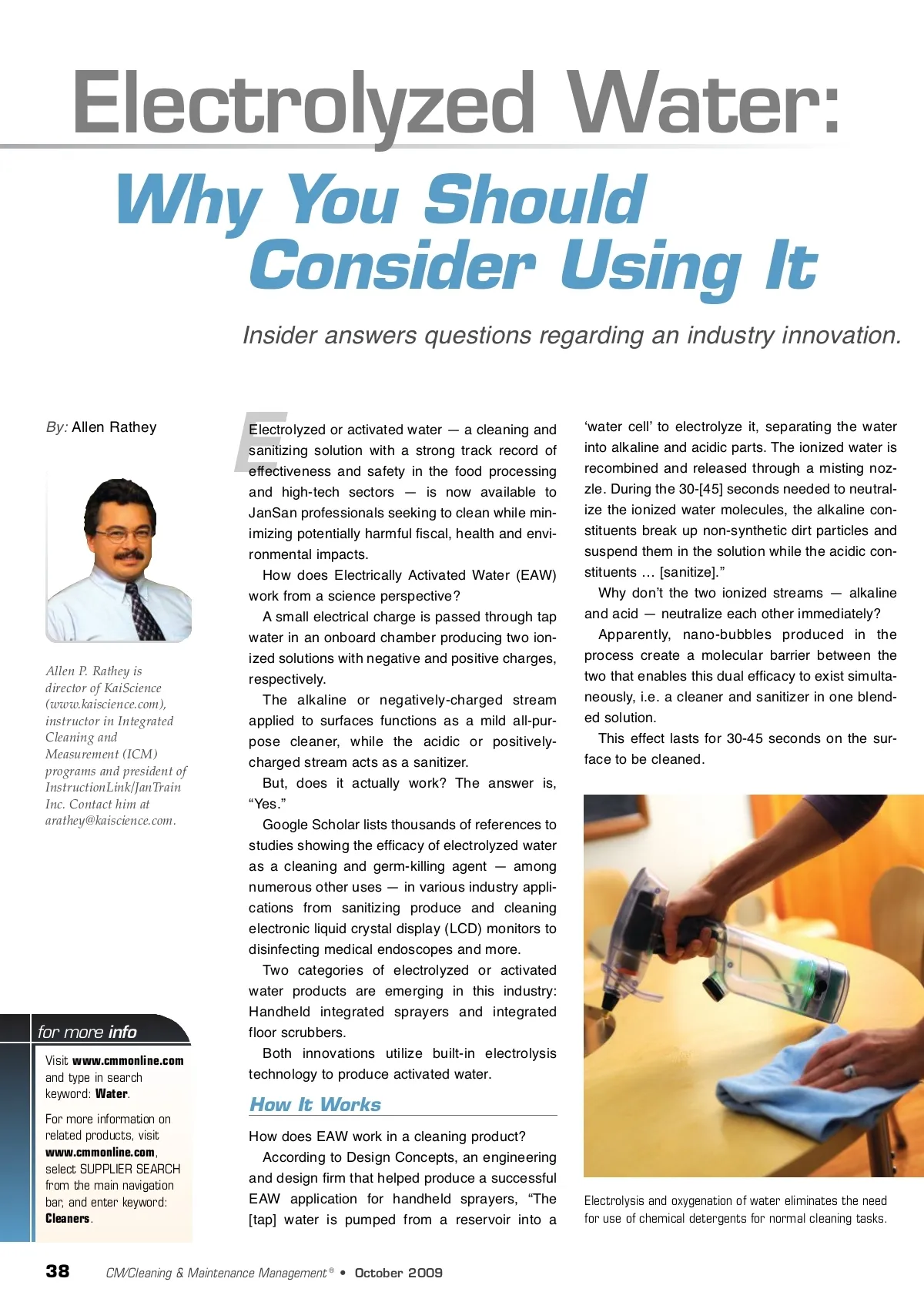
Electrolyzed Water: Why You Should Consider Using It Insider answers questions regarding an industry innovation. By: Allen Rathey E Allen P. Rathey is director of KaiScience (www.kaiscience.com), instructor in Integrated Cleaning and Measurement (ICM) programs and president of InstructionLink/JanTrain Inc. Contact him at [email protected]. for more info Visit www.cmmonline.com and type in search keyword: Water . For more information on related products, visit www.cmmonline.com , select SUPPLIER SEARCH from the main navigation bar, and enter keyword: Cleaners . Electrolyzed or activated water — a cleaning and sanitizing solution with a strong track record of effectiveness and safety in the food processing and high-tech sectors — is now available to JanSan professionals seeking to clean while min-imizing potentially harmful fiscal, health and envi-ronmental impacts. How does Electrically Activated Water (EAW) work from a science perspective? A small electrical charge is passed through tap water in an onboard chamber producing two ion-ized solutions with negative and positive charges, respectively. The alkaline or negatively-charged stream applied to surfaces functions as a mild all-pur-pose cleaner, while the acidic or positively-charged stream acts as a sanitizer. But, does it actually work? The answer is, “Yes.” Google Scholar lists thousands of references to studies showing the efficacy of electrolyzed water as a cleaning and germ-killing agent — among numerous other uses — in various industry appli-cations from sanitizing produce and cleaning electronic liquid crystal display (LCD) monitors to disinfecting medical endoscopes and more. Two categories of electrolyzed or activated water products are emerging in this industry: Handheld integrated sprayers and integrated floor scrubbers. Both innovations utilize built-in electrolysis technology to produce activated water. ʻwater cellʼ to electrolyze it, separating the water into alkaline and acidic parts. The ionized water is recombined and released through a misting noz-zle. During the 30-[45] seconds needed to neutral-ize the ionized water molecules, the alkaline con-stituents break up non-synthetic dirt particles and suspend them in the solution while the acidic con-stituents … [sanitize].” Why donʼt the two ionized streams — alkaline and acid — neutralize each other immediately? Apparently, nano-bubbles produced in the process create a molecular barrier between the two that enables this dual efficacy to exist simulta-neously, i.e. a cleaner and sanitizer in one blend-ed solution. This effect lasts for 30-45 seconds on the sur-face to be cleaned. How It Works How does EAW work in a cleaning product? According to Design Concepts, an engineering and design firm that helped produce a successful EAW application for handheld sprayers, “The [tap] water is pumped from a reservoir into a Electrolysis and oxygenation of water eliminates the need for use of chemical detergents for normal cleaning tasks. 38 CM/Cleaning & Maintenance Management ® • October 2009
CMM – Archives Oct 2009: 38