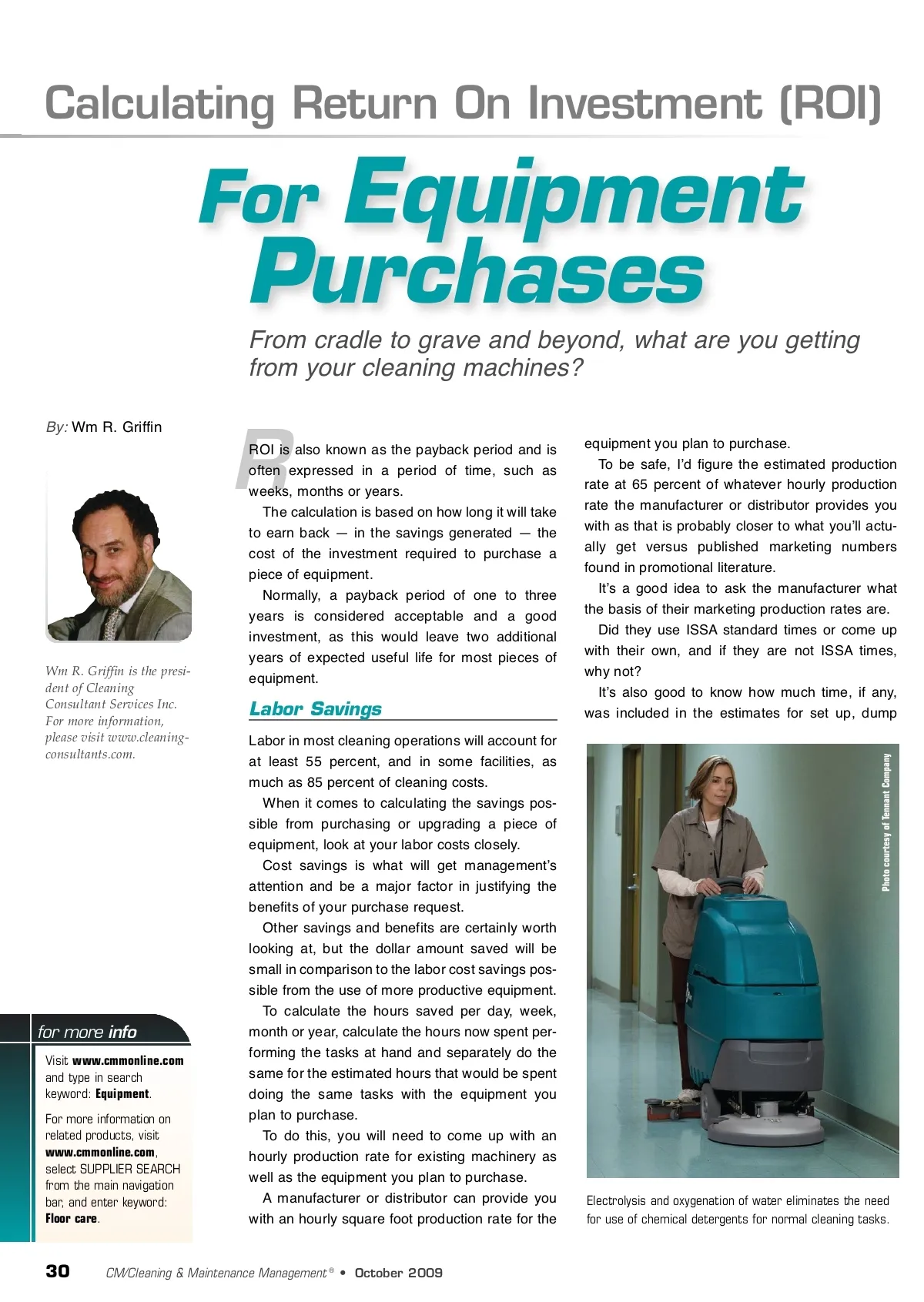
and refilling the equipment each shift. To get real-life, accurate time estimates, run a test with your people in your facility for one or two shifts and use those num-bers to calculate a realistic hourly produc-tion rate for your facility and the equipment currently in use. Multiply the annual hours saved by the burdened hour rate, which includes all ben-efit and tax costs, for applicable staff involved in using the floor care equipment or performing floor care presently. To keep things simple, the best way to cal-culate labor cost savings is to calculate the total hours saved each day and multiply the hours saved by the number of days worked per month — the average is 21 — to come up with the total hours saved each month. Then, multiply the number of hours saved each month by 12 — the number of months per year — to get an annual num-ber of hours saved. The savings in hours or minutes per day is the difference between the hours you are spending now per day doing the work ver-sus the number of hours you would spend doing the work at the production rate of the machine that you plan to purchase. To make this calculation, you will need to know the number of square feet your staff is cleaning now with whatever method(s) you are using. You should be able to come up with these numbers from a blueprint or by actu-ally measuring the areas currently being cleaned. Once you know the value of the labor youʼre now using and the cost of the labor you would be using with a new piece of equipment, the difference between the two numbers is the cost savings you can expect. Other increased or decreased costs you need to calculate into the final figure are machine purchase price, repairs, chemicals and any other costs that would be incurred as a result of the change to the new machine. If you donʼt have an exact number, add 5 percent of the labor cost to the calculation for each year and you should be fairly close. and from refill stations, as well as the time spent filling and dumping solution and recovery tanks each shift. This may seem like a small matter, how-ever, transport, dump and refill times of half an hour to an hour per refill cycle are com-mon, depending on location and tank size. If this time can be reduced substantially, your production rate will increase and your costs will decrease. An increase in production of up to 30 per-cent or more may be possible in this area alone. Moreover, utilizing equipment and processes that reduce cleaning frequen-cies and drying times allows for efficient and economical labor allocation. As an example, when a low-moisture process is used for interim carpet cleaning, the work can be scheduled for the day shift and immediately prior to use, thus avoiding overtime on weekends or evening shift dif-ferential. This may be a small cost compared to loss of income from a room that is out of service in a hotel, hospital or other facility. Investments in technological advances should be given serious consideration due to the potential cost savings and quality enhancements. CM Other Important Considerations Green And Sustainable Cost Savings Although you may not be able to put an exact dollar amount on green or sustain-able cost savings, they should not be overlooked when calculating the poten-tial value of cost savings from equipment upgrades. Reduced Water And Sewer Costs Some companies claim as much as a 70 percent reduction in water use. The actual cost savings can be calculated by determining how much water is current-ly used — in gallons — compared with how much would be used if the amount was reduced by 50 to 70 percent. LEED Points The U.S. Green Building Council’s (USGBC) Leadership in Energy and Environmental Design (LEED) program rates buildings as to their sustainability and the amount of potential energy reduction they achieve. Buildings are awarded a certification level based on the actions they take to be more sustain-able in design, construction and opera-tion. Carbon Footprint Carbon footprint is an emerging concept primarily used in Europe and largely applied to personal use calculations at this time. Based on ISO 14064-1:2006 and other less definable standards and cal-culations. Life Cycle Analysis (LCA) LCA relates to the amount of energy used and waste generated during the life of a product. Chemical Savings Companies with new technology, such as electrolyzed water, foam or super concen-trate dilution systems that eliminate or greatly reduce the need for or use of deter-gents, are claiming a 30 to 100 percent reduction in chemical costs. If you have difficulty coming up with actu-al chemical cost numbers, use 2 percent of the annual labor cost and youʼll be relative-ly close. Technology Equals Productivity And Reduced Costs Due to the fast pace of technological advancement, even though a piece of equipment may not have reached the end of its actual useful life, it may be advanta-geous to trade in or surplus the equipment and upgrade to a new model that provides additional benefits and is more productive and cost effective. Many pieces of equipment will last much longer than three to five years, and the older the piece of equipment, the higher the expected maintenance cost to keep it run-ning efficiently. Dump And Refill Savings Donʼt overlook the time spent returning to www.cmmonline.com 31
CMM – Archives Oct 2009: 31